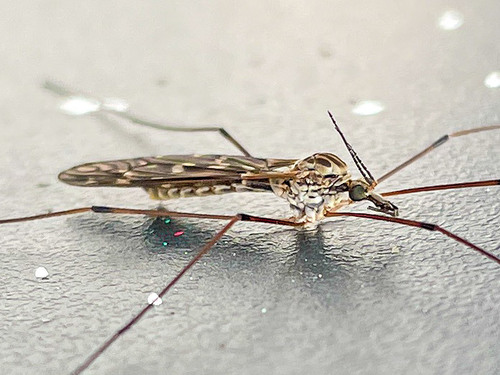
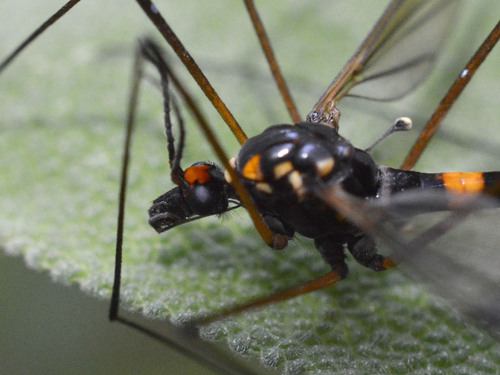
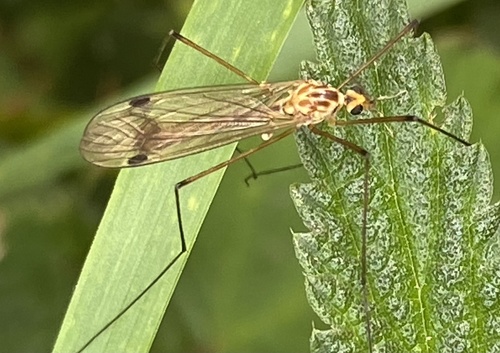
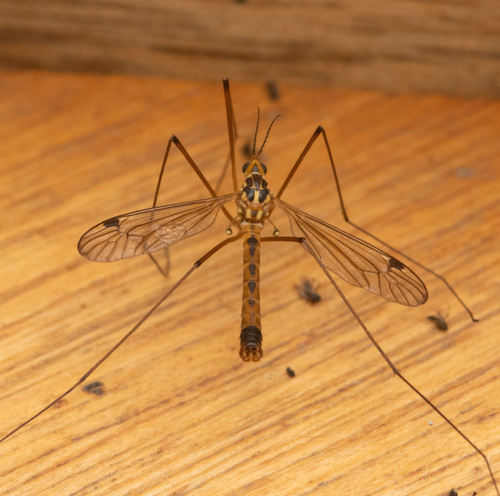
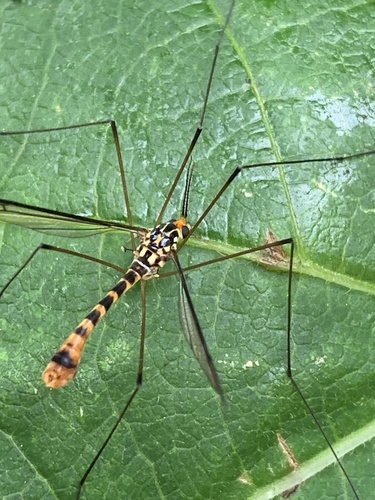
European Crane Fly

European Crane Fly

Tipula paludosa

Daily sighting probability ~10% · With luck
at Rotterdam [The Hague]

In 3 days ~20% in a week ~40%

25 Verified sightings at Rotterdam [The Hague]
19 In all 2 parks From 2019 to 2026
September Best month
☀️ Diurnal When it's spotted

About the European Crane Fly

Tipula paludosa, known as the European crane fly and its larva as leatherjacket, is a species in the genus Tipula, a genus of over 2,000 species distributed throughout the world. T. paludosa is native to northwestern Europe including Britain and Ireland, and also introduced to the northern aspects of North America, including Canada likely due to soil dispersion and other human-mediated activities. T. paludosa is often regarded as a pest of lawns, pastures, and hayfields, as its larvae cause significant damage to the roots, stems, and leaves of various plants, contributing to its invasiveness.

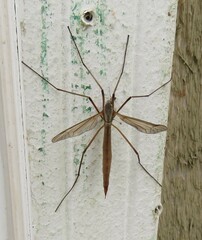
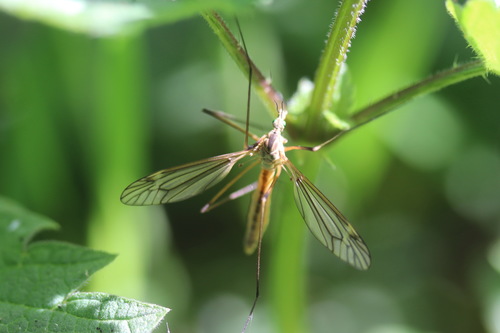
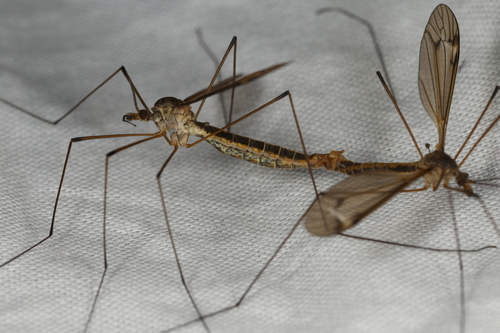
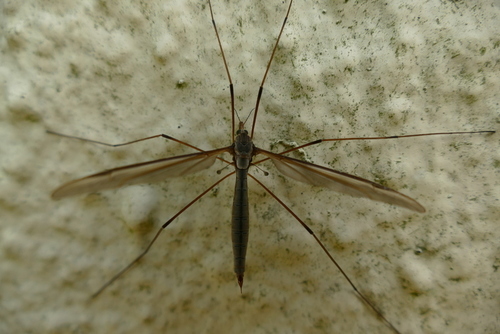
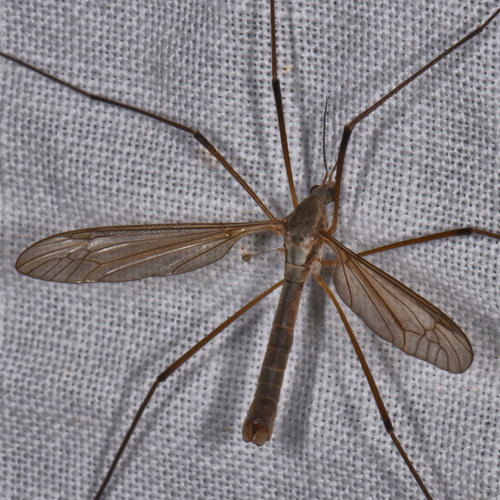
Tipula paludosa, at the adult stage, have greyish-brown bodies that are 1.5–2.5 cm long, with long, thin legs. Males have shorter bodies and large wings. The pupae are 3.0–3.5 cm long, with the mature being slightly larger at 3–4 cm. Females can lay about 200–300 eggs, which appear egg-shaped, are shiny black, and are about 1 mm long. Ventral spacing between the eyes of T. paludosa is twice the width in males and females compared to other species of Tipula. T. paludosa has 14 antennal segments for both males and females. The female abdominal length ratio is a... Wikipedia →
Global Distribution

Parks Where Found

# Park Country Daily sighting probability
1 Bavarian Forest National Park 🇩🇪 Germany
~10%
2 Wadden Sea National Park 🇩🇪 Germany
<5%

Cities Where Found

# City Country Daily sighting probability
1 Rotterdam [The Hague] 🇳🇱 Netherlands
~10%
2 Liverpool 🇬🇧 United Kingdom
~10%
3 Amsterdam 🇳🇱 Netherlands
~10%
4 Manchester 🇬🇧 United Kingdom
~10%
5 Brussels 🇧🇪 Belgium
~10%
6 Helsinki 🇫🇮 Finland
~10%
7 Toronto 🇨🇦 Canada
~10%
8 Birmingham 🇬🇧 United Kingdom
~10%
9 Hamburg 🇩🇪 Germany
~10%
10 Leeds 🇬🇧 United Kingdom
<5%

Before you go

What are the chances of seeing a European Crane Fly in Rotterdam [The Hague]?

With luck

About 10% of wildlife watchers report a European Crane Fly sighting in Rotterdam [The Hague] on a given day, based on 25 verified sightings from GBIF citizen-science data. It is the 82nd most-seen of the 355 insects we can rate there. Over three days the chance rises to about 20%, and over a week to about 40%, if each day is a fresh chance.

When is the best time to see a European Crane Fly in Rotterdam [The Hague]?

September

In that month about 30% of wildlife watchers report a European Crane Fly in Rotterdam [The Hague] on a given day, against under 5% in June–August and November–April, the lowest months.

What time of day is best to see a European Crane Fly?

Between 9 am and noon

Across all the parks we cover, that three-hour window holds the most European Crane Fly sightings with a recorded time, and about 7 in 10 of them come between 6 am and 6 pm: it is a daytime animal.

Is Rotterdam [The Hague] the best place to see a European Crane Fly?

Yes

Of the 22 cities where we can rate European Crane Fly sightings, Rotterdam [The Hague] has the highest daily chance: about 10%. Next come Liverpool (United Kingdom, about 10%) and Amsterdam (Netherlands, about 10%).

Which relatives of the European Crane Fly live in Rotterdam [The Hague]?

Same genus: Tipula

The closest relatives of the European Crane Fly that you can see in Rotterdam [The Hague] (genus Tipula, Common Crane Flies) are Black-Striped Cranefly (about 10%) and Tipula lateralis (about 10%), with each one's daily chance of a sighting.

Where does the European Crane Fly sighting chance come from?

GBIF citizen-science records

It is estimated from how often the European Crane Fly is recorded against all the insects logged in Rotterdam [The Hague] (25 verified sightings), calibrated against known sighting rates. Figures are rounded to the nearest 10% because citizen-science data supports honest approximations, not decimals, and months with records from fewer than five people show "—". How it works.

← Back to Rotterdam [The Hague]