



Completed

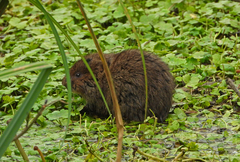

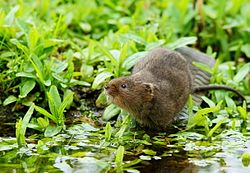
European Water Vole
Arvicola amphibius
Silhouette: T. Michael Keesey · PhyloPic
- KingdomAnimalia (Animals)
- PhylumChordata (Chordates)
- ClassMammalia (Mammals)
- OrderRodentia (Rodents)
- FamilyCricetidae (Hamsters, Voles, Lemmings, and Allies)
- GenusArvicola (Eurasian Water Voles)
- SpeciesArvicola amphibius (European Water Vole)
In 3 days ~10% in a week ~20%
5 Verified sightings at Saint Petersburg
5 In 1 park From 2019 to 2026
April Best month
☀️ Diurnal When it's spotted
About the European Water Vole
The European water vole (Arvicola amphibius) or northern water vole is a semi-aquatic rodent. It is often informally called the water rat, though it only superficially resembles a true rat. Water voles have rounder noses than rats, deep brown fur, chubby faces, and short fuzzy ears; unlike rats, their tails, paws, and ears are covered with hair.
In the wild, on average, water voles only live about five months. Maximum longevity in captivity is two and a half years. Water voles reach 14–22 centimetres (5.5–8.7 in) in length, plus a tail which is about half the length of the body. Weights reported for adults are variable. It is possible for large, optimal adults to weigh as much as 225 to 386 g (7.9 to 13.6 oz). However, these are peak weights. Elsewhere, the mean body mass has been reported as 60 to 140 g (2.1 to 4.9 oz), although this figure includes immature water voles. The minimum weight to successfully breed as well as to survive winter is reportedly 112 g (4.0 oz) in females and 115 g (4.1 oz) in males. As a species, the mean body mass is claimed as 140 g (4.9 oz).
Overall, European water voles are a uniform dark brown colour, with slightly paler coloration on... Wikipedia →
Recent sightings of European Water Vole in Saint Petersburg
LIVEiNaturalistGlobal Distribution
Parks Where Found
| # | Park | Country | Daily sighting probability |
|---|---|---|---|
| 1 | Cairngorms National Park | 🇬🇧 United Kingdom |
More parks will be added in future updates.
Cities Where Found
| # | City | Country | Daily sighting probability |
|---|---|---|---|
| 1 | Helsinki | 🇫🇮 Finland | |
| 2 | Liverpool | 🇬🇧 United Kingdom | |
| 3 | Moscow | 🇷🇺 Russia | |
| 4 | London | 🇬🇧 United Kingdom | |
| 5 | Saint Petersburg | 🇷🇺 Russia |
Zoos & Centres Where Found
| # | Zoo / Centre | Country | |
|---|---|---|---|
| 1 | Slimbridge Wetland Centre | 🇬🇧 United Kingdom | |
| 2 | British Wildlife Centre | 🇬🇧 United Kingdom | |
| 3 | Tierpark Schlichtweg 15 in München | 🇩🇪 Germany | |
| 4 | Zoo Schlichtweg 11 in München | 🇩🇪 Germany |
Closest Relatives at Saint Petersburg





Before you go
What are the chances of seeing a European Water Vole in Saint Petersburg?
Rare
Under 5% of wildlife watchers report a European Water Vole sighting in Saint Petersburg on a given day, based on 5 verified sightings from GBIF citizen-science data. It is the 13th most-seen of the 14 mammals we can rate there. Over three days the chance rises to about 10%, and over a week to about 20%, if each day is a fresh chance.
When is the best time to see a European Water Vole in Saint Petersburg?
Any time of year
In every month with enough records, under 5% of wildlife watchers report a European Water Vole in Saint Petersburg on a given day, so our monthly data shows no clear season.
What time of day is best to see a European Water Vole?
Between 11 am and 2 pm
Across all the parks we cover, that three-hour window holds the most European Water Vole sightings with a recorded time, and about 8 in 10 of them come between 6 am and 6 pm: it is a daytime animal.
Is Saint Petersburg the best place to see a European Water Vole?
5th of 5
Of the 5 cities where we can rate European Water Vole sightings, Saint Petersburg ranks 5th at under 5%. The best odds are in Helsinki (Finland, about 10%), Liverpool (United Kingdom, about 10%) and Moscow (Russia, under 5%).
Where does the European Water Vole sighting chance come from?
GBIF citizen-science records
It is estimated from how often the European Water Vole is recorded against all the mammals logged in Saint Petersburg (5 verified sightings), calibrated against known sighting rates. Figures are rounded to the nearest 10% because citizen-science data supports honest approximations, not decimals, and months with records from fewer than five people show "—". How it works.
