Least Weasel

Least Weasel

Mustela nivalis

Silhouette: Ferran Sayol · PhyloPic

LCLeast ConcernNTVUENCR
Daily sighting probability <5% · Rare
at Saint Petersburg

In 3 days ~10% in a week ~20%

12 Verified sightings at Saint Petersburg
10 In 1 park From 2019 to 2026
August Best month
☀️ Diurnal When it's spotted

About the Least Weasel

The least weasel (Mustela nivalis), little weasel, common weasel, or simply weasel is the smallest member of the genus Mustela, family Mustelidae and order Carnivora. It is native to Eurasia, North America and North Africa, and has been introduced to New Zealand, Malta, Crete, the Azores, and São Tomé. It is classified as least concern by the IUCN, due to its wide distribution and large population throughout the Northern Hemisphere. Eighteen subspecies are recognised.

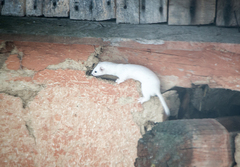
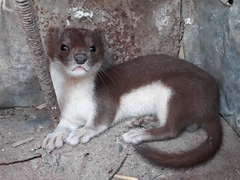
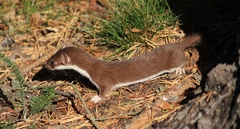
The least weasel varies greatly in size over its range. The body is slender and elongated, and the legs and tail are relatively short. The colour varies geographically, as does the pelage type and length of tail. The dorsal surface, flanks, limbs and tail of the animal are usually some shade of brown while the underparts are white. The line delineating the boundary between the two colours is usually straight. At high altitudes and in the northern part of its range, the coat becomes pure white in winter.

Small rodents form the largest part of the least weasel's diet, but it also kills and eats rabbits, other mammals, and occasionally birds, birds' eggs, fish and frogs. Males mark their territories with olfactory signals and have exclusive home ranges which may intersect with or include several female ranges. Least weasels use pre-existing holes to sleep, store food and raise their young. Breeding takes place in the spring and summer, and there is a single litter of about six kits which are reared exclusively by the female. Due to its small size and fierce nature, the least weasel plays an important part in the mythology and legend of various cultures. Wikipedia →


Sounds

Uncertain0:33

Spain · 2026

© Jose Manuel Unanue · XC1146321 · CC BY-NC-SA 4.0

Recording0:03

France · 2025

© nopelm · iNaturalist · CC BY-NC 4.0

Recording0:10

Ukraine · 2025

© Олександр Гриб · iNaturalist · CC BY-NC 4.0

Global Distribution

Parks Where Found

# Park Country Daily sighting probability
1 Pyrénées National Park 🇫🇷 France
~10%

More parks will be added in future updates.

Cities Where Found

# City Country Daily sighting probability
1 Cairo 🇪🇬 Egypt
~30%
2 Leeds 🇬🇧 United Kingdom
~10%
3 Moscow 🇷🇺 Russia
~10%
4 Helsinki 🇫🇮 Finland
~10%
5 Prague 🇨🇿 Czechia
<5%
6 Saint Petersburg 🇷🇺 Russia
<5%
7 Calgary 🇨🇦 Canada
<5%

Zoos & Centres Where Found

# Zoo / Centre Country
1 Zoo Sibiu 🇷🇴 Romania In captivity
2 British Wildlife Centre 🇬🇧 United Kingdom In captivity
3 AQUA Akvarium & Dyrepark 🇩🇰 Denmark In captivity
4 Zoo Samara 🇷🇺 Russia In captivity

Before you go

What are the chances of seeing a Least Weasel in Saint Petersburg?

Rare

Under 5% of wildlife watchers report a Least Weasel sighting in Saint Petersburg on a given day, based on 12 verified sightings from GBIF citizen-science data. It is the 9th most-seen of the 14 mammals we can rate there. Over three days the chance rises to about 10%, and over a week to about 20%, if each day is a fresh chance.

When is the best time to see a Least Weasel in Saint Petersburg?

August

In that month about 10% of wildlife watchers report a Least Weasel in Saint Petersburg on a given day, against under 5% in September to July, the lowest months. That is one of Saint Petersburg's wettest months, with about 100 mm of rain against 40 mm in February.

What time of day is best to see a Least Weasel?

Between 2 and 5 pm

Across all the parks we cover, that three-hour window holds the most Least Weasel sightings with a recorded time, and about 8 in 10 of them come between 6 am and 6 pm: it is a daytime animal.

Is Saint Petersburg the best place to see a Least Weasel?

6th of 7

Of the 7 cities where we can rate Least Weasel sightings, Saint Petersburg ranks 6th at under 5%. The best odds are in Cairo (Egypt, about 30%), Leeds (United Kingdom, about 10%) and Moscow (Russia, about 10%).

Where does the Least Weasel sighting chance come from?

GBIF citizen-science records

It is estimated from how often the Least Weasel is recorded against all the mammals logged in Saint Petersburg (12 verified sightings), calibrated against known sighting rates. Figures are rounded to the nearest 10% because citizen-science data supports honest approximations, not decimals, and months with records from fewer than five people show "—". How it works.

← Back to Saint Petersburg