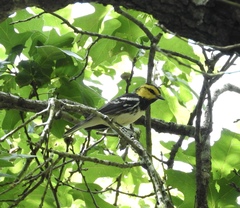
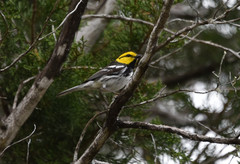
Golden-cheeked Warbler

Golden-cheeked Warbler

Setophaga chrysoparia

Silhouette: Dylan GE Gomes · PhyloPic

LCNTVUENEndangeredCR
Daily sighting probability <5% · Rare
at San Antonio

In 3 days <5%

19 Verified sightings at San Antonio
114 In all 4 parks From 2019 to 2026
April Best month
☀️ Diurnal When it's spotted

About the Golden-cheeked Warbler

The golden-cheeked warbler (Setophaga chrysoparia) is an endangered species of bird that breeds in Central Texas, from Palo Pinto County southwestward along the eastern and southern edge of the Edwards Plateau to Kinney County. The golden-cheeked warbler is the only bird species with a breeding range endemic to Texas.

The golden-cheeked warbler is very striking due to its bright yellow cheeks that are contrasted by its black throat and back. It is also identified by its unique buzzing song emerging from the wooded canyons where it breeds. Golden-cheeked warblers breed in 33 counties in central Texas and are dependent on ashe juniper (blueberry juniper or cedar) for their fine bark strips used as nesting material.

The golden-cheeked warbler can be found in numerous state parks within Texas. These parks include Colorado Bend State Park (SP), Dinosaur Valley SP, Garner SP, Guadalupe River SP, Honey Creek State Natural Area (SNA), Hill Country SNA, Kerr Management Area, Longhorn Cavern SP, Lost Maples SNA, Meridian SP, Pedernales Falls SP, Possum Kingdom SP, and South Llano River SP.

The golden-cheeked warbler is endemic to Texas and Mexico... Wikipedia →

Sounds

Call0:23

United States · 2012

© Paul Marvin · XC460671 · CC BY-NC-SA 4.0

Song0:45

United States · 2014

© Ronnie Kramer · XC171977 · CC BY-NC-SA 4.0

Flight call0:22

United States · 2013

© Andrew Spencer · XC152880 · CC BY-NC-SA 3.0

Global Distribution

Parks Where Found

# Park Country Daily sighting probability
1 Celaque National Park 🇭🇳 Honduras
~10%
2 La Tigra National Park 🇭🇳 Honduras
~10%
3 Cumbres de Monterrey National Park 🇲🇽 Mexico
<5%
4 Cañón del Sumidero National Park 🇲🇽 Mexico
<5%

Cities Where Found

# City Country Daily sighting probability
1 San Antonio 🇺🇸 United States
<5%
2 Austin 🇺🇸 United States
<5%

Before you go

What are the chances of seeing a Golden-cheeked Warbler in San Antonio?

Rare

Under 5% of wildlife watchers report a Golden-cheeked Warbler sighting in San Antonio on a given day, based on 19 verified sightings from GBIF citizen-science data. It is the 209th most-seen of the 255 birds we can rate there. Over three days the chance rises to under 5%, if each day is a fresh chance.

When is the best time to see a Golden-cheeked Warbler in San Antonio?

Any time of year

In every month with enough records, under 5% of wildlife watchers report a Golden-cheeked Warbler in San Antonio on a given day, so our monthly data shows no clear season.

What time of day is best to see a Golden-cheeked Warbler?

Between 8 and 11 am

Across all the parks we cover, that three-hour window holds the most Golden-cheeked Warbler sightings with a recorded time, and about 9 in 10 of them come between 6 am and 6 pm: it is a daytime animal.

Is San Antonio the best place to see a Golden-cheeked Warbler?

Yes

Of the 2 cities where we can rate Golden-cheeked Warbler sightings, San Antonio has the highest daily chance: under 5%. Next come Austin (United States, under 5%).

Which relatives of the Golden-cheeked Warbler live in San Antonio?

Same genus: Setophaga

The closest relatives of the Golden-cheeked Warbler that you can see in San Antonio (genus Setophaga, Setophaga Warblers) are Yellow-rumped Warbler (about 30%), Yellow Warbler (about 10%) and Northern Yellow Warbler (about 10%), with each one's daily chance of a sighting.

Where does the Golden-cheeked Warbler sighting chance come from?

GBIF citizen-science records

It is estimated from how often the Golden-cheeked Warbler is recorded against all the birds logged in San Antonio (19 verified sightings), calibrated against known sighting rates. Figures are rounded to the nearest 10% because citizen-science data supports honest approximations, not decimals, and months with records from fewer than five people show "—". How it works.

← Back to San Antonio