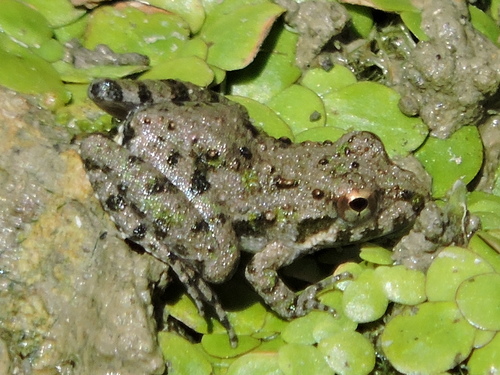
Western Narrow-mouthed Toad

Western Narrow-mouthed Toad

Gastrophryne olivacea

Silhouette: Dmitry Bogdanov (vectorized by T. Michael Keesey) · PhyloPic

LCLeast ConcernNTVUENCR
Daily sighting probability <5% · Rare
at San Antonio

In 3 days ~10% in a week ~20%

19 Verified sightings at San Antonio
7 In 1 park From 2019 to 2026
May Best month
🌙 Nocturnal When it's spotted

About the Western Narrow-mouthed Toad

Gastrophryne olivacea, the Great Plains narrow-mouthed toad or western narrow-mouthed toad, is a species of microhylid frog found throughout much of the south-central United States from Nebraska south through Texas, and into northern Mexico. Though not a true toad, evidenced by the smooth, moist skin, its common name is due to its terrestrial habit.

Great Plains narrow-mouthed toads are a small (19-42 mm snout to vent), fossorial, flat-bodied species, with a sharply pointed snout. They are typically olive green to grey-brown in color, sometimes with black blotching. Their undersides are lighter colored. Their skin secretions can cause severe, burning pain if they get into the eyes.

This toad is found in a wide range of habitats, but most frequently on moist ground or in leaf litter, and under rocks or fallen logs. They breed throughout the spring and summer in pools of water left by rainfall. They have been found to hybridize with Gastrophyrne carolinensis. Their primary diet is ants.

Western narrow-mouthed toads have a mutualistic relationship with tarantulas. They will live together, and in exchange will eat ants that attempt to invade... Wikipedia →


Sounds

Advertisement call0:42

United States · 2010

© Chris Harrison · XC890251 · CC BY-NC-SA 4.0

Recording0:29

United States · 2024

© Mike Cook · iNaturalist · CC BY-NC 4.0

Recording0:06

United States · 2025

© Chris Bentley · iNaturalist · CC BY-NC 4.0

Global Distribution

Parks Where Found

# Park Country Daily sighting probability
1 Cumbres de Monterrey National Park 🇲🇽 Mexico
<5%

More parks will be added in future updates.

Cities Where Found

# City Country Daily sighting probability
1 Austin 🇺🇸 United States
~10%
2 San Antonio 🇺🇸 United States
<5%

Before you go

What are the chances of seeing a Western Narrow-mouthed Toad in San Antonio?

Rare

Under 5% of wildlife watchers report a Western Narrow-mouthed Toad sighting in San Antonio on a given day, based on 19 verified sightings from GBIF citizen-science data. It is the 6th most-seen of the 8 amphibians we can rate there. Over three days the chance rises to about 10%, and over a week to about 20%, if each day is a fresh chance.

When is the best time to see a Western Narrow-mouthed Toad in San Antonio?

May and July

In those months about 10% of wildlife watchers report a Western Narrow-mouthed Toad in San Antonio on a given day, against under 5% in June and August–April, the lowest months.

What time of day is best to see a Western Narrow-mouthed Toad?

Between 9 pm and midnight

Across all the parks we cover, that three-hour window holds the most Western Narrow-mouthed Toad sightings with a recorded time, and about 7 in 10 of them come between 6 pm and 6 am: it is mostly seen at night.

Is San Antonio the best place to see a Western Narrow-mouthed Toad?

2nd of 2

Of the 2 cities where we can rate Western Narrow-mouthed Toad sightings, San Antonio ranks 2nd at under 5%. The best odds are in Austin (United States, about 10%).

Which relatives of the Western Narrow-mouthed Toad live in San Antonio?

Same order: Anura

The closest relatives of the Western Narrow-mouthed Toad that you can see in San Antonio (order Anura, Frogs and Toads) are Gulf Coast Toad (about 30%), Rio Grande Leopard Frog (about 10%) and American Bullfrog (about 10%), with each one's daily chance of a sighting.

Where does the Western Narrow-mouthed Toad sighting chance come from?

GBIF citizen-science records

It is estimated from how often the Western Narrow-mouthed Toad is recorded against all the amphibians logged in San Antonio (19 verified sightings), calibrated against known sighting rates. Figures are rounded to the nearest 10% because citizen-science data supports honest approximations, not decimals, and months with records from fewer than five people show "—". How it works.

← Back to San Antonio