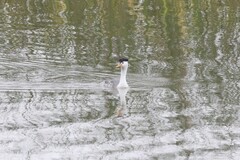
Clark's Grebe

Clark's Grebe

Aechmophorus clarkii

Silhouette: PhyloPic

LCLeast ConcernNTVUENCR
Daily sighting probability ~10% · With luck
at San Francisco

In 3 days ~30% in a week ~50%

9,340 Verified sightings at San Francisco
902 In all 5 parks From 2019 to 2026
March Best month
☀️ Diurnal When it's spotted

About the Clark's Grebe

Clark's grebe (Aechmophorus clarkii) is a North American waterbird species in the grebe family. Until the 1980s, it was thought to be a pale morph of the western grebe, which it resembles in size, range, and behavior. Intermediates between the two species are known.

This species nests on large inland lakes in western North America and migrates to the Pacific coast over the winter. It maintains local populations year-round in California, Nevada, and Arizona (the Lower Colorado River Valley), as well as in central Mexico.

It feeds by diving for insects, polychaete worms, crustaceans, and salamanders. It performs the same elaborate courtship display as the western grebe. The "Clark" of its common name—and its specific epithet clarkii—honors John Henry Clark, a 19th-century American surveyor who was also a naturalist and collector. The genus name Aechmophorus comes from the Ancient Greek words αἰχμά (transliterated "aichme"), meaning 'point of a spear', and φόρος ("phoros"), meaning 'bearing'; together translating as 'spear point bearer' and referring to the bird's long, dagger-like beak.

In Mexico, it is called achichilique pico naranja (the western grebe... Wikipedia →

Sounds

Begging call0:31

United States · 2022

© Sue Riffe · XC758995 · CC BY-NC-SA 4.0

Call0:09

United States · 2021

© Paul Marvin · XC641950 · CC BY-NC-SA 4.0

Song0:08

United States · 2017

© Jim Holmes · XC367258 · CC BY-NC-SA 4.0

Global Distribution

Parks Where Found

# Park Country Daily sighting probability
1 Channel Islands National Park 🇺🇸 United States
~10%
2 El Vizcaíno Biosphere Reserve 🇲🇽 Mexico
~10%
3 Redwood National Park 🇺🇸 United States
<5%
4 Yellowstone National Park 🇺🇸 United States
<5%
5 Grand Teton National Park 🇺🇸 United States
<5%

Cities Where Found

# City Country Daily sighting probability
1 San Francisco 🇺🇸 United States
~10%
2 Los Angeles 🇺🇸 United States
~10%
3 Mexico City 🇲🇽 México
<5%
4 San Diego 🇺🇸 United States
<5%
5 Las Vegas 🇺🇸 United States
<5%
6 Salt Lake City 🇺🇸 United States
<5%
7 Denver 🇺🇸 United States
<5%
8 Mesa 🇺🇸 United States
<5%
9 Calgary 🇨🇦 Canada
<5%
10 Sacramento 🇺🇸 United States
<5%

Before you go

What are the chances of seeing a Clark's Grebe in San Francisco?

With luck

About 10% of wildlife watchers report a Clark's Grebe sighting in San Francisco on a given day, based on 9,340 verified sightings from GBIF citizen-science data. It is the 87th most-seen of the 375 birds we can rate there. Over three days the chance rises to about 30%, and over a week to about 50%, if each day is a fresh chance.

When is the best time to see a Clark's Grebe in San Francisco?

January and March

In those months about 20% of wildlife watchers report a Clark's Grebe in San Francisco on a given day, against under 5% in June to October, the lowest months. Those are among San Francisco's wettest months, with about 85 mm of rain a month against almost none in July.

What time of day is best to see a Clark's Grebe?

Between 9 am and noon

Across all the parks we cover, that three-hour window holds the most Clark's Grebe sightings with a recorded time, and about 8 in 10 of them come between 6 am and 6 pm: it is a daytime animal.

Is San Francisco the best place to see a Clark's Grebe?

Yes

Of the 12 cities where we can rate Clark's Grebe sightings, San Francisco has the highest daily chance: about 10%. Next come Los Angeles (United States, about 10%) and Mexico City (México, under 5%).

Where does the Clark's Grebe sighting chance come from?

GBIF citizen-science records

It is estimated from how often the Clark's Grebe is recorded against all the birds logged in San Francisco (9,340 verified sightings), calibrated against known sighting rates. Figures are rounded to the nearest 10% because citizen-science data supports honest approximations, not decimals, and months with records from fewer than five people show "—". How it works.

← Back to San Francisco