Ridgway's Rail

Ridgway's Rail

Rallus obsoletus

Silhouette: Ferran Sayol · PhyloPic

LCNTNear ThreatenedVUENCR
Daily sighting probability <5% · Rare
at San Francisco

In 3 days ~10% in a week ~30%

4,106 Verified sightings at San Francisco
57 In 1 park From 2019 to 2026
January Best month
☀️ Diurnal When it's spotted

About the Ridgway's Rail

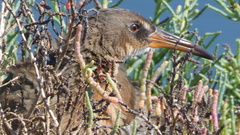
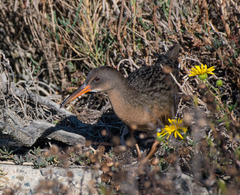
Ridgway's rail (Rallus obsoletus) is a species of bird found principally along the Pacific coast of North America from the San Francisco Bay Area to southern Baja California, as well as in some regions of the Gulf of California. A member of the rail family, Rallidae, it is a large cinnamon-brown rail that lives in brackish tidal marshes and rarely flies. Its name commemorates American ornithologist Robert Ridgway.

This species is closely related to the clapper rail, and until recently was considered a subspecies. It has a long, downward curving bill and is grayish brown with a pale chestnut breast and conspicuous whitish rump patch. It is most active nocturnally and crepuscularly.

Typically cinnamon-brown in color, it is darker in coloration on the back. Adult coloration is variable, with several color morphs. The total length in adults is 32–41 cm (13–16 in), and weight ranges 160–470 g (5.6–16.6 oz). Males are about 20% larger than females. Size can vary by geographical location. Hatchlings are covered in black downy feathers.

Ridgway's rail forages along the ecotone between mudflat and higher vegetated zones and in tidal sloughs. Mussels, clams, arthropods... Wikipedia →

Sounds

Call0:58

United States · 2021

© Scott Olmstead · XC649092 · CC BY-NC-SA 4.0

Song0:09

Mexico · 2020

© Manuel Grosselet · XC571041 · CC BY-NC-SA 4.0

Alarm call0:31

Mexico · 2020

© Isain Contreras Rodríguez · XC566851 · CC BY-NC-SA 4.0

Global Distribution

Parks Where Found

# Park Country Daily sighting probability
1 El Vizcaíno Biosphere Reserve 🇲🇽 Mexico
~10%

More parks will be added in future updates.

Cities Where Found

# City Country Daily sighting probability
1 San Diego 🇺🇸 United States
~10%
2 San Francisco 🇺🇸 United States
<5%
3 Los Angeles 🇺🇸 United States
<5%

Before you go

What are the chances of seeing a Ridgway's Rail in San Francisco?

Rare

Under 5% of wildlife watchers report a Ridgway's Rail sighting in San Francisco on a given day, based on 4,106 verified sightings from GBIF citizen-science data. It is the 134th most-seen of the 375 birds we can rate there. Over three days the chance rises to about 10%, and over a week to about 30%, if each day is a fresh chance.

When is the best time to see a Ridgway's Rail in San Francisco?

November to January

In those months about 10% of wildlife watchers report a Ridgway's Rail in San Francisco on a given day, against under 5% in February to October, the lowest months. Those are among San Francisco's wettest months, with about 85 mm of rain a month against almost none in July.

What time of day is best to see a Ridgway's Rail?

Between 7 and 10 am

Across all the parks we cover, that three-hour window holds the most Ridgway's Rail sightings with a recorded time, and about 9 in 10 of them come between 6 am and 6 pm: it is a daytime animal.

Is San Francisco the best place to see a Ridgway's Rail?

2nd of 3

Of the 3 cities where we can rate Ridgway's Rail sightings, San Francisco ranks 2nd at under 5%. The best odds are in San Diego (United States, about 10%).

Where does the Ridgway's Rail sighting chance come from?

GBIF citizen-science records

It is estimated from how often the Ridgway's Rail is recorded against all the birds logged in San Francisco (4,106 verified sightings), calibrated against known sighting rates. Figures are rounded to the nearest 10% because citizen-science data supports honest approximations, not decimals, and months with records from fewer than five people show "—". How it works.

← Back to San Francisco