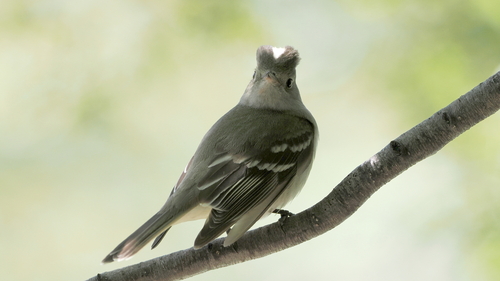
Black-chinned Siskin

Black-chinned Siskin

Spinus barbatus

Silhouette: Andy Wilson · PhyloPic

LCLeast ConcernNTVUENCR
Daily sighting probability ~40% · Likely
at Santiago

In 3 days ~80% in a week >90%

4,008 Verified sightings at Santiago
2,550 In all 4 parks From 2019 to 2026
September Best month
☀️ Diurnal When it's spotted

About the Black-chinned Siskin

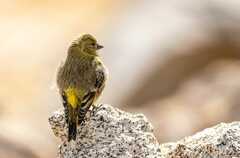
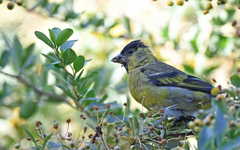
The black-chinned siskin (Spinus barbatus) is a species of bird in the family Fringillidae, the finches and euphonias. It is found in Argentina, Chile and the Falkland Islands. The black-chinned siskin has a complicated taxonomic history. It was originally described in 1782 with the binomial Fringilla barbata. It was renamed Chrysomitris barbata in 1860. It was tentatively placed in genus Spinus in 1889 and was first proposed with its current binomial in 1909. Between those dates several other putative species were described with different genera but all were eventually determined to be examples what is now Spinus barbatus. Sometime after 1926 genus Spinus was relegated to subgenus status within genus Carduelis. Beginning in about 2009 the subgenus was restored to full genus level and the black-chinned siskin, the rest of the New World siskins, and the New World goldfinches were therefore returned to genus Spinus.

The black-chinned siskin is monotypic. The black-chinned siskin is 12 to 13 cm (4.7 to 5.1 in) long and weighs about 13 to 20 g (0.46 to 0.71 oz). The species is sexually dimorphic. Adult males have black lores, forehead, and... Wikipedia →

Sounds

Call0:32

Chile · 2025

© Marc Anderson · XC1036291 · CC BY-NC-ND 4.0

Song0:45

Chile · 2023

© Scott Olmstead · XC872002 · CC BY-NC-SA 4.0

Begging call1:08

Chile · 2018

© Cristian Pinto · XC444650 · CC BY-NC-SA 4.0

Global Distribution

Parks Where Found

# Park Country Daily sighting probability
1 Tierra del Fuego National Park 🇦🇷 Argentina
~70%
2 Vicente Pérez Rosales National Park 🇨🇱 Chile
~50%
3 Nahuel Huapi National Park 🇦🇷 Argentina
~50%
4 Torres del Paine National Park 🇨🇱 Chile
~40%

Cities Where Found

# City Country Daily sighting probability
1 Santiago 🇨🇱 Chile
~40%

Before you go

What are the chances of seeing a Black-chinned Siskin in Santiago?

Likely

About 40% of wildlife watchers report a Black-chinned Siskin sighting in Santiago on a given day, based on 4,008 verified sightings from GBIF citizen-science data. It is the 16th most-seen of the 110 birds we can rate there. Over three days the chance rises to about 80%, and over a week to over 90%, if each day is a fresh chance.

When is the best time to see a Black-chinned Siskin in Santiago?

June to September

In those months about 60% of wildlife watchers report a Black-chinned Siskin in Santiago on a given day, against about 20% in February and March, the lowest months. Those are among Santiago's wettest months, with about 40 mm of rain a month against 5 mm in December.

What time of day is best to see a Black-chinned Siskin?

Between 10 am and 1 pm

Across all the parks we cover, that three-hour window holds the most Black-chinned Siskin sightings with a recorded time, and about 8 in 10 of them come between 6 am and 6 pm: it is a daytime animal.

Where else can you see a Black-chinned Siskin?

Only Santiago, in our data

Santiago is the only city on Wallace's Line with enough records to rate Black-chinned Siskin sightings: about 40% of wildlife watchers there report one on a given day.

Which relatives of the Black-chinned Siskin live in Santiago?

Same order: Passeriformes

The closest relatives of the Black-chinned Siskin that you can see in Santiago (order Passeriformes, Perching Birds) are Austral Thrush (over 90%), Rufous-collared Sparrow (about 90%) and Southern House Wren (about 90%), with each one's daily chance of a sighting.

Where does the Black-chinned Siskin sighting chance come from?

GBIF citizen-science records

It is estimated from how often the Black-chinned Siskin is recorded against all the birds logged in Santiago (4,008 verified sightings), calibrated against known sighting rates. Figures are rounded to the nearest 10% because citizen-science data supports honest approximations, not decimals, and months with records from fewer than five people show "—". How it works.

← Back to Santiago