Rufous-tailed Plantcutter

Rufous-tailed Plantcutter

Phytotoma rara

Silhouette: Edwin Price · PhyloPic

LCLeast ConcernNTVUENCR
Daily sighting probability ~50% · Likely
at Santiago

In 3 days ~80% in a week >90%

4,645 Verified sightings at Santiago
527 In all 3 parks From 2019 to 2026
August Best month
☀️ Diurnal When it's spotted

About the Rufous-tailed Plantcutter

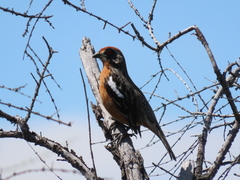
The rufous-tailed plantcutter (Phytotoma rara), sometimes called the Chilean plantcutter, is a passerine bird of southern South America, now placed in the cotinga family. It is a medium-sized bird about 19 centimetres (7.5 in) long with a long black tail with a red base. Males have greyish-brown upper parts, a chestnut crown and breast, and dark facial markings. Females are similar but lack the chestnut crown and have streaked, buff underparts. There is a wing bar which is white in the male and buff in the female. This is a fairly common species with a wide range, and the International Union for Conservation of Nature has rated its conservation status as being of "least concern".

It is a stocky bird, 18-20 centimetres in length, with short wings and a red eye. The longish tail is black with a reddish base. The upperparts of the male are grey-brown with dark streaks while the crown and underparts are chestnut-coloured. There is a white bar on the wing and a pattern of dark and pale areas on the face. Females have buff underparts with brown streaks and have buff rather than white in the wings. They do not have the males' chestnut crown but may show a cinnamon wash to... Wikipedia →

Sounds

Call0:04

Chile · 2020

© Ignacio Escobar · XC585698 · CC BY-NC-SA 4.0

Song0:39

Chile · 2019

© Cristian Pinto · XC498622 · CC BY-NC-SA 4.0

Song0:16

Chile · 2018

© Peter Boesman · XC450071 · CC BY-NC-ND 4.0

Global Distribution

Parks Where Found

# Park Country Daily sighting probability
1 Torres del Paine National Park 🇨🇱 Chile
~20%
2 Nahuel Huapi National Park 🇦🇷 Argentina
~20%
3 Vicente Pérez Rosales National Park 🇨🇱 Chile
<5%

Cities Where Found

# City Country Daily sighting probability
1 Santiago 🇨🇱 Chile
~50%

Before you go

What are the chances of seeing a Rufous-tailed Plantcutter in Santiago?

Likely

About 50% of wildlife watchers report a Rufous-tailed Plantcutter sighting in Santiago on a given day, based on 4,645 verified sightings from GBIF citizen-science data. It is the 13th most-seen of the 110 birds we can rate there. Over three days the chance rises to about 80%, and over a week to over 90%, if each day is a fresh chance.

When is the best time to see a Rufous-tailed Plantcutter in Santiago?

August to January

In those months about 50% of wildlife watchers report a Rufous-tailed Plantcutter in Santiago on a given day, against about 30% in April, the lowest month.

What time of day is best to see a Rufous-tailed Plantcutter?

Between noon and 3 pm

Across all the parks we cover, that three-hour window holds the most Rufous-tailed Plantcutter sightings with a recorded time, and about 9 in 10 of them come between 6 am and 6 pm: it is a daytime animal.

Where else can you see a Rufous-tailed Plantcutter?

Only Santiago, in our data

Santiago is the only city on Wallace's Line with enough records to rate Rufous-tailed Plantcutter sightings: about 50% of wildlife watchers there report one on a given day.

Which relatives of the Rufous-tailed Plantcutter live in Santiago?

Same order: Passeriformes

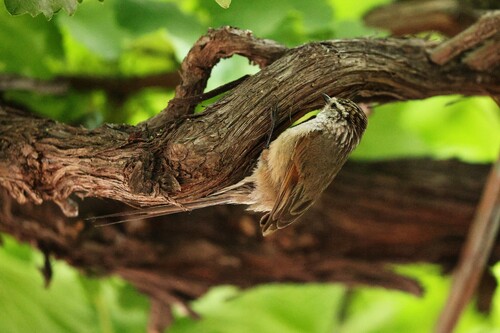
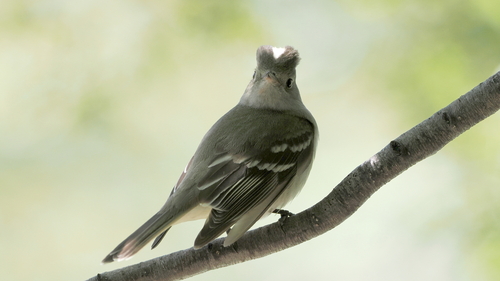
The closest relatives of the Rufous-tailed Plantcutter that you can see in Santiago (order Passeriformes, Perching Birds) are Austral Thrush (over 90%), Rufous-collared Sparrow (about 90%) and Southern House Wren (about 90%), with each one's daily chance of a sighting.

Where does the Rufous-tailed Plantcutter sighting chance come from?

GBIF citizen-science records

It is estimated from how often the Rufous-tailed Plantcutter is recorded against all the birds logged in Santiago (4,645 verified sightings), calibrated against known sighting rates. Figures are rounded to the nearest 10% because citizen-science data supports honest approximations, not decimals, and months with records from fewer than five people show "—". How it works.

← Back to Santiago