Degu

Degu

Octodon degus

LCLeast ConcernNTVUENCR
Daily sighting probability ~10% · With luck
at Santiago

In 3 days ~20% in a week ~30%

7 Verified sightings at Santiago
August Best month
☀️ Diurnal When it's spotted

About the Degu

The common degu (Octodon degus; ), or, historically, the degu, is a small hystricomorpha rodent endemic to the Chilean matorral ecoregion of central Chile. The name degu on its own indicates either the entire genus Octodon or, more commonly, just the common degu. Common degus belong to the parvorder Caviomorpha of the infraorder Hystricognathi, along with the chinchilla and guinea pig. The word degu comes from the Mapuche word dewü, meaning 'mouse' or 'rat'.

Although found in a relatively small natural habitat when compared to other species of rodents, degus are prolific and thus classified as a least-concern species by IUCN. The animal may be kept as a domestic pet, though there are prohibitions on their ownership in some territories. As a pet, the degu is larger than a golden hamster but smaller than a fancy rat.

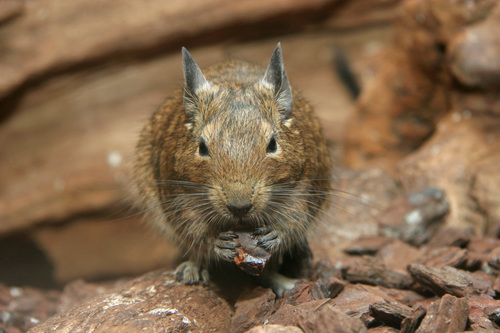
The common degu is a small animal with a body length of 25.0 to 31.0 cm (9.8–12.2 in) and a weight of 170 to 400 g (6.0 to 14.1 oz). It has yellow-brown fur above and creamy-yellow below, with yellow around the eyes and a paler band around the neck. It has a long, thin tail with a tufted, black tip, dark sparsely furred ears, and pale grey toes. Its fifth... Wikipedia →
Global Distribution

Parks Where Found

# Park Country Daily sighting probability

More parks will be added in future updates.

Cities Where Found

# City Country Daily sighting probability
1 Santiago 🇨🇱 Chile
~10%

Zoos & Centres Where Found

# Zoo / Centre Country
1 National Zoological Park 🇺🇸 United States In captivity
2 Tierpark Berlin 🇩🇪 Germany In captivity
3 Natura Artis Magistra 🇳🇱 Netherlands In captivity
4 Bronx Zoo 🇺🇸 United States In captivity
5 Bratislava Zoo 🇸🇰 Slovakia In captivity
6 Planète Sauvage 🇫🇷 France In captivity
7 Banham Zoo 🇬🇧 United Kingdom In captivity
8 Nuremberg Zoo 🇩🇪 Germany In captivity
9 Tiergarten Am Tiergarten 28 in Nürnberg 🇩🇪 Germany In captivity
10 Kyiv Zoo 🇺🇦 Ukraine In captivity
11 Philadelphia Zoo 🇺🇸 United States In captivity
12 Budapest Zoo & Botanical Garden 🇭🇺 Hungary In captivity
13 Ueno Zoo 🇯🇵 Japan In captivity
14 Rivne Zoo 🇺🇦 Ukraine In captivity
15 Buin Zoo 🇨🇱 Chile In captivity
16 Kazan Zoo & Botanical Garden 🇷🇺 Russia In captivity
17 Tierpark Lange Erlen 🇨🇭 Switzerland In captivity
18 Ueno Zoological Gardens (West Garden) 🇯🇵 Japan In captivity
19 Leningrad Zoo 🇷🇺 Russia In captivity
20 Tierpark Bretten 🇩🇪 Germany In captivity
21 Zoo Linz 🇦🇹 Austria In captivity
22 Monkey Park 🇪🇸 Spain In captivity
23 Tiergarten Am Tiergarten 12 in Nürnberg 🇩🇪 Germany In captivity
24 Tiergarten Am Tiergarten 14 in Nürnberg 🇩🇪 Germany In captivity
25 Tiergarten Am Tiergarten 6 in Nürnberg 🇩🇪 Germany In captivity
26 Aquarium Terrarium 🇭🇷 Croatia In captivity
27 Ocean Park, Krasnodar 🇷🇺 Russia In captivity

Before you go

What are the chances of seeing a Degu in Santiago?

With luck

About 10% of wildlife watchers report a Degu sighting in Santiago on a given day, based on 7 verified sightings from GBIF citizen-science data. Over three days the chance rises to about 20%, and over a week to about 30%, if each day is a fresh chance.

When is the best time to see a Degu in Santiago?

July–August and December–January

In those months about 10% of wildlife watchers report a Degu in Santiago on a given day, against under 5% in February–June and September–November, the lowest months.

What time of day is best to see a Degu?

Between 10 am and 1 pm

Across all the parks we cover, that three-hour window holds the most Degu sightings with a recorded time, and about 9 in 10 of them come between 6 am and 6 pm: it is a daytime animal.

Where else can you see a Degu?

Only Santiago, in our data

Santiago is the only city on Wallace's Line with enough records to rate Degu sightings: about 10% of wildlife watchers there report one on a given day.

Where does the Degu sighting chance come from?

GBIF citizen-science records

It is estimated from how often the Degu is recorded against all the mammals logged in Santiago (7 verified sightings), calibrated against known sighting rates. Figures are rounded to the nearest 10% because citizen-science data supports honest approximations, not decimals, and months with records from fewer than five people show "—". How it works.

← Back to Santiago