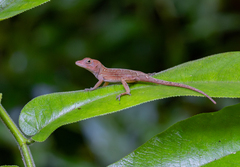
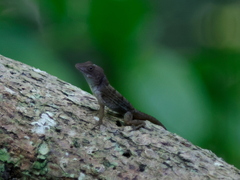
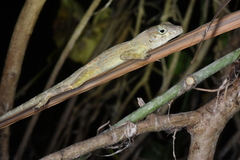
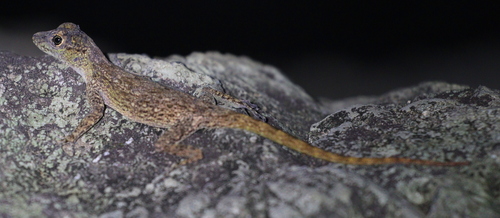
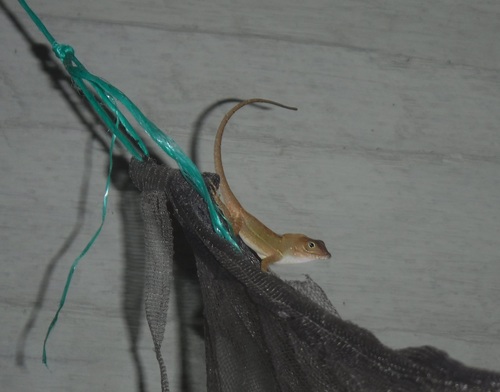
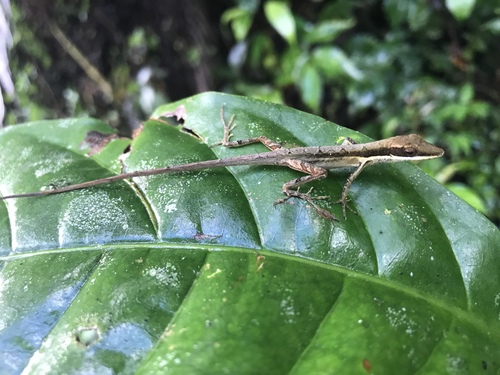
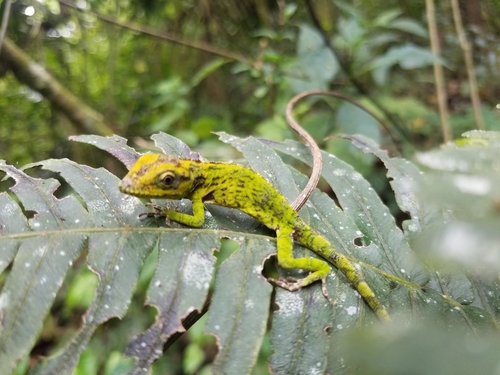
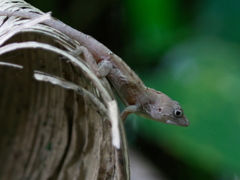
Cordillera Oriental Stout Anole

Cordillera Oriental Stout Anole

Anolis higuey

Silhouette: Sarah Werning · PhyloPic

Endemic
Daily sighting probability ~40% · Likely
at Santo Domingo

In 3 days ~80% in a week >90%

39 Verified sightings at Santo Domingo
July Best month
☀️ Diurnal When it's spotted

About the Cordillera Oriental Stout Anole

Anolis higuey, the Cordillera Oriental stout anole, is a species of lizard in the family Dactyloidae. Males grow to 69 mm (2.7 in) and females to 51 mm (2.0 in) in snout–vent length. Males have dirty-white dewlaps with a yellow, green, or orange hue and regularly-arranged gorgetals, smaller in size towards the center of the dewlap. It is endemic to the eastern Dominican Republic, where it lives in a variety of habitats at elevations of up to 290 m (950 ft).

Anolis higuey was formally described in 2019 as Audantia higuey based on a specimen from Manatí Park Bávaro in the La Altagracia Province of the Dominican Republic. The species is named after Higüey, a pre-Columbian Taíno chiefdom that was located in the anole's range. It has the common name Cordillera Oriental stout anole.

Specimens of Anolis higuey were historically considered to represent Anolis cybotes, but A. higuey is in actuality most closely related to a clade formed by A. doris, armouri, shrevei, ravifaux, and hispaniolae. The extremely large genus Anolis is sometimes split into several smaller genera; under this arrangement, Anolis higuey is placed in the genus Audantia, a group of more than a dozen species... Wikipedia →
Global Distribution

Parks Where Found

# Park Country Daily sighting probability

More parks will be added in future updates.

Cities Where Found

# City Country Daily sighting probability
1 Santo Domingo 🇩🇴 Dominican Republic
~40%

Before you go

What are the chances of seeing a Cordillera Oriental Stout Anole in Santo Domingo?

Likely

About 40% of wildlife watchers report a Cordillera Oriental Stout Anole sighting in Santo Domingo on a given day, based on 39 verified sightings from GBIF citizen-science data. It is the 5th most-seen of the 22 reptiles we can rate there. Over three days the chance rises to about 80%, and over a week to over 90%, if each day is a fresh chance.

When is the best time to see a Cordillera Oriental Stout Anole in Santo Domingo?

July and December–March

In those months about 50% of wildlife watchers report a Cordillera Oriental Stout Anole in Santo Domingo on a given day, against about 30% in May, September and November, the lowest months.

What time of day is best to see a Cordillera Oriental Stout Anole?

Between 10 am and 1 pm

Across all the parks we cover, that three-hour window holds the most Cordillera Oriental Stout Anole sightings with a recorded time, and about 8 in 10 of them come between 6 am and 6 pm: it is a daytime animal.

Where else can you see a Cordillera Oriental Stout Anole?

Only Santo Domingo, in our data

Santo Domingo is the only city on Wallace's Line with enough records to rate Cordillera Oriental Stout Anole sightings: about 40% of wildlife watchers there report one on a given day.

Which relatives of the Cordillera Oriental Stout Anole live in Santo Domingo?

Same genus: Anolis

The closest relatives of the Cordillera Oriental Stout Anole that you can see in Santo Domingo (genus Anolis, Anoles) are Bark Anole (about 80%), Common Stout Anole (about 70%) and Cuban Green Anole (about 40%), with each one's daily chance of a sighting.

Where does the Cordillera Oriental Stout Anole sighting chance come from?

GBIF citizen-science records

It is estimated from how often the Cordillera Oriental Stout Anole is recorded against all the reptiles logged in Santo Domingo (39 verified sightings), calibrated against known sighting rates. Figures are rounded to the nearest 10% because citizen-science data supports honest approximations, not decimals, and months with records from fewer than five people show "—". How it works.

← Back to Santo Domingo