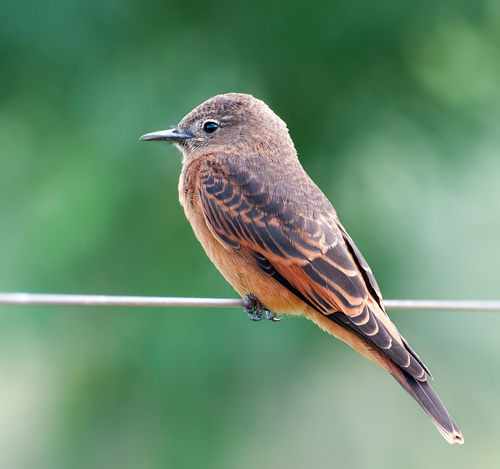
Gray-hooded Attila

Gray-hooded Attila

Attila rufus

Silhouette: Emily Willoughby · PhyloPic

LCLeast ConcernNTVUENCR Endemic
Daily sighting probability <5% · Rare
at São Paulo

In 3 days <5%

30 Verified sightings at São Paulo
575 In all 2 parks From 2019 to 2026
February Best month
☀️ Diurnal When it's spotted

About the Gray-hooded Attila

The grey-hooded attila (Attila rufus) is a species of bird in the family Tyrannidae, the tyrant flycatchers. It is endemic to Brazil. The grey-hooded attila was originally described as Tyrannus rufus. From early in the twentieth century until the 1970s many authors classified genus Attila in family Cotingidae; after that it was recognized as belonging to family Tyrannidae.

The grey-hooded attila is 20 to 21 cm (7.9 to 8.3 in) long and weighs 36.5 to 51.5 g (1.3 to 1.8 oz). The sexes have the same plumage. Adults of the nominate subspecies have a gray head and nape. Their upperparts are mostly deep rufous with a paler cinnamon-rufous rump and tail. Their wings are mostly deep rufous with blackish primaries. Their chin is gray with white streaks. Their breast is rufous and their belly a paler yellowish rufous. Subspecies A. r. hellmayri has a whitish chin and rufous throat. Adults of both subspecies have a dark iris, a longish bill with a dark maxilla and a whitish to grayish mandible, and gray legs and feet. Juveniles... Wikipedia →

Sounds

Song0:13

Brazil · 2026

© Fabrício Grigolin · XC1088387 · CC BY-NC-SA 4.0

Call0:22

Brazil · 2025

© Ricardo José Mitidieri · XC1064980 · CC BY-NC-SA 4.0

Begging call0:30

Brazil · 2024

© Augusto Matheus dos Santos · XC950382 · CC BY-NC-SA 4.0

Global Distribution

Parks Where Found

# Park Country Daily sighting probability
1 Serra dos Órgãos National Park 🇧🇷 Brazil
~50%
2 Itatiaia National Park 🇧🇷 Brazil
~20%

Cities Where Found

# City Country Daily sighting probability
1 Santos 🇧🇷 Brazil
~10%
2 São Paulo 🇧🇷 Brazil
<5%

Before you go

What are the chances of seeing a Gray-hooded Attila in São Paulo?

Rare

Under 5% of wildlife watchers report a Gray-hooded Attila sighting in São Paulo on a given day, based on 30 verified sightings from GBIF citizen-science data. It is the 261st most-seen of the 353 birds we can rate there. Over three days the chance rises to under 5%, if each day is a fresh chance.

When is the best time to see a Gray-hooded Attila in São Paulo?

Any time of year

In every month with enough records, under 5% of wildlife watchers report a Gray-hooded Attila in São Paulo on a given day, so our monthly data shows no clear season.

What time of day is best to see a Gray-hooded Attila?

Between 7 and 10 am

Across all the parks we cover, that three-hour window holds the most Gray-hooded Attila sightings with a recorded time, and about 9 in 10 of them come between 6 am and 6 pm: it is a daytime animal.

Is São Paulo the best place to see a Gray-hooded Attila?

2nd of 2

Of the 2 cities where we can rate Gray-hooded Attila sightings, São Paulo ranks 2nd at under 5%. The best odds are in Santos (Brazil, about 10%).

Which relatives of the Gray-hooded Attila live in São Paulo?

Same family: Tyrannidae

The closest relatives of the Gray-hooded Attila that you can see in São Paulo (family Tyrannidae, Tyrant Flycatchers) are Great Kiskadee (over 90%), Tropical Kingbird (about 30%) and Boat-billed Flycatcher (about 30%), with each one's daily chance of a sighting.

Where does the Gray-hooded Attila sighting chance come from?

GBIF citizen-science records

It is estimated from how often the Gray-hooded Attila is recorded against all the birds logged in São Paulo (30 verified sightings), calibrated against known sighting rates. Figures are rounded to the nearest 10% because citizen-science data supports honest approximations, not decimals, and months with records from fewer than five people show "—". How it works.

← Back to São Paulo