

White-winged Coot

White-winged Coot

Fulica leucoptera

Silhouette: Andy Wilson · PhyloPic

LCLeast ConcernNTVUENCR
Daily sighting probability <5% · Rare
at São Paulo

In 3 days <5% in a week ~10%

102 Verified sightings at São Paulo
157 In all 2 parks From 2019 to 2026
May Best month
☀️ Diurnal When it's spotted

About the White-winged Coot

The white-winged coot (Fulica leucoptera) is a species of bird in the subfamily Rallinae of the family Rallidae. It is found in Argentina, Bolivia, Brazil, Chile, Paraguay, Uruguay, and the Falkland Islands. The white-winged coot is monotypic.

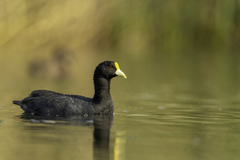
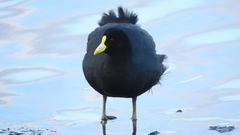
The white-winged coot is 35 to 43 cm (14 to 17 in) long and weighs about 400 to 600 g (14 to 21 oz). The sexes are alike. Adults have a yellow to greenish yellow bill and a small yellow to orange-yellow frontal shield, though these colors may further vary. Their legs and feet are pale sea green to yellow-green and have blackish toes and joints. Their plumage is slaty gray that is blacker on the head and neck. They have white undertail coverts, and wide white tips on the secondaries provide the English name. Immature birds have a dusky olive bill, greenish gray legs and feet, gray-brown upperparts, and paler underparts than adults. Juveniles are dark drab gray with dusky mottling on a white head and neck.

The white-winged coot is found in most of southern South America, in northern to central Chile and separately from eastern and southern Bolivia, Paraguay, and far... Wikipedia →

Sounds

Call0:37

Argentina · 2023

© Bernard BOUSQUET · XC827894 · CC BY-NC-SA 4.0

Song0:20

Argentina

© Bernabe Lopez-Lanus · XC48554 · CC BY-NC-SA 3.0

Alarm call0:19

Uruguay · 2007

© Alvaro Riccetto · XC16591 · CC BY-NC-ND 2.5

Global Distribution

Parks Where Found

# Park Country Daily sighting probability
1 Torres del Paine National Park 🇨🇱 Chile
~10%
2 Nahuel Huapi National Park 🇦🇷 Argentina
<5%

Cities Where Found

# City Country Daily sighting probability
1 Santa Cruz de la Sierra 🇧🇴 Bolivia
~30%
2 Buenos Aires 🇦🇷 Argentina
~20%
3 Cordoba 🇦🇷 Argentina
~10%
4 Montevideo 🇺🇾 Uruguay
~10%
5 São Paulo 🇧🇷 Brazil
<5%
6 Santiago 🇨🇱 Chile
<5%

Before you go

What are the chances of seeing a White-winged Coot in São Paulo?

Rare

Under 5% of wildlife watchers report a White-winged Coot sighting in São Paulo on a given day, based on 102 verified sightings from GBIF citizen-science data. It is the 186th most-seen of the 353 birds we can rate there. Over three days the chance rises to under 5%, and over a week to about 10%, if each day is a fresh chance.

When is the best time to see a White-winged Coot in São Paulo?

Any time of year

In every month with enough records, under 5% of wildlife watchers report a White-winged Coot in São Paulo on a given day, so our monthly data shows no clear season.

What time of day is best to see a White-winged Coot?

Between 9 am and noon

Across all the parks we cover, that three-hour window holds the most White-winged Coot sightings with a recorded time, and nearly all of them come between 6 am and 6 pm: it is a daytime animal.

Is São Paulo the best place to see a White-winged Coot?

5th of 6

Of the 6 cities where we can rate White-winged Coot sightings, São Paulo ranks 5th at under 5%. The best odds are in Santa Cruz de la Sierra (Bolivia, about 30%), Buenos Aires (Argentina, about 20%) and Cordoba (Argentina, about 10%).

Which relatives of the White-winged Coot live in São Paulo?

Same family: Rallidae

The closest relatives of the White-winged Coot that you can see in São Paulo (family Rallidae, Rails, Gallinules, and Coots) are Common Moorhen (about 30%), Slaty-breasted Wood-Rail (about 10%) and Blackish Rail (about 10%), with each one's daily chance of a sighting.

Where does the White-winged Coot sighting chance come from?

GBIF citizen-science records

It is estimated from how often the White-winged Coot is recorded against all the birds logged in São Paulo (102 verified sightings), calibrated against known sighting rates. Figures are rounded to the nearest 10% because citizen-science data supports honest approximations, not decimals, and months with records from fewer than five people show "—". How it works.

← Back to São Paulo