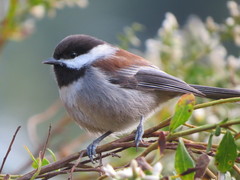
Chestnut-backed Chickadee

Chestnut-backed Chickadee

Poecile rufescens

Silhouette: Andy Wilson · PhyloPic

LCLeast ConcernNTVUENCR
Daily sighting probability ~50% · Likely
at Seattle

In 3 days ~80% in a week >90%

36,806 Verified sightings at Seattle
10,159 In all 7 parks From 2019 to 2026
July Best month
☀️ Diurnal When it's spotted

About the Chestnut-backed Chickadee

The chestnut-backed chickadee (Poecile rufescens) is a small passerine bird in the tit family, native to western North America. In the early 20th century, Joseph Grinnell hypothesized that the chestnut-backed chickadee diverged from the boreal chickadee (Poecile hudsonicus), because both species inhabited similar coniferous forest environments. Grinnell noted that the main differences between the boreal chickadee and the chestnut-backed were in the shade and tone of their respective brown coloration. He drew parallels between the varied chickadee characteristics using the fact that some bird species become smaller and more vibrantly brown as their habitat becomes more humid. Modern molecular phylogenetic studies have confirmed that the chestnut-backed chickadee is sister to the boreal chickadee since there were strong genetic similarities in mitochondrial DNA. More recent research regarding the population distribution of the chestnut-backed chickadee suggests that the genetic fragmentation of the chestnut-backed chickadee from the boreal chickadee was due to the changing glacial landscapes of the Pleistocene era. After this species divergence, the chestnut-backed chickadee... Wikipedia →

Sounds

Call1:11

United States · 2026

© Greg Irving · XC1149498 · CC BY-NC-SA 4.0

Song0:52

Canada · 2022

© Barry Edmonston · XC725123 · CC BY-NC-SA 4.0

Alarm call0:27

United States · 2019

© Whitney Neufeld-Kaiser · XC540321 · CC BY-NC-SA 4.0

Global Distribution

Parks Where Found

# Park Country Daily sighting probability
1 Olympic National Park 🇺🇸 United States
~60%
2 Redwood National Park 🇺🇸 United States
~50%
3 Great Bear Rainforest 🇨🇦 Canada
~50%
4 Pacific Rim National Park Reserve 🇨🇦 Canada
~50%
5 Glacier National Park 🇺🇸 United States
~10%
6 Yosemite National Park 🇺🇸 United States
<5%
7 Kenai Fjords National Park 🇺🇸 United States
<5%

Cities Where Found

# City Country Daily sighting probability
1 San Francisco 🇺🇸 United States
~50%
2 Seattle 🇺🇸 United States
~50%
3 Portland 🇺🇸 United States
~30%
4 Vancouver 🇨🇦 Canada
~20%

Before you go

What are the chances of seeing a Chestnut-backed Chickadee in Seattle?

Likely

About 50% of wildlife watchers report a Chestnut-backed Chickadee sighting in Seattle on a given day, based on 36,806 verified sightings from GBIF citizen-science data. It is the 12th most-seen of the 271 birds we can rate there. Over three days the chance rises to about 80%, and over a week to over 90%, if each day is a fresh chance.

When is the best time to see a Chestnut-backed Chickadee in Seattle?

March to September

In those months about 50% of wildlife watchers report a Chestnut-backed Chickadee in Seattle on a given day, against about 40% in October to February, the lowest months.

What time of day is best to see a Chestnut-backed Chickadee?

Between 8 and 11 am

Across all the parks we cover, that three-hour window holds the most Chestnut-backed Chickadee sightings with a recorded time, and about 9 in 10 of them come between 6 am and 6 pm: it is a daytime animal.

Is Seattle the best place to see a Chestnut-backed Chickadee?

Among the best

Of the 4 cities where we can rate Chestnut-backed Chickadee sightings, Seattle ranks 2nd at about 50%, level with the leaders once rounded. The best odds are in San Francisco (United States, about 50%).

Where does the Chestnut-backed Chickadee sighting chance come from?

GBIF citizen-science records

It is estimated from how often the Chestnut-backed Chickadee is recorded against all the birds logged in Seattle (36,806 verified sightings), calibrated against known sighting rates. Figures are rounded to the nearest 10% because citizen-science data supports honest approximations, not decimals, and months with records from fewer than five people show "—". How it works.

← Back to Seattle