Red-throated Thrush

Red-throated Thrush

Turdus ruficollis

Silhouette: Sharon Wegner-Larsen · PhyloPic

LCLeast ConcernNTVUENCR
Daily sighting probability <5% · Rare
at Seoul

In 3 days <5%

11 Verified sightings at Seoul
30 In 1 park From 2019 to 2026
January Best month
☀️ Diurnal When it's spotted

About the Red-throated Thrush

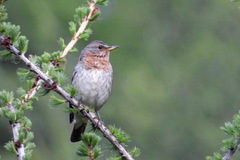
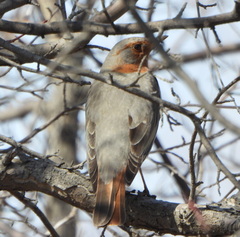
The red-throated thrush (Turdus ruficollis) is a passerine bird in the thrush family. It is sometimes regarded as one subspecies of a polytypic species, "dark-throated thrush", black-throated thrush then being the other subspecies. More recent treatments regard the two as separate species. The scientific name comes from Latin. Turdus is "thrush" and the specific ruficollis is derived from rufus, "red", and collum, "neck".

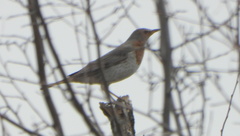
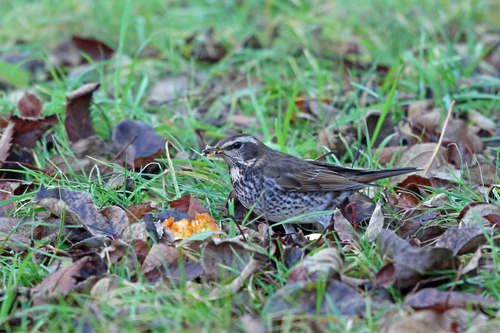
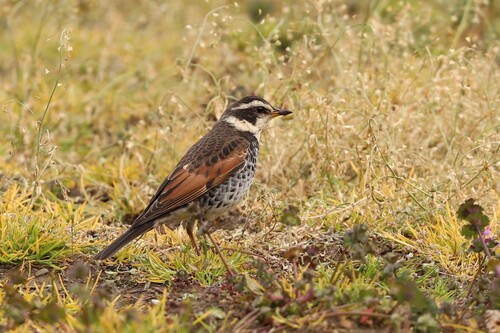
The red-throated thrush is a migratory Palearctic species. It breeds in East Siberia to North Manchuria wintering to West China, Myanmar, and Northeast India. Its range overlaps with the more westerly-breeding black-throated thrush. It is a large thrush with a plain grey back and reddish underwings. The adult male has a red throat. Females and young birds lack the bib, but have black-streaked underparts. This bird species is a very rare vagrant to western Europe.

"BirdLife International Species factsheet: Turdus ruficollis". BirdLife International. Retrieved 21 November 2009. Wikipedia →

Sounds

Call0:29

Mongolia · 2025

© Richard E. Webster · XC1027957 · CC BY-NC-SA 4.0

Flight call0:21

Mongolia · 2022

© Stanislas Wroza · XC766019 · CC BY-NC-SA 4.0

Alarm call0:43

China · 2021

© PT xiao · XC649139 · CC BY-NC-SA 4.0

Global Distribution

Parks Where Found

# Park Country Daily sighting probability
1 Gobi Gurvansaikhan National Park 🇲🇳 Mongolia
~10%

More parks will be added in future updates.

Cities Where Found

# City Country Daily sighting probability
1 Xining 🇨🇳 China
~10%
2 Lanzhou 🇨🇳 China
~10%
3 Beijing 🇨🇳 China
~10%
4 Tianjin 🇨🇳 China
~10%
5 Ulaanbaatar 🇲🇳 Mongolia
~10%
6 Hong Kong 🇨🇳 China
<5%
7 Seoul 🇰🇷 South Korea
<5%
8 Kathmandu 🇳🇵 Nepal
<5%

Before you go

What are the chances of seeing a Red-throated Thrush in Seoul?

Rare

Under 5% of wildlife watchers report a Red-throated Thrush sighting in Seoul on a given day, based on 11 verified sightings from GBIF citizen-science data. It is the 203rd most-seen of the 231 birds we can rate there. Over three days the chance rises to under 5%, if each day is a fresh chance.

When is the best time to see a Red-throated Thrush in Seoul?

Any time of year

In every month with enough records, under 5% of wildlife watchers report a Red-throated Thrush in Seoul on a given day, so our monthly data shows no clear season.

What time of day is best to see a Red-throated Thrush?

Between 11 am and 2 pm

Across all the parks we cover, that three-hour window holds the most Red-throated Thrush sightings with a recorded time, and about 9 in 10 of them come between 6 am and 6 pm: it is a daytime animal.

Is Seoul the best place to see a Red-throated Thrush?

7th of 8

Of the 8 cities where we can rate Red-throated Thrush sightings, Seoul ranks 7th at under 5%. The best odds are in Xining (China, about 10%), Lanzhou (China, about 10%) and Beijing (China, about 10%).

Which relatives of the Red-throated Thrush live in Seoul?

Same genus: Turdus

The closest relatives of the Red-throated Thrush that you can see in Seoul (genus Turdus, Typical Thrushes) are Naumann's Thrush (about 20%), Grey-backed Thrush (about 20%) and Dusky Thrush (about 10%), with each one's daily chance of a sighting.

Where does the Red-throated Thrush sighting chance come from?

GBIF citizen-science records

It is estimated from how often the Red-throated Thrush is recorded against all the birds logged in Seoul (11 verified sightings), calibrated against known sighting rates. Figures are rounded to the nearest 10% because citizen-science data supports honest approximations, not decimals, and months with records from fewer than five people show "—". How it works.

← Back to Seoul