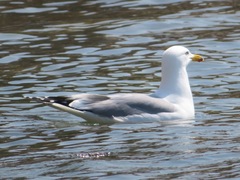
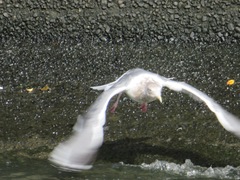
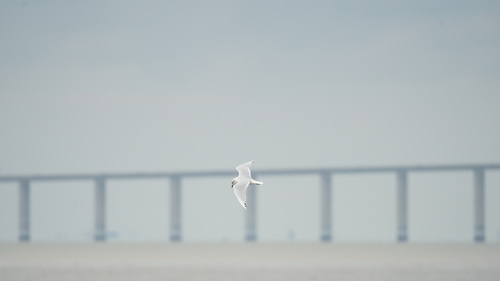
Vega Gull
Daily sighting probability ~10% · With luck
at Seoul

In 3 days ~20% in a week ~40%

479 Verified sightings at Seoul
February Best month
☀️ Diurnal When it's spotted

About the Vega Gull

The Vega gull, East Siberian gull, or East Siberian herring gull (Larus vegae) is a large gull of the herring gull/lesser black-backed gull complex which breeds in Northeast Asia. Its classification is still controversial and uncertain. It is variously treated as a separate species, as a subspecies of the American herring gull (L. smithsonianus) or included with both the American herring gull and European herring gull in L. argentatus. The Mongolian gull Larus mongolicus was formerly regarded as a subspecies of Vega gull. It was described in 1887 from specimens collected on the 1878–1880 Vega Expedition on the Swedish ship SS Vega.

The Vega gull is similar to the herring gull but is slightly darker grey above. The head of the Vega gull is heavily streaked with brown in winter, especially on the back and sides of the neck forming a collar. The legs are usually bright pink. First- and second-winter Vega gulls are darker than the similar Mongolian gull, notably on the crown of the head where Mongolian gulls even in first- and second-winter are a bit paler. Almost the full body of first- and second-winter Vega gulls displays darker brown flecks and streaks. Adult... Wikipedia →

Global Distribution

Parks Where Found

# Park Country Daily sighting probability

More parks will be added in future updates.

Cities Where Found

# City Country Daily sighting probability
1 Busan 🇰🇷 South Korea
~10%
2 Seoul 🇰🇷 South Korea
~10%
3 Hiroshima 🇯🇵 Japan
<5%
4 Fukuoka 🇯🇵 Japan
<5%
5 Tokyo 🇯🇵 Japan
<5%
6 Shanghai 🇨🇳 China
<5%
7 Tianjin 🇨🇳 China
<5%
8 Hangzhou 🇨🇳 China
<5%
9 Osaka 🇯🇵 Japan
<5%
10 Nagoya 🇯🇵 Japan
<5%

Zoos & Centres Where Found

# Zoo / Centre Country
1 Zhuhai Chimelong Ocean Kingdom 🇨🇳 China In captivity
2 杭州野生动物世界 🇨🇳 China In captivity

Before you go

What are the chances of seeing a Vega Gull in Seoul?

With luck

About 10% of wildlife watchers report a Vega Gull sighting in Seoul on a given day, based on 479 verified sightings from GBIF citizen-science data. It is the 65th most-seen of the 231 birds we can rate there. Over three days the chance rises to about 20%, and over a week to about 40%, if each day is a fresh chance.

When is the best time to see a Vega Gull in Seoul?

February

In that month about 20% of wildlife watchers report a Vega Gull in Seoul on a given day, against under 5% in April to October, the lowest months. That is one of Seoul's driest months, with about 30 mm of rain against 360 mm in July.

What time of day is best to see a Vega Gull?

Between 9 am and noon

Across all the parks we cover, that three-hour window holds the most Vega Gull sightings with a recorded time, and about 9 in 10 of them come between 6 am and 6 pm: it is a daytime animal.

Is Seoul the best place to see a Vega Gull?

Among the best

Of the 12 cities where we can rate Vega Gull sightings, Seoul ranks 2nd at about 10%, level with the leaders once rounded. The best odds are in Busan (South Korea, about 10%).

Where does the Vega Gull sighting chance come from?

GBIF citizen-science records

It is estimated from how often the Vega Gull is recorded against all the birds logged in Seoul (479 verified sightings), calibrated against known sighting rates. Figures are rounded to the nearest 10% because citizen-science data supports honest approximations, not decimals, and months with records from fewer than five people show "—". How it works.

← Back to Seoul