African Collared Dove

African Collared Dove

Streptopelia roseogrisea

Silhouette: Andy Wilson · PhyloPic

LCLeast ConcernNTVUENCR
Daily sighting probability <5% · Rare
at Serrekunda

In 3 days ~10% in a week ~20%

20 Verified sightings at Serrekunda
23 In all 2 parks From 2019 to 2026
February Best month
☀️ Diurnal When it's spotted

About the African Collared Dove

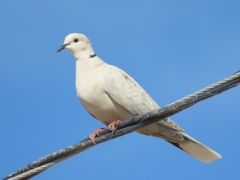
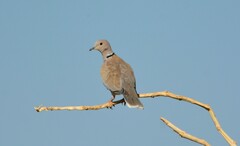
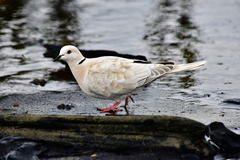
The African collared dove (Streptopelia roseogrisea) is a small dove found in the Sahel, northern parts of the Horn of Africa and southwestern Arabia. Although it lives in arid lands, it is found around water sources. This bird is typically around 26 cm (10 in) in length and 130–166 g weight. Its upper body, from shoulders to tail, is a pale greyish brown, though the wing edge has a bluish tinge. The flight feathers are darker, and nearly black. The head, neck and breast are pinkish shading to white on the chin and belly. There is no sexual dimorphism.

Two subspecies are currently accepted, though the genetic difference is minimal and the species may be better considered monotypic. Streptopelia roseogrisea roseogrisea — nominate subspecies; across Africa in the Sahel region just south of the Sahara Desert east to north-central Sudan

Streptopelia roseogrisea arabica (Neumann, 1904) — northeast Sudan to Eritrea and Somalia, and southwestern Arabia; slightly darker than nominate The African collared dove is the wild ancestor of the domestic Barbary dove; some in the past have suggested that the Eurasian collared dove (Streptopelia decaocto) may also have been involved, but there is only minimal evidence to support this. The African collared dove is able to interbreed with the Barbary dove, and it is thought that the increase in the range of colours of Barbary doves available that occurred in the later 20th century was the result of the importation of African collared doves into the United States for interbreeding.

It has a diet of grass seeds and other plants. They would also eat berries, insects, and snails. Wikipedia →

Sounds

Song0:21

Saudi Arabia · 2025

© Zsombor Károlyi · XC1163976 · CC BY-NC-SA 4.0

Call0:49

Senegal · 2026

© Peter Boesman · XC1081415 · CC BY-NC-ND 4.0

Song0:25

Saudi Arabia · 2022

© David Darrell-Lambert · XC746351 · CC BY-NC-SA 4.0

Global Distribution

Parks Where Found

# Park Country Daily sighting probability
1 Awash National Park 🇪🇹 Ethiopia
~10%
2 Niokolo-Koba National Park 🇸🇳 Senegal
<5%

Cities Where Found

# City Country Daily sighting probability
1 Auckland 🇳🇿 New Zealand
~10%
2 Maiduguri 🇳🇬 Nigeria
~10%
3 Riyadh 🇸🇦 Saudi Arabia
~10%
4 Serrekunda 🇬🇲 Gambia
<5%
5 Addis Ababa 🇪🇹 Ethiopia
<5%
6 Mesa 🇺🇸 United States
<5%

Zoos & Centres Where Found

# Zoo / Centre Country
1 Moscow Zoo 🇷🇺 Russia In captivity
2 Abilene Zoological Gardens 🇺🇸 United States In captivity
3 Bronx Zoo 🇺🇸 United States In captivity
4 Yerevan Zoo 🇦🇲 Armenia In captivity
5 Fonghuanggu Bird and Ecology Park 🇹🇼 Taiwan In captivity
6 Nyíregyháza Zoo 🇭🇺 Hungary In captivity
7 Wildpark Saarbrücken 🇩🇪 Germany In captivity
8 Център за защита на природата и животните 🇧🇬 Bulgaria In captivity
9 Elmvale Jungle Zoo 🇨🇦 Canada In captivity
10 Avilon Zoo 🇵🇭 Philippines In captivity
11 Bioparque Educativo Quillón 🇨🇱 Chile In captivity
12 The Abilene Zoo 🇺🇸 United States In captivity
13 Leningrad Zoo 🇷🇺 Russia In captivity
14 Willowbank Wildlife Reserve 🇳🇿 New Zealand In captivity
15 Jardín Zoológico El Bosque 🇨🇺 Cuba In captivity
16 Santillana Zoo 🇪🇸 Spain In captivity
17 Cambridge Butterfly Conservatory 🇨🇦 Canada In captivity
18 Kobelt-Zoo 🇩🇪 Germany In captivity
19 Tierpark Recklinghausen 🇩🇪 Germany In captivity
20 Bird Kingdom 🇨🇦 Canada In captivity
21 Sea Life Aquarium 🇺🇸 United States In captivity
22 Bloedel Conservatory 🇨🇦 Canada In captivity
23 Dobrich Zoo 🇧🇬 Bulgaria In captivity
24 Exotic Animal World 🇿🇦 South Africa In captivity
25 L'arche Desnoe 🇫🇷 France In captivity
26 Ranger Red’s Zoo & Conservation Park 🇦🇺 Australia In captivity
27 Tierpark Bad Kösen 🇩🇪 Germany In captivity
28 Зоовольерный комплекс 🇷🇺 Russia In captivity

Before you go

What are the chances of seeing an African Collared Dove in Serrekunda?

Rare

Under 5% of wildlife watchers report an African Collared Dove sighting in Serrekunda on a given day, based on 20 verified sightings from GBIF citizen-science data. It is the 153rd most-seen of the 213 birds we can rate there. Over three days the chance rises to about 10%, and over a week to about 20%, if each day is a fresh chance.

When is the best time to see an African Collared Dove in Serrekunda?

January and February

In those months about 10% of wildlife watchers report an African Collared Dove in Serrekunda on a given day, against under 5% in March to December, the lowest months. Those are among Serrekunda's driest months, with almost no rain against 290 mm in August.

What time of day is best to see an African Collared Dove?

Between 10 am and 1 pm

Across all the parks we cover, that three-hour window holds the most African Collared Dove sightings with a recorded time, and about 9 in 10 of them come between 6 am and 6 pm: it is a daytime animal.

Is Serrekunda the best place to see an African Collared Dove?

4th of 6

Of the 6 cities where we can rate African Collared Dove sightings, Serrekunda ranks 4th at under 5%. The best odds are in Auckland (New Zealand, about 10%), Maiduguri (Nigeria, about 10%) and Riyadh (Saudi Arabia, about 10%).

Which relatives of the African Collared Dove live in Serrekunda?

Same genus: Streptopelia

The closest relatives of the African Collared Dove that you can see in Serrekunda (genus Streptopelia, Turtle-Doves and Collared-Doves) are Red-eyed Dove (about 80%), Vinaceous Dove (about 60%) and African Mourning Dove (about 50%), with each one's daily chance of a sighting.

Where does the African Collared Dove sighting chance come from?

GBIF citizen-science records

It is estimated from how often the African Collared Dove is recorded against all the birds logged in Serrekunda (20 verified sightings), calibrated against known sighting rates. Figures are rounded to the nearest 10% because citizen-science data supports honest approximations, not decimals, and months with records from fewer than five people show "—". How it works.

← Back to Serrekunda