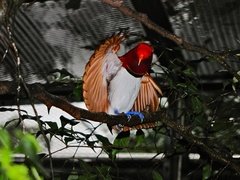
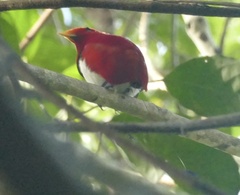
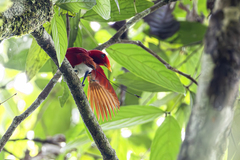
King Bird-of-Paradise

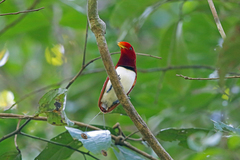
King Bird-of-Paradise

Cicinnurus regius

Silhouette: Federico Pelliccioni · PhyloPic

LCLeast ConcernNTVUENCR
Daily sighting probability <5% · Rare
at Singapore

In 3 days <5%

47 Verified sightings at Singapore
December Best month
☀️ Diurnal When it's spotted

About the King Bird-of-Paradise

The king bird-of-paradise (Cicinnurus regius) is a passerine bird of the Paradisaeidae (bird-of-paradise) family. It is considered by the IOC checklist to be the only member of the genus Cicinnurus, although the genus Diphyllodes is closely related and is subsumed under Cicinnurus by many other authorities.

The king bird-of-paradise is a common and wide-ranging species, distributed throughout lowland forests of New Guinea and western satellite islands. Some populations range quite high into the hills and lower mountains, and these are poorly known as yet.

The first captive breeding of this species was by Sten Bergman of Sweden in 1958. He was awarded a commemorative medal by the Foreign Bird League to mark this achievement. The king bird-of-paradise was formally described in 1758 by the Swedish naturalist Carl Linnaeus in the tenth edition of his Systema Naturae under the binomial name Paradisaea regius. The type locality is the Aru Islands. It is now the only species placed in the genus Cicinnurus that was introduced in 1816 by the French ornithologist Louis Pierre Vieillot. The genus name combines the Ancient Greek κικιννος/kikinnos meaning "ringlet" or "curled lock... Wikipedia →

Sounds

Call0:15

Indonesia · 2019

© Marc Anderson · XC632692 · CC BY-NC-ND 4.0

Song0:50

Papua New Guinea · 1993

© Scott Connop · XC587202 · CC BY-NC-SA 4.0

Alarm call0:24

Indonesia · 1997

© Bas van Balen · XC140736 · CC BY-NC-SA 3.0

Global Distribution

Parks Where Found

# Park Country Daily sighting probability

More parks will be added in future updates.

Cities Where Found

# City Country Daily sighting probability
1 Singapore 🇸🇬 Singapore
<5%

Zoos & Centres Where Found

# Zoo / Centre Country
1 Zoo Pilsen 🇨🇿 Czechia In captivity
2 Wilhelma 🇩🇪 Germany In captivity
3 Oasi Naturalistica di Sant'Alessio 🇮🇹 Italy In captivity
4 Bali Bird Park 🇮🇩 Indonesia In captivity

Before you go

What are the chances of seeing a King Bird-of-Paradise in Singapore?

Rare

Under 5% of wildlife watchers report a King Bird-of-Paradise sighting in Singapore on a given day, based on 47 verified sightings from GBIF citizen-science data. It is the 250th most-seen of the 298 birds we can rate there. Over three days the chance rises to under 5%, if each day is a fresh chance.

When is the best time to see a King Bird-of-Paradise in Singapore?

Any time of year

In every month with enough records, under 5% of wildlife watchers report a King Bird-of-Paradise in Singapore on a given day, so our monthly data shows no clear season.

What time of day is best to see a King Bird-of-Paradise?

Between 7 and 10 am

Across all the parks we cover, that three-hour window holds the most King Bird-of-Paradise sightings with a recorded time, and about 8 in 10 of them come between 6 am and 6 pm: it is a daytime animal.

Where else can you see a King Bird-of-Paradise?

Only Singapore, in our data

Singapore is the only city on Wallace's Line with enough records to rate King Bird-of-Paradise sightings: under 5% of wildlife watchers there report one on a given day.

Which relatives of the King Bird-of-Paradise live in Singapore?

Same order: Passeriformes

The closest relatives of the King Bird-of-Paradise that you can see in Singapore (order Passeriformes, Perching Birds) are Javan Myna (about 80%), Yellow-vented Bulbul (about 70%) and Black-naped Oriole (about 70%), with each one's daily chance of a sighting.

Where does the King Bird-of-Paradise sighting chance come from?

GBIF citizen-science records

It is estimated from how often the King Bird-of-Paradise is recorded against all the birds logged in Singapore (47 verified sightings), calibrated against known sighting rates. Figures are rounded to the nearest 10% because citizen-science data supports honest approximations, not decimals, and months with records from fewer than five people show "—". How it works.

← Back to Singapore