


Completed

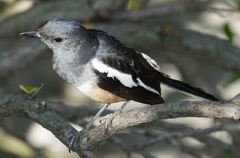



Oriental Magpie-Robin
Copsychus saularis
Silhouette: Martin Bulla, based on François Desbordes' illustration · PhyloPic
- KingdomAnimalia (Animals)
- PhylumChordata (Chordates)
- ClassAves (Birds)
- OrderPasseriformes (Perching Birds)
- FamilyMuscicapidae (Old World Flycatchers, Robins, and Chats)
- GenusCopsychus (Magpie-Robins and Shamas)
- SpeciesCopsychus saularis (Oriental Magpie-Robin)
In 3 days ~80% in a week >90%
5,440 Verified sightings at Singapore
28,749 In all 39 parks From 2019 to 2026
June Best month
🌅 Crepuscular When it's spotted
About the Oriental Magpie-Robin
The Oriental magpie-robin (Copsychus saularis) is a small passerine bird that was formerly classed as a member of the thrush family Turdidae, but now considered an Old World flycatcher. The males are distinctive black and white birds with a long tail that is held upright as they forage on the ground or perch conspicuously. Occurring across most of the Indian subcontinent and parts of Southeast Asia, they are common birds in urban gardens as well as forests. They are particularly well known for their songs and are popular as cagebirds.
The oriental magpie-robin is considered the national bird of Bangladesh. This species is 19 centimetres (7.5 in) long, including the long tail, which is usually held cocked upright when hopping on the ground. When they are singing a song the tail is normal like other birds. It is similar in shape to the smaller European robin, but is longer-tailed. The male has black upperparts, head and throat apart from a white shoulder patch. The underparts and the sides of the long tail are white. Females are greyish black above and greyish white under. Young birds have scaly brown upperparts and head.
The nominate race is found on the Indian subcontinent... Wikipedia →
Sounds
Recording0:18
China · 2025
© xiaodou · iNaturalist · CC BY-NC 4.0
Recording0:14
Singapore · 2026
© Soh Kam Yung · iNaturalist · CC BY-NC 4.0
Recording0:08
Singapore · 2021
© carmpenterbee · iNaturalist · CC BY-NC 4.0
Recent sightings of Oriental Magpie-Robin in Singapore
LIVEiNaturalistGlobal Distribution
Parks Where Found
Cities Where Found
| # | City | Country | Daily sighting probability |
|---|---|---|---|
| 1 | Xiuying District | 🇨🇳 China | |
| 2 | Bangkok | 🇹🇭 Thailand | |
| 3 | Hong Kong | 🇨🇳 China | |
| 4 | Xiamen City | 🇨🇳 China | |
| 5 | Savar | 🇧🇩 Bangladesh | |
| 6 | Dhaka | 🇧🇩 Bangladesh | |
| 7 | Zhuhai [Macau] | 🇨🇳 China | |
| 8 | Guangzhou | 🇨🇳 China | |
| 9 | Kathmandu | 🇳🇵 Nepal | |
| 10 | Phnom Penh | 🇰🇭 Cambodia |
Zoos & Centres Where Found
| # | Zoo / Centre | Country | |
|---|---|---|---|
| 1 | Bronx Zoo | 🇺🇸 United States | |
| 2 | Phoenix Zoo | 🇺🇸 United States | |
| 3 | Toledo Zoo | 🇺🇸 United States | |
| 4 | Nanning Zoo | 🇨🇳 China | |
| 5 | Gembira Loka Zoo | 🇮🇩 Indonesia | |
| 6 | Bandung Zoo | 🇮🇩 Indonesia | |
| 7 | Hong Kong Zoological and Botanical Gardens | 🇨🇳 China | |
| 8 | Tracy Aviary | 🇺🇸 United States | |
| 9 | Macau Zoo | 🇲🇴 Macao SAR China | |
| 10 | National Aviary | 🇺🇸 United States | |
| 11 | Sea World Indonesia | 🇮🇩 Indonesia | |
| 12 | Edward Youde Aviary | 🇭🇰 Hong Kong SAR China | |
| 13 | Jakarta Aquarium | 🇮🇩 Indonesia |
Closest Relatives at Singapore





Before you go
What are the chances of seeing an Oriental Magpie-Robin in Singapore?
Likely
About 40% of wildlife watchers report an Oriental Magpie-Robin sighting in Singapore on a given day, based on 5,440 verified sightings from GBIF citizen-science data. It is the 14th most-seen of the 298 birds we can rate there. Over three days the chance rises to about 80%, and over a week to over 90%, if each day is a fresh chance.
When is the best time to see an Oriental Magpie-Robin in Singapore?
April to August
In those months about 50% of wildlife watchers report an Oriental Magpie-Robin in Singapore on a given day, against about 20% in November, the lowest month.
What time of day is best to see an Oriental Magpie-Robin?
Between 2 and 5 am
Across all the parks we cover, that three-hour window holds the most Oriental Magpie-Robin sightings with a recorded time, and about 6 in 10 of them come between 6 am and 6 pm: it is most active around dawn and dusk.
Is Singapore the best place to see an Oriental Magpie-Robin?
79th of 110
Of the 110 cities where we can rate Oriental Magpie-Robin sightings, Singapore ranks 79th at about 40%. The best odds are in Xiuying District (China, about 90%), Bangkok (Thailand, about 90%) and Hong Kong (China, about 80%).
Where does the Oriental Magpie-Robin sighting chance come from?
GBIF citizen-science records
It is estimated from how often the Oriental Magpie-Robin is recorded against all the birds logged in Singapore (5,440 verified sightings), calibrated against known sighting rates. Figures are rounded to the nearest 10% because citizen-science data supports honest approximations, not decimals, and months with records from fewer than five people show "—". How it works.
