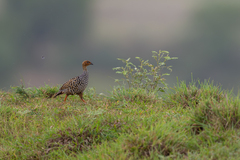
Painted Francolin

Painted Francolin

Francolinus pictus

Silhouette: Amanda Kuhlman · PhyloPic

LCLeast ConcernNTVUENCR
Daily sighting probability ~10% · With luck
at Solapur

In 3 days ~20% in a week ~40%

8 Verified sightings at Solapur
1,079 In all 2 parks From 2019 to 2026
June Best month
☀️ Diurnal When it's spotted

About the Painted Francolin

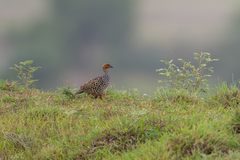
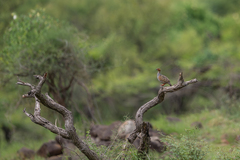
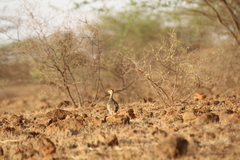
The painted francolin or painted partridge (Francolinus pictus) is a species of francolin found in grassy areas in central and southern India and in the lowlands of southeastern Sri Lanka. Thomas C. Jerdon noted that the species was found mainly in Central India south of the Narmada and to the east of the Western Ghats as well as the Chota Nagpur and Northern Circars. It partly overlaps with the black francolin with which it partly overlaps and is said to sometimes hybridize. This species can be so distinguished from a black francolin female by the lack of a rufous hind collar and the white spots on the underside. The face is rufous and there is no dark stripe running behind the eye.

This species is endemic to the Indian subcontinent. It is distributed patchily from Rajasthan and Uttar Pradesh south into peninsular India (but not along the Malabar coast and rare south of Coimbatore) and in Sri Lanka. The species interbreeds with the black francolin along its northern and appears similar to the female of that species but has no rufous hindcollar, instead having a bright rufous face and throat. The underside has white spots while the legs are orange-yellow to red. It... Wikipedia →

Sounds

Song1:13

India · 2025

© Peter Boesman · XC1030586 · CC BY-NC-ND 4.0

Uncertain1:05

India · 2021

© Amol Mande · XC662750 · CC BY-NC-SA 4.0

Call0:06

India · 2016

© Yogesh Patel · XC338333 · CC BY-NC-SA 4.0

Global Distribution

Parks Where Found

# Park Country Daily sighting probability
1 Kanha National Park 🇮🇳 India
~10%
2 Bandhavgarh National Park 🇮🇳 India
<5%

Cities Where Found

# City Country Daily sighting probability
1 Nashik 🇮🇳 India
~10%
2 Nagpur 🇮🇳 India
~10%
3 Solapur 🇮🇳 India
~10%
4 Rajkot 🇮🇳 India
<5%
5 Pune 🇮🇳 India
<5%
6 Indore 🇮🇳 India
<5%

Before you go

What are the chances of seeing a Painted Francolin in Solapur?

With luck

About 10% of wildlife watchers report a Painted Francolin sighting in Solapur on a given day, based on 8 verified sightings from GBIF citizen-science data. It is the 67th most-seen of the 86 birds we can rate there. Over three days the chance rises to about 20%, and over a week to about 40%, if each day is a fresh chance.

When is the best time to see a Painted Francolin in Solapur?

May to July

In those months about 20% of wildlife watchers report a Painted Francolin in Solapur on a given day, against under 5% in October to April, the lowest months. Those are among Solapur's wettest months, with about 75 mm of rain a month against almost none in January. August has too few records to rate.

What time of day is best to see a Painted Francolin?

Between 8 and 11 am

Across all the parks we cover, that three-hour window holds the most Painted Francolin sightings with a recorded time, and about 8 in 10 of them come between 6 am and 6 pm: it is a daytime animal.

Is Solapur the best place to see a Painted Francolin?

Among the best

Of the 6 cities where we can rate Painted Francolin sightings, Solapur ranks 3rd at about 10%, level with the leaders once rounded. The best odds are in Nashik (India, about 10%) and Nagpur (India, about 10%).

Which relatives of the Painted Francolin live in Solapur?

Same family: Phasianidae

The closest relatives of the Painted Francolin that you can see in Solapur (family Phasianidae, Pheasants, Grouse, and Allies) are Grey Francolin (about 60%) and Common Peafowl (about 50%), with each one's daily chance of a sighting.

Where does the Painted Francolin sighting chance come from?

GBIF citizen-science records

It is estimated from how often the Painted Francolin is recorded against all the birds logged in Solapur (8 verified sightings), calibrated against known sighting rates. Figures are rounded to the nearest 10% because citizen-science data supports honest approximations, not decimals, and months with records from fewer than five people show "—". How it works.

← Back to Solapur