Green-and-Golden Bell Frog

Green-and-Golden Bell Frog

Ranoidea aurea

Silhouette: Vijay Karthick · PhyloPic

Endemic
Daily sighting probability ~10% · With luck
at Sydney

In 3 days ~20% in a week ~30%

76 Verified sightings at Sydney
February Best month
☀️🌙 Day & Night When it's spotted

About the Green-and-Golden Bell Frog

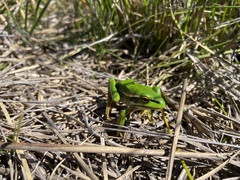
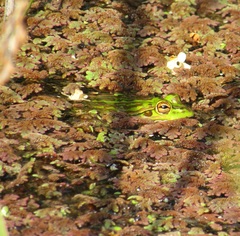
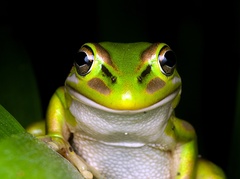
The green and golden bell frog (Ranoidea aurea), also named the green bell frog, green and golden swamp frog and green frog, is a species of ground-dwelling tree frog native to eastern Australia. Despite its classification and climbing abilities, it does not live in trees and spends almost all of its time close to ground level. It can reach up to 11 cm (4.5 in) in length, making it one of Australia's largest frogs.

Coloured gold and green, the frogs are voracious eaters of insects, but will also eat larger prey, such as worms and mice. They are mainly diurnal, although this is mostly to warm in the sun. They tend to be less active in winter except in warmer or wetter periods, and breed in the warmer months. Males reach maturity after around 9 months, while for the larger females, this does not occur until they are two years old. The frogs can engage in cannibalism, and males frequently attack and injure one another if they infringe on one another's space.

Many populations, particularly in the Sydney region, inhabit areas of infrequent disturbance, such as golf courses, disused industrial land, brick pits, and landfill areas. Though once one of the most common frogs in south-east Australia, the green and golden bell frog has endured major population declines, particularly in highland areas, leading to its current classification as globally endangered. Its numbers have continued to fall and are threatened by habitat loss and degradation, pollution, introduced species, and parasites and pathogens, including the chytrid Batrachochytrium dendrobatidis. As most of the remaining populations live on private land, the logistics of the conservation effort can be complicated. Despite the situation in Australia, some frog populations have survived with more success in New Zealand and several other Pacific islands, where it has been introduced. However, even in these areas the population of green and golden bell has been rapidly declining in the past few decades. Wikipedia →

Sounds

Recording0:41

Australia · 2023

© Brendan Casey · iNaturalist · CC BY-NC 4.0

Recording0:17

New Zealand · 2019

© Will · iNaturalist · CC BY-NC 4.0

Recording0:14

New Zealand · 2025

© Laura Mantin · iNaturalist · CC BY-NC 4.0

Global Distribution

Parks Where Found

# Park Country Daily sighting probability

More parks will be added in future updates.

Cities Where Found

# City Country Daily sighting probability
1 Auckland 🇳🇿 New Zealand
~20%
2 Sydney 🇦🇺 Australia
~10%

Zoos & Centres Where Found

# Zoo / Centre Country
1 Orana Wildlife Park 🇳🇿 New Zealand In captivity
2 National Zoo & Aquarium 🇦🇺 Australia In captivity
3 Taronga Zoo 🇦🇺 Australia In captivity
4 Currumbin Wildlife Sanctuary 🇦🇺 Australia In captivity
5 Sydney Zoo 🇦🇺 Australia In captivity
6 Willowbank Wildlife Reserve 🇳🇿 New Zealand In captivity
7 Symbio Wildlife Park 🇦🇺 Australia In captivity
8 Kelly Tarlton's Sea Life Aquarium 🇳🇿 New Zealand In captivity
9 Melbourne Aquarium 🇦🇺 Australia In captivity
10 Sea Life Sydney Aquarium 🇦🇺 Australia In captivity
11 Wild Life Sydney 🇦🇺 Australia In captivity

Before you go

What are the chances of seeing a Green-and-Golden Bell Frog in Sydney?

With luck

About 10% of wildlife watchers report a Green-and-Golden Bell Frog sighting in Sydney on a given day, based on 76 verified sightings from GBIF citizen-science data. It is the 6th most-seen of the 8 amphibians we can rate there. Over three days the chance rises to about 20%, and over a week to about 30%, if each day is a fresh chance.

When is the best time to see a Green-and-Golden Bell Frog in Sydney?

November to April

In those months about 10% of wildlife watchers report a Green-and-Golden Bell Frog in Sydney on a given day, against under 5% in May to October, the lowest months.

What time of day is best to see a Green-and-Golden Bell Frog?

Between 8 and 11 pm

Across all the parks we cover, that three-hour window holds the most Green-and-Golden Bell Frog sightings with a recorded time, and about half of them come between 6 am and 6 pm: it is seen both by day and at night.

Is Sydney the best place to see a Green-and-Golden Bell Frog?

2nd of 2

Of the 2 cities where we can rate Green-and-Golden Bell Frog sightings, Sydney ranks 2nd at about 10%. The best odds are in Auckland (New Zealand, about 20%).

Which relatives of the Green-and-Golden Bell Frog live in Sydney?

Same genus: Ranoidea

The closest relatives of the Green-and-Golden Bell Frog that you can see in Sydney (genus Ranoidea) are Leaf Green Treefrog (about 10%) and Ranoidea caerulea (about 10%), with each one's daily chance of a sighting.

Where does the Green-and-Golden Bell Frog sighting chance come from?

GBIF citizen-science records

It is estimated from how often the Green-and-Golden Bell Frog is recorded against all the amphibians logged in Sydney (76 verified sightings), calibrated against known sighting rates. Figures are rounded to the nearest 10% because citizen-science data supports honest approximations, not decimals, and months with records from fewer than five people show "—". How it works.

← Back to Sydney