Ranoidea caerulea

Ranoidea caerulea

Ranoidea caerulea

Silhouette: Vijay Karthick · PhyloPic

Daily sighting probability ~10% · With luck
at Sydney

In 3 days ~20% in a week ~30%

48 Verified sightings at Sydney
119 In all 4 parks From 2019 to 2026
February Best month
🌙 Nocturnal When it's spotted

About the Ranoidea caerulea

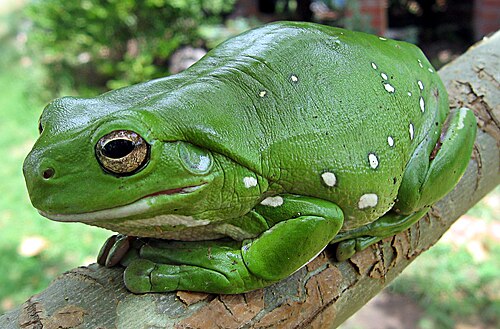
The Australian green tree frog (Pelodryas caerulea), also known as simply green tree frog in Australia, White's tree frog, or dumpy tree frog, is a species of tree frog native to Australia and New Guinea, with introduced populations in the United States and New Zealand, though the latter is believed to have died out. It is morphologically similar to some other members of its family, particularly the magnificent tree frog (P. splendida) and the white-lipped tree frog (Sandyrana infrafrenata).

Larger than most Australian frogs, the Australian green tree frog reaches 10 cm (4 in) or more in length. Its average lifespan in captivity, about 16 years, is long compared with most frogs. Docile and well suited to living near human dwellings, Australian green tree frogs are often found on window sills or inside houses, eating insects drawn by the light. The green tree frog screams when it is in danger to scare off its foe, and squeaks when it is touched.

Due to its appearance and behavioural traits, the green tree frog is a popular exotic pet throughout the world. The skin secretions of the frog have antibacterial and antiviral properties that may prove useful in pharmaceutical preparations and which have rendered it relatively immune to the population declines being experienced by many species of amphibian. It is a common species and the International Union for Conservation of Nature has assessed its conservation status as being "least concern". Wikipedia →
Sounds

Advertisement call0:57

Australia · 2020

© Marc Anderson · XC1103865 · CC BY-NC-ND 4.0

Uncertain0:19

Australia · 2021

© James Lambert · XC696610 · CC BY-NC-ND 4.0

Advertisement call0:10

Australia · 2015

© Chris Harrison · XC890479 · CC BY-NC-SA 4.0

Global Distribution

Parks Where Found

# Park Country Daily sighting probability
1 Kakadu National Park 🇦🇺 Australia
~30%
2 Springbrook National Park 🇦🇺 Australia
~20%
3 Noosa National Park 🇦🇺 Australia
~20%
4 Lamington National Park 🇦🇺 Australia
~20%

Cities Where Found

# City Country Daily sighting probability
1 Brisbane 🇦🇺 Australia
~20%
2 Sydney 🇦🇺 Australia
~10%

Before you go

What are the chances of seeing a Ranoidea caerulea in Sydney?

With luck

About 10% of wildlife watchers report a Ranoidea caerulea sighting in Sydney on a given day, based on 48 verified sightings from GBIF citizen-science data. It is the 7th most-seen of the 8 amphibians we can rate there. Over three days the chance rises to about 20%, and over a week to about 30%, if each day is a fresh chance.

When is the best time to see a Ranoidea caerulea in Sydney?

October to May

In those months about 10% of wildlife watchers report a Ranoidea caerulea in Sydney on a given day, against under 5% in June to September, the lowest months.

What time of day is best to see a Ranoidea caerulea?

Between 7 and 10 pm

Across all the parks we cover, that three-hour window holds the most Ranoidea caerulea sightings with a recorded time, and about 8 in 10 of them come between 6 pm and 6 am: it is mostly seen at night.

Is Sydney the best place to see a Ranoidea caerulea?

2nd of 2

Of the 2 cities where we can rate Ranoidea caerulea sightings, Sydney ranks 2nd at about 10%. The best odds are in Brisbane (Australia, about 20%).

Which relatives of the Ranoidea caerulea live in Sydney?

Same genus: Ranoidea

The closest relatives of the Ranoidea caerulea that you can see in Sydney (genus Ranoidea) are Leaf Green Treefrog (about 10%) and Green-and-Golden Bell Frog (about 10%), with each one's daily chance of a sighting.

Where does the Ranoidea caerulea sighting chance come from?

GBIF citizen-science records

It is estimated from how often the Ranoidea caerulea is recorded against all the amphibians logged in Sydney (48 verified sightings), calibrated against known sighting rates. Figures are rounded to the nearest 10% because citizen-science data supports honest approximations, not decimals, and months with records from fewer than five people show "—". How it works.

← Back to Sydney