Many-banded Krait

Many-banded Krait

Bungarus multicinctus

Silhouette: Michael Scroggie, from original photograph by Gary M. Stolz, USFWS (original photograph in public domain). · PhyloPic

LCNTVUVulnerableENCR
Daily sighting probability ~10% · With luck
at Tainan

In 3 days ~30% in a week ~60%

10 Verified sightings at Tainan
August Best month
☀️ Diurnal When it's spotted

About the Many-banded Krait

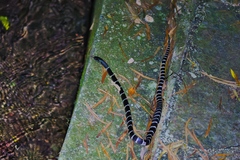
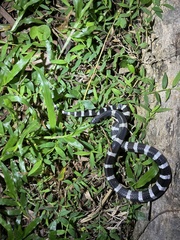
The many-banded krait (Bungarus multicinctus), also known as the Taiwanese krait or the Chinese krait, is an extremely venomous species of elapid snake found in much of central and southern China and Southeast Asia. The species was first described by the scientist Edward Blyth in 1861. Averaging 1 to 1.5 m (3.5 to 5 ft) in length, it is a black or bluish-black snake with many white bands across its body. The many-banded krait mostly inhabits marshy areas throughout its geographical distribution, though it does occur in other habitat types.

Zoologist and pharmacist Edward Blyth described the many-banded krait as a new species in 1861, noting that it had many more bands than the banded krait (Bungarus fasciatus). It still bears its original name Bungarus multicinctus. The generic name is a Latinisation of Telugu baṅgāru, "krait." The specific name multicinctus is derived from the Latin multi-, combining form of multus, "much, many", and Latin cinctus, past participle of cingere, "to encircle"—as in a "band". The common name "krait" is from Hindi (करैत karait), which is perhaps ultimately derived from the Sanskrit word (काल kāla), which means "black". It is also called as... Wikipedia →

Global Distribution

Parks Where Found

# Park Country Daily sighting probability

More parks will be added in future updates.

Cities Where Found

# City Country Daily sighting probability
1 Taichung 🇹🇼 Taiwan
~20%
2 Taipei 🇹🇼 Taiwan
~10%
3 Guangzhou 🇨🇳 China
~10%
4 Tainan 🇹🇼 Taiwan
~10%
5 Kaohsiung 🇹🇼 Taiwan
~10%
6 Hong Kong 🇨🇳 China
~10%
7 Tuen Mun 🇨🇳 China
~10%

Before you go

What are the chances of seeing a Many-banded Krait in Tainan?

With luck

About 10% of wildlife watchers report a Many-banded Krait sighting in Tainan on a given day, based on 10 verified sightings from GBIF citizen-science data. It is the 6th most-seen of the 11 reptiles we can rate there. Over three days the chance rises to about 30%, and over a week to about 60%, if each day is a fresh chance.

When is the best time to see a Many-banded Krait in Tainan?

August

In that month about 30% of wildlife watchers report a Many-banded Krait in Tainan on a given day, against under 5% in January, March–May and October, the lowest months. That is one of Tainan's wettest months, with about 440 mm of rain against 30 mm in February.

What time of day is best to see a Many-banded Krait?

Between 2 and 5 pm

Across all the parks we cover, that three-hour window holds the most Many-banded Krait sightings with a recorded time, and about 8 in 10 of them come between 6 am and 6 pm: it is a daytime animal.

Is Tainan the best place to see a Many-banded Krait?

4th of 7

Of the 7 cities where we can rate Many-banded Krait sightings, Tainan ranks 4th at about 10%. The best odds are in Taichung (Taiwan, about 20%), Taipei (Taiwan, about 10%) and Guangzhou (China, about 10%).

Where does the Many-banded Krait sighting chance come from?

GBIF citizen-science records

It is estimated from how often the Many-banded Krait is recorded against all the reptiles logged in Tainan (10 verified sightings), calibrated against known sighting rates. Figures are rounded to the nearest 10% because citizen-science data supports honest approximations, not decimals, and months with records from fewer than five people show "—". How it works.

← Back to Tainan