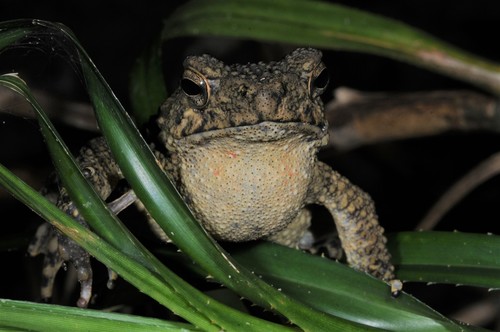
Crab-eating Frog

Crab-eating Frog

Fejervarya cancrivora

Silhouette: Jose Carlos Arenas-Monroy · PhyloPic

LCLeast ConcernNTVUENCR
Daily sighting probability ~20% · Possible
at Tasikmalaya

In 3 days ~60% in a week ~80%

8 Verified sightings at Tasikmalaya
20 In all 2 parks From 2019 to 2026
September Best month
🌙 Nocturnal When it's spotted

About the Crab-eating Frog

The crab-eating frog (Fejervarya cancrivora) is a frog native to south-eastern Asia including Taiwan, China, Sumatra in Indonesia, the Philippines and more rarely as far west as Orissa in India. It has also been introduced to Guam, most likely from Taiwan. It inhabits mangrove swamps and marshes and is one of 144 known modern amphibians which can tolerate brief excursions into seawater, and is possibly the only extant marine amphibian.

This frog can tolerate marine environments (immersion in sea water for brief periods or brackish water for extended periods) by increasing urea production and retention, and by remaining slightly hyperosmotic within urea and sodium flux. Adults can survive in salt water with salinity as high as 2.8%, and tadpoles can survive salinities as high as 3.9%.

The food sources of the crab-eating frog are mainly determined by the locally available prey. Near fresh water, its diet consists largely of insects. But in an environment with brackish water, small crustaceans, including crabs, form the main part.

In Southeast Asia, the crab-eating frog is locally hunted for food and is often farmed for its edible legs, including in... Wikipedia →

Sounds

Uncertain0:12

Singapore · 2026

© Joan Theng · XC1137281 · CC BY-NC-SA 4.0

Recording1:01

Singapore · 2024

© chugbug111 · iNaturalist · CC BY-NC 4.0

Recording0:14

Taiwan · 2022

© Edward Lin · iNaturalist · CC BY-NC 4.0

Global Distribution

Parks Where Found

# Park Country Daily sighting probability
1 Bako National Park 🇲🇾 Malaysia
~30%
2 Kinabatangan Wildlife Sanctuary 🇲🇾 Malaysia
~20%

Cities Where Found

# City Country Daily sighting probability
1 Makassar 🇮🇩 Indonesia
~50%
2 Bandar Lampung 🇮🇩 Indonesia
~30%
3 Jakarta 🇮🇩 Indonesia
~30%
4 Tasikmalaya 🇮🇩 Indonesia
~20%
5 Singapore 🇸🇬 Singapore
<5%

Before you go

What are the chances of seeing a Crab-eating Frog in Tasikmalaya?

Possible

About 20% of wildlife watchers report a Crab-eating Frog sighting in Tasikmalaya on a given day, based on 8 verified sightings from GBIF citizen-science data. It is the 6th most-seen of the 6 amphibians we can rate there. Over three days the chance rises to about 60%, and over a week to about 80%, if each day is a fresh chance.

When is the best time to see a Crab-eating Frog in Tasikmalaya?

September

In that month about 50% of wildlife watchers report a Crab-eating Frog in Tasikmalaya on a given day, against under 5% in April, June and December, the lowest months. That is one of Tasikmalaya's driest months, with about 110 mm of rain against 380 mm in December.

What time of day is best to see a Crab-eating Frog?

Between 7 and 10 pm

Across all the parks we cover, that three-hour window holds the most Crab-eating Frog sightings with a recorded time, and about 9 in 10 of them come between 6 pm and 6 am: it is mostly seen at night.

Is Tasikmalaya the best place to see a Crab-eating Frog?

4th of 5

Of the 5 cities where we can rate Crab-eating Frog sightings, Tasikmalaya ranks 4th at about 20%. The best odds are in Makassar (Indonesia, about 50%), Bandar Lampung (Indonesia, about 30%) and Jakarta (Indonesia, about 30%).

Where does the Crab-eating Frog sighting chance come from?

GBIF citizen-science records

It is estimated from how often the Crab-eating Frog is recorded against all the amphibians logged in Tasikmalaya (8 verified sightings), calibrated against known sighting rates. Figures are rounded to the nearest 10% because citizen-science data supports honest approximations, not decimals, and months with records from fewer than five people show "—". How it works.

← Back to Tasikmalaya