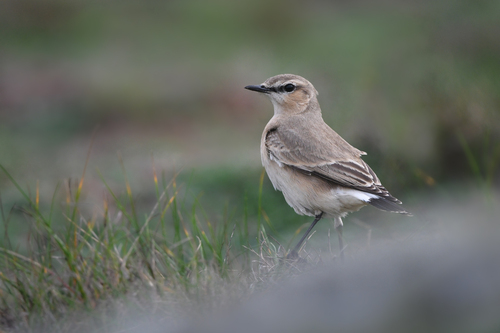
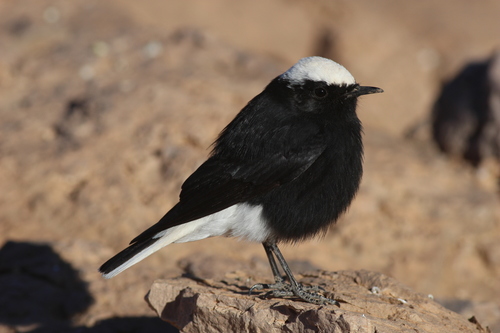
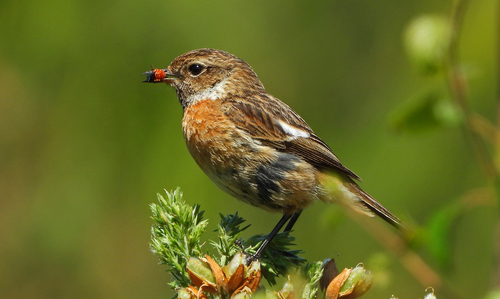
Cyprus Wheatear

Cyprus Wheatear

Oenanthe cypriaca

LCLeast ConcernNTVUENCR
Daily sighting probability <5% · Rare
at Tel Aviv

In 3 days <5%

32 Verified sightings at Tel Aviv
March Best month

About the Cyprus Wheatear

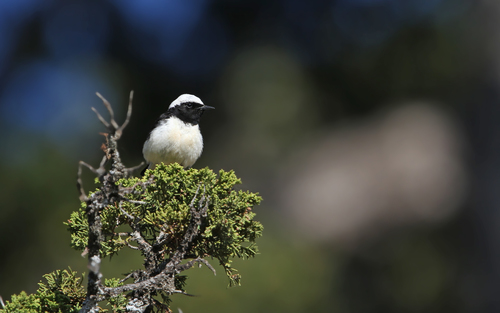
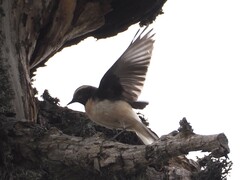
The Cyprus wheatear or Cyprus pied wheatear (Oenanthe cypriaca) is a small, 14–15 cm long passerine bird that was formerly classed as a member of the thrush family Turdidae, but is now more generally considered to be an Old World flycatcher, Muscicapidae. It was formerly treated as a subspecies (race) of pied wheatear but Sluys and van den Berg (1982) argued that the form deserved full species status, on the basis of differences in biometrics and especially song, and the lack of sexual plumage dimorphism in cypriaca.

This migratory insectivorous species breeds only in Cyprus, and winters in southern Sudan and Ethiopia. It has been recorded as a vagrant on Heligoland, Germany. This species closely resembles pied wheatear, although it has slightly more black on the tail and back, and on the head. The sexes are similar in appearance, a fact first documented by Christensen (1974). A 2010 study found that Cyprus wheatear differs from pied wheatear in fourteen external morphometric characters.

The song is distinctive, and very different from that of pied wheatear, resembling an insect. It consists of a series of high-pitched buzzing bursts. The song-perches utilised by this species are high for a wheatear, typically being 5 to 10 metres above ground. It often breeds in woodland habitats, unlike other wheatears (Oliver 1990 suggested that it occupies the ecological niche used elsewhere in the Western Palearctic by the common redstart). It is the most arboreal species of wheatear in the western palearctic and it uses often aerial sallying and perch-pounce-feeding tactics. Recent work suggest an ecological differentiation between Cyprus wheatear and migrating northern wheatears O. oenanthe and black-eared wheatears O. hispanica melanoleuca. Cyprus wheatear uses more aerial sallying and occupies more forested habitats, but needs a minimum amount of open/bare ground, and a minimum of high bush/tree vegetation (Randler et al. 2009). Wikipedia →
Sounds

Song0:26

Cyprus · 2025

© Alain Verneau · XC1049034 · CC BY-NC-SA 4.0

Alarm call0:31

Cyprus · 2018

© Julia Wittmann · XC422355 · CC BY-NC-SA 4.0

Song0:47

Cyprus · 2022

© Marcin Sołowiej · XC777930 · CC BY-NC-SA 4.0

Global Distribution

Parks Where Found

# Park Country Daily sighting probability

More parks will be added in future updates.

Cities Where Found

# City Country Daily sighting probability
1 Tel Aviv 🇮🇱 Israel
<5%

Before you go

What are the chances of seeing a Cyprus Wheatear in Tel Aviv?

Rare

Under 5% of wildlife watchers report a Cyprus Wheatear sighting in Tel Aviv on a given day, based on 32 verified sightings from GBIF citizen-science data. It is the 169th most-seen of the 232 birds we can rate there. Over three days the chance rises to under 5%, if each day is a fresh chance.

When is the best time to see a Cyprus Wheatear in Tel Aviv?

Any time of year

In every month with enough records, under 5% of wildlife watchers report a Cyprus Wheatear in Tel Aviv on a given day, so our monthly data shows no clear season.

Where else can you see a Cyprus Wheatear?

Only Tel Aviv, in our data

Tel Aviv is the only city on Wallace's Line with enough records to rate Cyprus Wheatear sightings: under 5% of wildlife watchers there report one on a given day.

Which relatives of the Cyprus Wheatear live in Tel Aviv?

Same genus: Oenanthe

The closest relatives of the Cyprus Wheatear that you can see in Tel Aviv (genus Oenanthe, Wheatears and Allies) are Northern Wheatear (about 10%) and Isabelline Wheatear (about 10%), with each one's daily chance of a sighting.

Where does the Cyprus Wheatear sighting chance come from?

GBIF citizen-science records

It is estimated from how often the Cyprus Wheatear is recorded against all the birds logged in Tel Aviv (32 verified sightings), calibrated against known sighting rates. Figures are rounded to the nearest 10% because citizen-science data supports honest approximations, not decimals, and months with records from fewer than five people show "—". How it works.

← Back to Tel Aviv