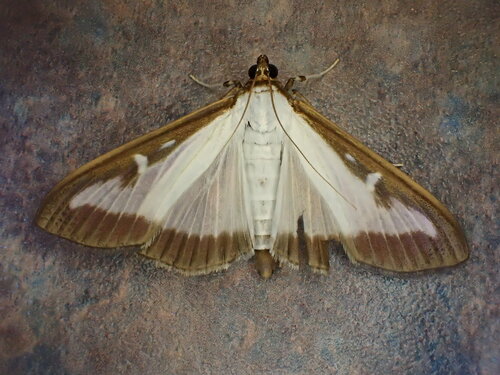
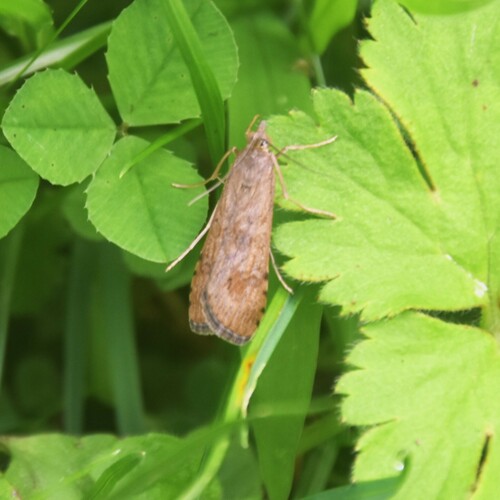
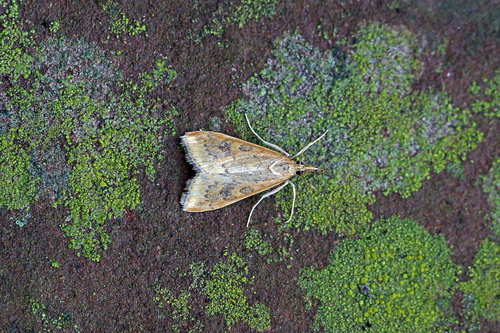
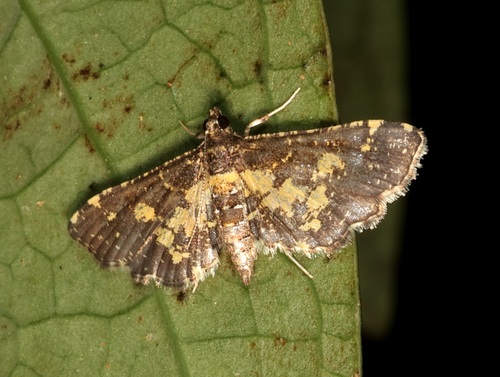
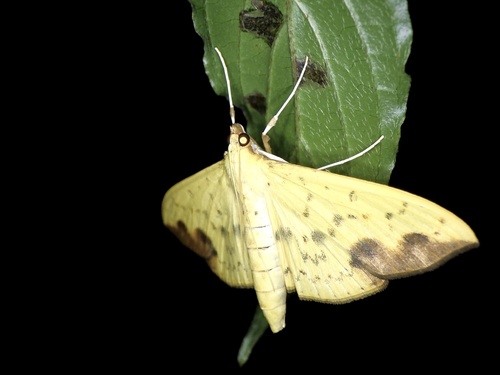
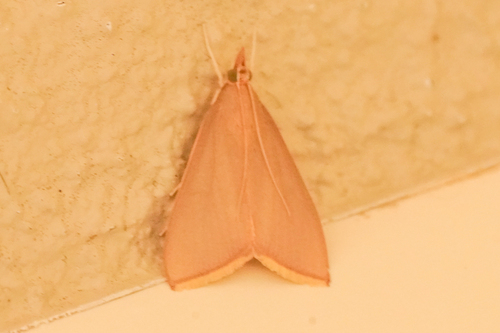
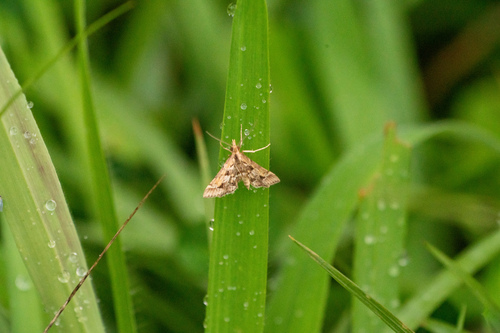
Crocidophora butleri silhouette

Silhouette: Andy Wilson · PhyloPic

Crocidophora butleri

Crocidophora butleri

Daily sighting probability <5% · Rare
at Tokyo

In 3 days ~10% in a week ~20%

11 Verified sightings at Tokyo
June Best month

About the Crocidophora butleri

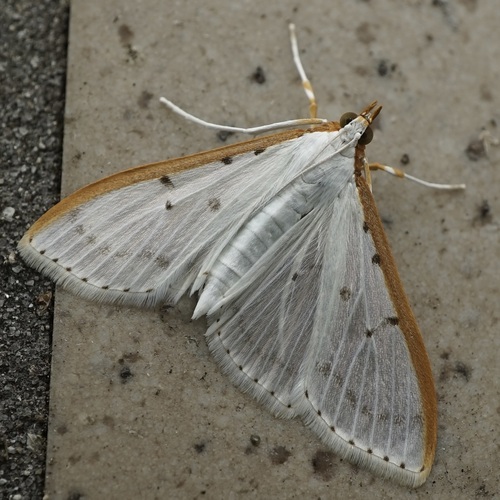
Sinibotys butleri is a snout moth in the subfamily Pyraustinae in the family Crambidae. It was described in the genus Crocidophora by Richard South in 1901 based on a single female imago collected in Ningbo in China's Zhejiang province. The species is sexually dimorphic, with females exhibiting shorter, less pointed forewings than the males. The imagines and genitalia of the species are illustrated in Lee et al. (2018).

The caterpillars feed on leaves of the bamboo species Phyllostachys edulis and P. nigra forma henonis in Japan. The species was originally described from China, and was later also recorded from Japan, specifically from Honshu. Lee et al. (2018) reported the species for the first time from Korea.

The species was apparently transported via larvae to a large-scale garden centre in Spain, from where it spread further over Europe. Caterpillars were subsequently reported from Belgium in 2013 and 2015, from the Netherlands in 2014, and from France in 2015, where it is now recorded from the departments of Gironde, Landes and Pyrénées-Atlantiques. The first German record is from June 2018 from Munich. Wikipedia →

Global Distribution

Parks Where Found

# Park Country Daily sighting probability

More parks will be added in future updates.

Cities Where Found

# City Country Daily sighting probability
1 Tokyo 🇯🇵 Japan
<5%

Before you go

What are the chances of seeing a Crocidophora butleri in Tokyo?

Rare

Under 5% of wildlife watchers report a Crocidophora butleri sighting in Tokyo on a given day, based on 11 verified sightings from GBIF citizen-science data. It is the 644th most-seen of the 1013 insects we can rate there. Over three days the chance rises to about 10%, and over a week to about 20%, if each day is a fresh chance.

When is the best time to see a Crocidophora butleri in Tokyo?

June

In that month about 10% of wildlife watchers report a Crocidophora butleri in Tokyo on a given day, against under 5% in July to May, the lowest months.

Where else can you see a Crocidophora butleri?

Only Tokyo, in our data

Tokyo is the only city on Wallace's Line with enough records to rate Crocidophora butleri sightings: under 5% of wildlife watchers there report one on a given day.

Which relatives of the Crocidophora butleri live in Tokyo?

Same family: Crambidae

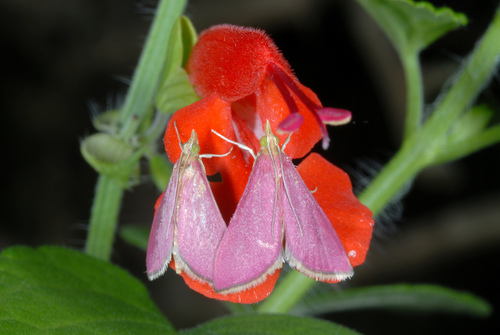
The closest relatives of the Crocidophora butleri that you can see in Tokyo (family Crambidae, Crambid Snout Moths) are Hawaiian Beet Webworm Moth (about 10%) and Lilac Pyralid (about 10%), with each one's daily chance of a sighting.

Where does the Crocidophora butleri sighting chance come from?

GBIF citizen-science records

It is estimated from how often the Crocidophora butleri is recorded against all the insects logged in Tokyo (11 verified sightings), calibrated against known sighting rates. Figures are rounded to the nearest 10% because citizen-science data supports honest approximations, not decimals, and months with records from fewer than five people show "—". How it works.

← Back to Tokyo