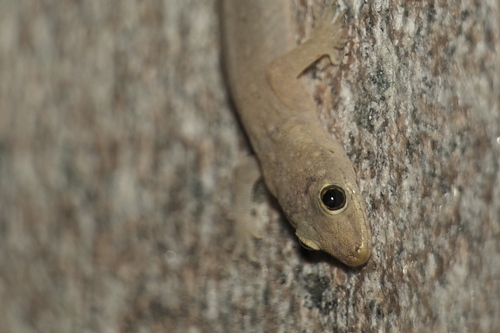
Oriental Leaf-toed Gecko

Oriental Leaf-toed Gecko

Hemidactylus bowringii

Silhouette: Andy Wilson · PhyloPic

LCLeast ConcernNTVUENCR
Daily sighting probability ~20% · Possible
at Tuen Mun

In 3 days ~50% in a week ~80%

49 Verified sightings at Tuen Mun
July Best month
🌙 Nocturnal When it's spotted

About the Oriental Leaf-toed Gecko

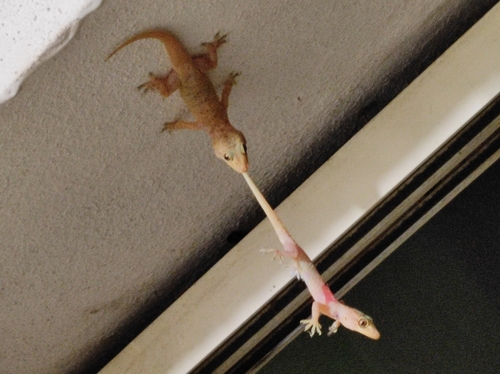
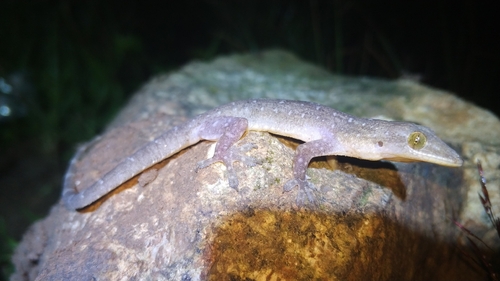
The Oriental leaf-toed gecko (Hemidactylus bowringii), also known commonly as the Asian smooth gecko, Bowring's gecko, Bowring's smooth gecko, and the Sikkimese dark-spotted gecko, is a species of lizard in the family Gekkonidae. The species is native to East Asia.

The specific name, bowringii, is in honor of either John Charles Bowring, who was a British amateur naturalist and businessman in Hong Kong, or his father John Bowring, who was a British diplomat and a governor of Hong Kong.

Boulenger (1885) described H. bowringii as follows: "Snout longer than the distance between the eye and the ear-opening, 1.4 times the diameter of the orbit; forehead slightly concave; ear-opening small, roundish. Body and limbs moderate; a slight fold of the skin along the flank. Digits free, moderately dilated, inner well developed; infradigital lamellae obliquely curved, 5 under the thumb, 7 or 8 under the fourth finger, 5 or 6 under the first toe, and 9 or 10 under the fourth toe. Upper surfaces covered with uniform small granular scales, largest on the snout, smallest on the occiput. Rostral four-sided, twice as broad as deep, with median cleft above; nostril pierced... Wikipedia →
Global Distribution

Parks Where Found

# Park Country Daily sighting probability

More parks will be added in future updates.

Cities Where Found

# City Country Daily sighting probability
1 Nanning 🇨🇳 China
~40%
2 Fuzhou 🇨🇳 China
~30%
3 Guangzhou 🇨🇳 China
~30%
4 Hong Kong 🇨🇳 China
~20%
5 Tuen Mun 🇨🇳 China
~20%
6 Xiamen City 🇨🇳 China
~20%
7 Taipei 🇹🇼 Taiwan
~10%
8 Zhuhai [Macau] 🇨🇳 China
~10%
9 Taichung 🇹🇼 Taiwan
~10%
10 Kaohsiung 🇹🇼 Taiwan
~10%

Before you go

What are the chances of seeing an Oriental Leaf-toed Gecko in Tuen Mun?

Possible

About 20% of wildlife watchers report an Oriental Leaf-toed Gecko sighting in Tuen Mun on a given day, based on 49 verified sightings from GBIF citizen-science data. It is the 3rd most-seen of the 21 reptiles we can rate there. Over three days the chance rises to about 50%, and over a week to about 80%, if each day is a fresh chance.

When is the best time to see an Oriental Leaf-toed Gecko in Tuen Mun?

July

In that month about 40% of wildlife watchers report an Oriental Leaf-toed Gecko in Tuen Mun on a given day, against under 5% in January, the lowest month. That is one of Tuen Mun's wettest months, with about 200 mm of rain against 20 mm in December.

What time of day is best to see an Oriental Leaf-toed Gecko?

Between 7 and 10 pm

Across all the parks we cover, that three-hour window holds the most Oriental Leaf-toed Gecko sightings with a recorded time, and about 9 in 10 of them come between 6 pm and 6 am: it is mostly seen at night.

Is Tuen Mun the best place to see an Oriental Leaf-toed Gecko?

5th of 10

Of the 10 cities where we can rate Oriental Leaf-toed Gecko sightings, Tuen Mun ranks 5th at about 20%. The best odds are in Nanning (China, about 40%), Fuzhou (China, about 30%) and Guangzhou (China, about 30%).

Which relatives of the Oriental Leaf-toed Gecko live in Tuen Mun?

Same genus: Hemidactylus

The closest relatives of the Oriental Leaf-toed Gecko that you can see in Tuen Mun (genus Hemidactylus, House Geckos) are Brooke's House Gecko (about 20%) and Garnot's House Gecko (about 10%), with each one's daily chance of a sighting.

Where does the Oriental Leaf-toed Gecko sighting chance come from?

GBIF citizen-science records

It is estimated from how often the Oriental Leaf-toed Gecko is recorded against all the reptiles logged in Tuen Mun (49 verified sightings), calibrated against known sighting rates. Figures are rounded to the nearest 10% because citizen-science data supports honest approximations, not decimals, and months with records from fewer than five people show "—". How it works.

← Back to Tuen Mun