American Shrew-mole

American Shrew-mole

Neurotrichus gibbsii

Silhouette: T. Michael Keesey · PhyloPic

LCLeast ConcernNTVUENCR
Daily sighting probability <5% · Rare
at Vancouver

In 3 days ~10% in a week ~30%

34 Verified sightings at Vancouver
35 In all 2 parks From 2019 to 2026
June Best month
☀️ Diurnal When it's spotted

About the American Shrew-mole

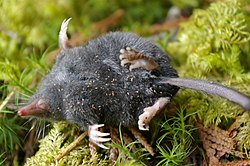
The American shrew mole (Neurotrichus gibbsii) is the smallest species of mole. It is the only living member of the genus Neurotrichus and the tribe Neurotrichini. It is also known as Gibb's shrew mole and least shrew mole. It is not closely related to the Asian shrew mole (Uropsilus in Urotrichini). Its shrew-like fur and typical mole head make the common name "shrew mole" fitting.

It is found in damp, forested or bushy areas with deep, loose soils in the northwestern United States and southwestern British Columbia. In the most northern part of its habitat, it lives along streams or moist dense woods and in the most southern part of its habitat, it is found in swampy areas that are overgrown with vegetation such as sedges or shrubs.

Like shrews, it has a pelage with guard hairs and underfur. Its fur is dense and soft. The color ranges from dark gray to a sooty bluish-black. Its tail is about half the length of its head and body. Its tail is also covered with scales and scattered coarse hairs. It has a long, flattened snout, and a short but thick, bristled tail. It is the smallest of the American moles. It is about 10 cm (3.9 in) in length... Wikipedia →

Global Distribution

Parks Where Found

# Park Country Daily sighting probability
1 Redwood National Park 🇺🇸 United States
~20%
2 Olympic National Park 🇺🇸 United States
<5%

Cities Where Found

# City Country Daily sighting probability
1 Seattle 🇺🇸 United States
~10%
2 Portland 🇺🇸 United States
~10%
3 Vancouver 🇨🇦 Canada
<5%

Before you go

What are the chances of seeing an American Shrew-mole in Vancouver?

Rare

Under 5% of wildlife watchers report an American Shrew-mole sighting in Vancouver on a given day, based on 34 verified sightings from GBIF citizen-science data. It is the 19th most-seen of the 28 mammals we can rate there. Over three days the chance rises to about 10%, and over a week to about 30%, if each day is a fresh chance.

When is the best time to see an American Shrew-mole in Vancouver?

April and June–September

In those months about 10% of wildlife watchers report an American Shrew-mole in Vancouver on a given day, against under 5% in May and October–March, the lowest months. Those are among Vancouver's driest months, with about 55 mm of rain a month against 210 mm in November.

What time of day is best to see an American Shrew-mole?

Between 9 am and noon

Across all the parks we cover, that three-hour window holds the most American Shrew-mole sightings with a recorded time, and about 9 in 10 of them come between 6 am and 6 pm: it is a daytime animal.

Is Vancouver the best place to see an American Shrew-mole?

3rd of 3

Of the 3 cities where we can rate American Shrew-mole sightings, Vancouver ranks 3rd at under 5%. The best odds are in Seattle (United States, about 10%) and Portland (United States, about 10%).

Where does the American Shrew-mole sighting chance come from?

GBIF citizen-science records

It is estimated from how often the American Shrew-mole is recorded against all the mammals logged in Vancouver (34 verified sightings), calibrated against known sighting rates. Figures are rounded to the nearest 10% because citizen-science data supports honest approximations, not decimals, and months with records from fewer than five people show "—". How it works.

← Back to Vancouver