Rough-skinned Newt

Rough-skinned Newt

Taricha granulosa

Silhouette: Neil Kelley · PhyloPic

LCLeast ConcernNTVUENCR
Daily sighting probability <5% · Rare
at Vancouver

In 3 days ~10% in a week ~20%

15 Verified sightings at Vancouver
351 In all 4 parks From 2019 to 2026
October Best month
☀️ Diurnal When it's spotted

About the Rough-skinned Newt

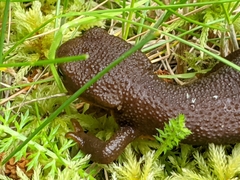
The rough-skinned newt or roughskin newt (Taricha granulosa) is a North American newt known for the strong toxin exuded from its skin. A stocky newt with rounded snout, it ranges from light brown to olive or brownish-black on top, with the underside, including the head, legs, and tail, a contrasting orange to yellow. The skin is granular, but males are smooth-skinned during breeding season. They measure 6 to 9 cm (2.4 to 3.5 in) in snout-to-vent length, and 11 to 18 cm (4.3 to 7.1 in) overall. They are similar to the California newt (Taricha torosa) but differ in having smaller eyes, yellow irises, V-shaped tooth patterns, and uniformly dark eyelids. Males can be distinguished from females during breeding season by large swollen vent lobes and cornified toe pads.

Rough-skinned newts are found throughout the Pacific Northwest. Their range extends south to Santa Cruz, California, and north to Alaska. They are uncommon east of the Cascade Mountains, though occasionally are found (and considered exotic, and possibly artificially introduced) as far as Montana. One isolated population lives in several ponds just north of Moscow, Idaho, and... Wikipedia →

Global Distribution

Parks Where Found

# Park Country Daily sighting probability
1 Redwood National Park 🇺🇸 United States
~40%
2 Olympic National Park 🇺🇸 United States
~20%
3 Great Bear Rainforest 🇨🇦 Canada
~20%
4 Pacific Rim National Park Reserve 🇨🇦 Canada
~10%

Cities Where Found

# City Country Daily sighting probability
1 Portland 🇺🇸 United States
~10%
2 Seattle 🇺🇸 United States
<5%
3 Vancouver 🇨🇦 Canada
<5%
4 San Francisco 🇺🇸 United States
<5%

Zoos & Centres Where Found

# Zoo / Centre Country
1 Northwest Trek Wildlife Park 🇺🇸 United States In captivity
2 Oregon Zoo 🇺🇸 United States In captivity
3 British Columbia Wildlife Park 🇨🇦 Canada In captivity
4 Vancouver Aquarium 🇨🇦 Canada In captivity
5 Aquário Vasco da Gama 🇵🇹 Portugal In captivity
6 Aquarium of the Bay 🇺🇸 United States In captivity

Before you go

What are the chances of seeing a Rough-skinned Newt in Vancouver?

Rare

Under 5% of wildlife watchers report a Rough-skinned Newt sighting in Vancouver on a given day, based on 15 verified sightings from GBIF citizen-science data. It is the 10th most-seen of the 11 amphibians we can rate there. Over three days the chance rises to about 10%, and over a week to about 20%, if each day is a fresh chance.

When is the best time to see a Rough-skinned Newt in Vancouver?

October

In that month about 10% of wildlife watchers report a Rough-skinned Newt in Vancouver on a given day, against under 5% in November to September, the lowest months.

What time of day is best to see a Rough-skinned Newt?

Between 7 and 10 am

Across all the parks we cover, that three-hour window holds the most Rough-skinned Newt sightings with a recorded time, and about 8 in 10 of them come between 6 am and 6 pm: it is a daytime animal.

Is Vancouver the best place to see a Rough-skinned Newt?

3rd of 4

Of the 4 cities where we can rate Rough-skinned Newt sightings, Vancouver ranks 3rd at under 5%. The best odds are in Portland (United States, about 10%) and Seattle (United States, under 5%).

Which relatives of the Rough-skinned Newt live in Vancouver?

Same order: Caudata

The closest relatives of the Rough-skinned Newt that you can see in Vancouver (order Caudata, Salamanders) are Northwestern Salamander (about 10%), Ensatina (about 10%) and Western Red-backed Salamander (about 10%), with each one's daily chance of a sighting.

Where does the Rough-skinned Newt sighting chance come from?

GBIF citizen-science records

It is estimated from how often the Rough-skinned Newt is recorded against all the amphibians logged in Vancouver (15 verified sightings), calibrated against known sighting rates. Figures are rounded to the nearest 10% because citizen-science data supports honest approximations, not decimals, and months with records from fewer than five people show "—". How it works.

← Back to Vancouver