About the Falcate Orangetip
Anthocharis midea, the falcate orangetip, is a North American butterfly that was described in 1809 by Jacob Hübner. It belongs to the family Pieridae, which is the white and sulphurs. These butterflies are mostly seen in the eastern United States, and in Texas and Oklahoma. They eat the nectar of violets and mustards. They tend to live in open, wet woods along waterways, in open swamps, and less often in dry woods and ridgetops. This species is a true springtime butterfly, being on the wing from April to May (March to May in southern Texas).
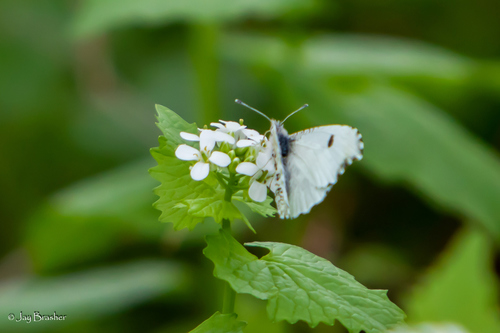
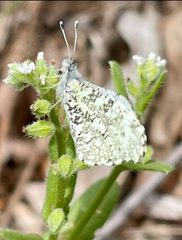
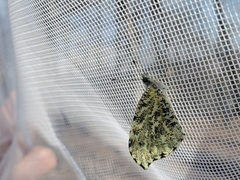
The tip of the upper side of the male's forewing is orange; females, however, lack this. Both have a round black spot located in the cell. The underside of the hindwing usually has intricate green marbling. The orangetips have a wingspan of around 3.5-4.5 centimeters.
The only similar species in the falcate orangetip's range is the Olympia marble (Euchloe olympia). The upper side of the Olympia marble's forewing has a grayish-black apex and the underside of the hindwing has yellow-green marbling.
Males patrol hilltops and flats all day seeking females. Females lay their eggs singly on... Wikipedia →