
Northern Red-bellied Cooter

Northern Red-bellied Cooter

Pseudemys rubriventris

Silhouette: SeismicShrimp · PhyloPic

LCNTNear ThreatenedVUENCR Endemic
Daily sighting probability ~20% · Possible
at Washington

In 3 days ~40% in a week ~70%

890 Verified sightings at Washington
10 In 1 park From 2019 to 2026
June Best month
☀️ Diurnal When it's spotted

About the Northern Red-bellied Cooter

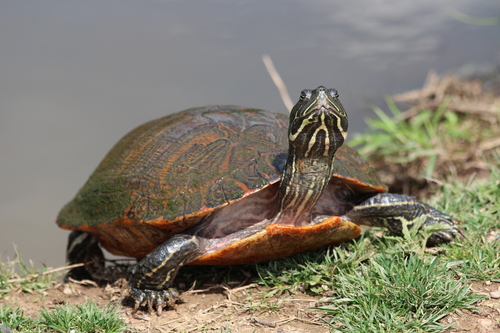
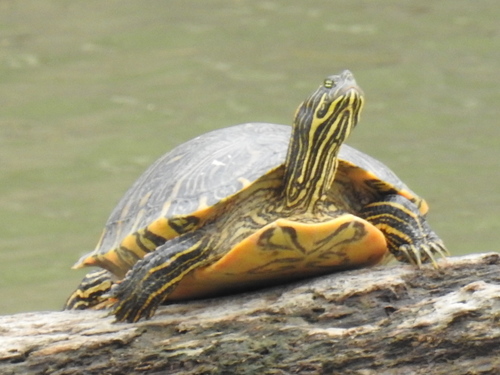
The northern red-bellied turtle (Pseudemys rubriventris) or American red-bellied turtle is a species of turtle in the Pseudemys (cooter) genus of the family Emydidae. This is a fairly large river turtle. Females average about 30 cm (12 in) in length and weigh on average around 3 kg (6.6 lb), although large females can measure up to 40 cm (16 in). Males' maximum size is 29.5 centimetres (11.6 in). The northern red-bellied turtle is the largest recorded basking turtle in the Chesapeake Bay region.

It is endemic to the United States. The current range of the red-bellied turtle includes a population in Massachusetts, the Plymouth red-bellied turtle, which was previously considered a distinct subspecies (Pseudemys rubriventris bangsi) as well as the coastal areas of New Jersey, Pennsylvania, Delaware, Maryland, Virginia and North Carolina.

The red-bellied turtle has appeared on Pennsylvania Fish and Boat Commission lists of endangered amphibians and reptiles since 1978 (McCoy 1985). Small (less than thirty individuals... Wikipedia →

Global Distribution

Parks Where Found

# Park Country Daily sighting probability
1 Shenandoah National Park 🇺🇸 United States
~10%

More parks will be added in future updates.

Cities Where Found

# City Country Daily sighting probability
1 Washington 🇺🇸 United States
~20%
2 Philadelphia 🇺🇸 United States
~10%
3 Baltimore 🇺🇸 United States
~10%
4 New York City 🇺🇸 United States
<5%

Zoos & Centres Where Found

# Zoo / Centre Country
1 Detroit Zoo 🇺🇸 United States In captivity
2 Parque Municipal Summit 🇵🇦 Panama In captivity
3 Louisiana Purchase Gardens and Zoo 🇺🇸 United States In captivity
4 Virginia Zoological Park 🇺🇸 United States In captivity
5 Chattanooga Zoo at Warner Park 🇺🇸 United States In captivity
6 Central Park Zoo 🇺🇸 United States In captivity
7 Zoo Koki (Parque zoológico y botánico) 🇪🇸 Spain In captivity
8 WWI Memorial Park Zoo 🇺🇸 United States In captivity
9 North Carolina Aquarium on Roanoke Island 🇺🇸 United States In captivity
10 Heartwood Haven Animal Sanctuary 🇺🇸 United States In captivity

Before you go

What are the chances of seeing a Northern Red-bellied Cooter in Washington?

Possible

About 20% of wildlife watchers report a Northern Red-bellied Cooter sighting in Washington on a given day, based on 890 verified sightings from GBIF citizen-science data. It is the 9th most-seen of the 25 reptiles we can rate there. Over three days the chance rises to about 40%, and over a week to about 70%, if each day is a fresh chance.

When is the best time to see a Northern Red-bellied Cooter in Washington?

March to October

In those months about 20% of wildlife watchers report a Northern Red-bellied Cooter in Washington on a given day, against under 5% in January, the lowest month.

What time of day is best to see a Northern Red-bellied Cooter?

Between 9 am and noon

Across all the parks we cover, that three-hour window holds the most Northern Red-bellied Cooter sightings with a recorded time, and about 9 in 10 of them come between 6 am and 6 pm: it is a daytime animal.

Is Washington the best place to see a Northern Red-bellied Cooter?

Yes

Of the 4 cities where we can rate Northern Red-bellied Cooter sightings, Washington has the highest daily chance: about 20%. Next come Philadelphia (United States, about 10%) and Baltimore (United States, about 10%).

Where does the Northern Red-bellied Cooter sighting chance come from?

GBIF citizen-science records

It is estimated from how often the Northern Red-bellied Cooter is recorded against all the reptiles logged in Washington (890 verified sightings), calibrated against known sighting rates. Figures are rounded to the nearest 10% because citizen-science data supports honest approximations, not decimals, and months with records from fewer than five people show "—". How it works.

← Back to Washington