Collared Finchbill

Collared Finchbill

Spizixos semitorques

Silhouette: PhyloPic

LCLeast ConcernNTVUENCR
Daily sighting probability <5% · Rare
at Wenzhou

In 3 days ~10% in a week ~30%

6 Verified sightings at Wenzhou
289 In all 2 parks From 2019 to 2026
November Best month
☀️ Diurnal When it's spotted

About the Collared Finchbill

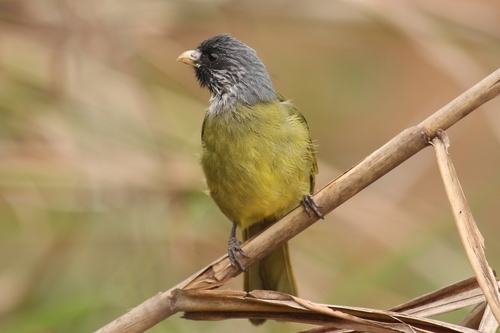
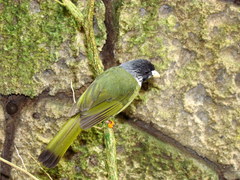
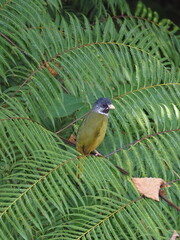
The collared finchbill (Spizixos semitorques) is a species of songbird in the bulbul family, Pycnonotidae. It is found in China, Taiwan, Japan and Vietnam. The species favors forested hills at moderate elevations. Primarily a frugivore, the collared finchbill also eats seeds and insects. The birds are typically monogamous, with females building nests in trees in which to lay their eggs.

They eat fruit, including Hedera nepalensis and Paederia scandens. Alternate names for the collared finchbill include the black-headed finch-bill, Chinese finch-bill, Japanese finch-bill, collared finch-billed bulbul and Swinhoe's finch-billed bulbul.

Found in Taiwan and Miyako and Yaeyama Islands of Japan Wikipedia →

Sounds

Song0:10

China · 2026

© Albert Lastukhin · XC1138608 · CC BY-NC-ND 4.0

Call0:26

China · 2024

© Peter Boesman · XC916614 · CC BY-NC-ND 4.0

Alarm call0:18

China · 2022

© He Wenjin/文进 · XC771861 · CC BY-NC-SA 4.0

Global Distribution

Parks Where Found

# Park Country Daily sighting probability
1 Taroko National Park 🇹🇼 Taiwan
~10%
2 Jiuzhaigou National Park 🇨🇳 China
~10%

Cities Where Found

# City Country Daily sighting probability
1 Guiyang 🇨🇳 China
~90%
2 Chongqing 🇨🇳 China
~30%
3 Changsha 🇨🇳 China
~20%
4 Wuhan 🇨🇳 China
~10%
5 Nanchang 🇨🇳 China
~10%
6 Nanjing 🇨🇳 China
~10%
7 Chengdu 🇨🇳 China
~10%
8 Hefei 🇨🇳 China
~10%
9 Hangzhou 🇨🇳 China
~10%
10 Xi'an 🇨🇳 China
~10%

Zoos & Centres Where Found

# Zoo / Centre Country
1 Disney's Animal Kingdom 🇺🇸 United States In captivity
2 San Diego Zoo 🇺🇸 United States In captivity
3 Zoo Miami 🇺🇸 United States In captivity
4 Brookfield Zoo 🇺🇸 United States In captivity
5 Beijing Zoo 🇨🇳 China In captivity
6 Sedgwick County Zoo 🇺🇸 United States In captivity
7 Chester Zoo 🇬🇧 United Kingdom In captivity
8 Philadelphia Zoo 🇺🇸 United States In captivity
9 Lincoln Park Zoo 🇺🇸 United States In captivity
10 Bird Kingdom 🇨🇦 Canada In captivity

Before you go

What are the chances of seeing a Collared Finchbill in Wenzhou?

Rare

Under 5% of wildlife watchers report a Collared Finchbill sighting in Wenzhou on a given day, based on 6 verified sightings from GBIF citizen-science data. It is the 39th most-seen of the 50 birds we can rate there. Over three days the chance rises to about 10%, and over a week to about 30%, if each day is a fresh chance.

When is the best time to see a Collared Finchbill in Wenzhou?

November

In that month about 20% of wildlife watchers report a Collared Finchbill in Wenzhou on a given day, against under 5% in March–June, August–October and December–January, the lowest months. July has too few records to rate.

What time of day is best to see a Collared Finchbill?

Between 3 and 6 pm

Across all the parks we cover, that three-hour window holds the most Collared Finchbill sightings with a recorded time, and about 9 in 10 of them come between 6 am and 6 pm: it is a daytime animal.

Is Wenzhou the best place to see a Collared Finchbill?

12th of 17

Of the 17 cities where we can rate Collared Finchbill sightings, Wenzhou ranks 12th at under 5%. The best odds are in Guiyang (China, about 90%), Chongqing (China, about 30%) and Changsha (China, about 20%).

Which relatives of the Collared Finchbill live in Wenzhou?

Same family: Pycnonotidae

The closest relatives of the Collared Finchbill that you can see in Wenzhou (family Pycnonotidae, Bulbuls) are Light-vented Bulbul (about 30%) and Black Bulbul (about 20%), with each one's daily chance of a sighting.

Where does the Collared Finchbill sighting chance come from?

GBIF citizen-science records

It is estimated from how often the Collared Finchbill is recorded against all the birds logged in Wenzhou (6 verified sightings), calibrated against known sighting rates. Figures are rounded to the nearest 10% because citizen-science data supports honest approximations, not decimals, and months with records from fewer than five people show "—". How it works.

← Back to Wenzhou