Titan Stag Beetle

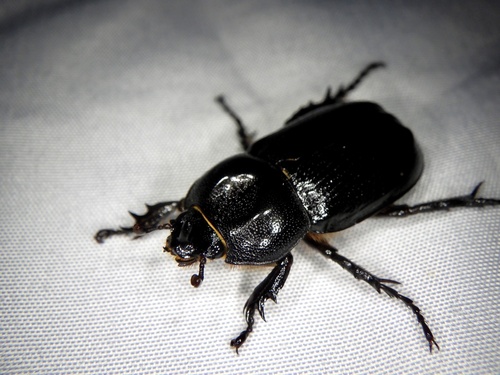
Titan Stag Beetle

Serrognathus titanus

Daily sighting probability ~20% · Possible
at Wuhan

In 3 days ~40% in a week ~70%

12 Verified sightings at Wuhan
39 In all 3 parks From 2019 to 2026
September Best month
☀️ Diurnal When it's spotted

About the Titan Stag Beetle

Serrognathus titanus is a species of beetle in the family Lucanidae. It was described by Jean Baptiste Boisduval in 1835. Huang and Chen (2013) separated Serognathus from the genus Dorcus by representing morphological characters and DNA analysis.

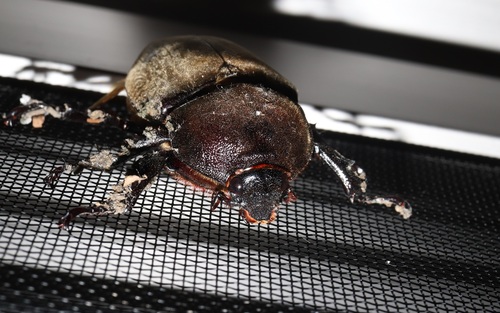
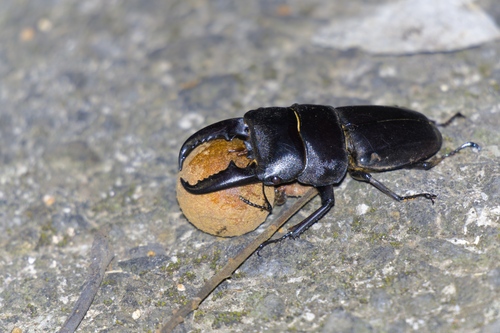
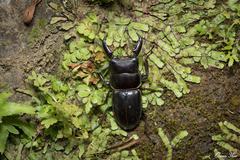
Males measure 32.0–111.3 millimetres (1.26–4.38 in) including mandibles; females 36.5–54 millimetres (1.44–2.13 in). It has an elongated, somewhat flat body dull black with blackish antennae and legs. Male's antler-like jaws have small teeth along inner edge and a pair of big teeth toward the bottom, and are forked at end. The head of a large male reaches nearly the length of its prothorax and abdomen combined.

Adults can be seen from May to August. They feed on tree juice, especially of Quercus species. Females lay eggs on the underground part of fallen oaks. The eggs hatch in about a month and the larvae feed on rotten wood. The larval period lasts about one year. The complete life cycle can last approximately from 1 to 2 years.

This species is widely distributed in Indonesia, the Philippines, Malaysia, Thailand, Vietnam, Laos, Myanmar, India, Japan, China, Taiwan and Korea. Wikipedia →
Global Distribution

Parks Where Found

# Park Country Daily sighting probability
1 Taroko National Park 🇹🇼 Taiwan
~20%
2 Khao Yai National Park 🇹🇭 Thailand
~10%
3 Kinabalu Park 🇲🇾 Malaysia
~10%

Cities Where Found

# City Country Daily sighting probability
1 Guiyang 🇨🇳 China
~50%
2 Chongqing 🇨🇳 China
~50%
3 Changzhou 🇨🇳 China
~40%
4 Chengdu 🇨🇳 China
~40%
5 Nanjing 🇨🇳 China
~30%
6 Taipei 🇹🇼 Taiwan
~30%
7 Busan 🇰🇷 South Korea
~30%
8 Shanghai 🇨🇳 China
~20%
9 Fuzhou 🇨🇳 China
~20%
10 Hangzhou 🇨🇳 China
~20%

Before you go

What are the chances of seeing a Titan Stag Beetle in Wuhan?

Possible

About 20% of wildlife watchers report a Titan Stag Beetle sighting in Wuhan on a given day, based on 12 verified sightings from GBIF citizen-science data. It is the 15th most-seen of the 62 insects we can rate there. Over three days the chance rises to about 40%, and over a week to about 70%, if each day is a fresh chance.

When is the best time to see a Titan Stag Beetle in Wuhan?

June–July and September

In those months about 30% of wildlife watchers report a Titan Stag Beetle in Wuhan on a given day, against under 5% in October to April, the lowest months. Those are among Wuhan's wettest months, with about 170 mm of rain a month against 35 mm in December.

What time of day is best to see a Titan Stag Beetle?

Between 7 and 10 am

Across all the parks we cover, that three-hour window holds the most Titan Stag Beetle sightings with a recorded time, and about 8 in 10 of them come between 6 am and 6 pm: it is a daytime animal.

Is Wuhan the best place to see a Titan Stag Beetle?

13th of 21

Of the 21 cities where we can rate Titan Stag Beetle sightings, Wuhan ranks 13th at about 20%. The best odds are in Guiyang (China, about 50%), Chongqing (China, about 50%) and Changzhou (China, about 40%).

Where does the Titan Stag Beetle sighting chance come from?

GBIF citizen-science records

It is estimated from how often the Titan Stag Beetle is recorded against all the insects logged in Wuhan (12 verified sightings), calibrated against known sighting rates. Figures are rounded to the nearest 10% because citizen-science data supports honest approximations, not decimals, and months with records from fewer than five people show "—". How it works.

← Back to Wuhan