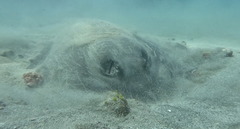
Longtail Stingray

Longtail Stingray

Hypanus longus

Silhouette: Eloisa Pinheiro Giareta · PhyloPic

Daily sighting probability ~40% · Likely
at Coiba National Park

In 3 days ~80% in a week >90%

14 Verified sightings at Coiba National Park From 2019 to 2026
28 In all 2 parks
February Best month
☀️ Diurnal When it's spotted

About the Longtail Stingray

The longtail stingray (Hypanus longus, often misspelled longa), is a species of stingray in the family Dasyatidae, found in the eastern Pacific Ocean from Baja California to Colombia. It inhabits sandy habitats down to a depth of 90 m (300 ft). Measuring up to 1.56 m (5.1 ft) across, this species has a rhomboid pectoral fin disc, a lower (but not upper) fin fold on the tail, and numerous dermal denticles along the back and behind the stinging spine. The longtail stingray feeds mainly on bottom-dwelling bony fishes and crustaceans. It is aplacental viviparous, with females giving birth to 1–5 young in late summer. It is caught for food, likely throughout its range, but specific fishery data is lacking.

American zoologist Samuel Garman published the original description of the longtail stingray in an 1880 issue of the scientific journal Bulletin of the Museum of Comparative Zoology. He gave it the name Trygon longa, in reference to the long tail, and designated a specimen from Acapulco, Mexico and another from Panama as the syntypes. Subsequent authors placed this species in the genus Dasyatis. A 2001 phylogenetic analysis by Lisa Rosenberger, based on morphological... Wikipedia →

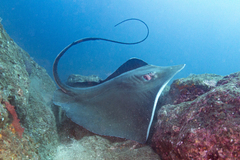
Global Distribution

Parks Where Found

# Park Country Daily sighting probability
1 Coiba National Park 🇵🇦 Panama
~40%
2 Machalilla National Park 🇪🇨 Ecuador
~40%

Zoos & Centres Where Found

# Zoo / Centre Country
1 Burgers' Ocean 🇳🇱 Netherlands In captivity
2 Royal Burgers' Zoo 🇳🇱 Netherlands In captivity
3 Aquarium Barcelona 🇪🇸 Spain In captivity
4 Acuario Michin Guadalajara 🇲🇽 Mexico In captivity
5 Grandview Mall Aquarium 🇨🇳 China In captivity
6 Ocean Park Hong Kong 🇨🇳 China In captivity

Before you go

What are the chances of seeing a Longtail Stingray in Coiba National Park?

Likely

About 40% of wildlife watchers report a Longtail Stingray sighting in Coiba National Park on a given day, based on 14 verified sightings from GBIF citizen-science data from 2019 to 2026. It is the 3rd most-seen of the 5 sharks and rays we can rate there. Over three days the chance rises to about 80%, and over a week to over 90%, if each day is a fresh chance.

When is the best time to see a Longtail Stingray in Coiba National Park?

February

In that month about 80% of wildlife watchers report a Longtail Stingray in Coiba National Park on a given day, against about 20% in May, July and November–December, the lowest months. That is one of Coiba National Park's driest months, with about 35 mm of rain against 590 mm in November. June and September–October have too few records to rate.

What time of day is best to see a Longtail Stingray?

Between 9 am and noon

Across all the parks we cover, that three-hour window holds the most Longtail Stingray sightings with a recorded time, and about 8 in 10 of them come between 6 am and 6 pm: it is a daytime animal.

Is Coiba National Park the best place to see a Longtail Stingray?

Yes

Of the 2 parks where we can rate Longtail Stingray sightings, Coiba National Park has the highest daily chance: about 40%. Next come Machalilla National Park (Ecuador, about 40%).

Which relatives of the Longtail Stingray live in Coiba National Park?

Same order: Myliobatiformes

The closest relatives of the Longtail Stingray that you can see in Coiba National Park (order Myliobatiformes, Stingrays) are Leopard Round Ray (about 60%) and Pacific Eagle Ray (about 40%), with each one's daily chance of a sighting.

Where does the Longtail Stingray sighting chance come from?

GBIF citizen-science records

It is estimated from how often the Longtail Stingray is recorded against all the sharks and rays logged in Coiba National Park (14 verified sightings from 2019 to 2026), calibrated against known sighting rates. Figures are rounded to the nearest 10% because citizen-science data supports honest approximations, not decimals, and months with records from fewer than five people show "—". How it works.

← Back to Coiba National Park