Thomas's Shaggy Bat

Thomas's Shaggy Bat

Centronycteris centralis

Silhouette: T. Michael Keesey · PhyloPic

LCLeast ConcernNTVUENCR
Daily sighting probability ~10% · With luck
at Corcovado National Park

In 3 days ~30% in a week ~60%

11 Verified sightings at Corcovado National Park From 2019 to 2026
18 In all 2 parks
March Best month
☀️ Diurnal When it's spotted

About the Thomas's Shaggy Bat

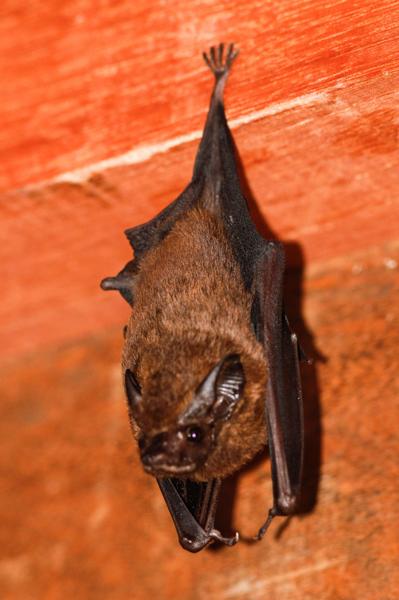
The Thomas's shaggy bat (Centronycteris centralis) is a bat species from Central and South America. It was previously included in the shaggy bat but Simmons and Handley (1998) showed that the species were distinct. It was described as a new species in 1912 by British mammalogist Oldfield Thomas. The holotype had been collected by H. J. Watson in 1898 in Panama. Its species name "centralis" is Latin for "in the middle."

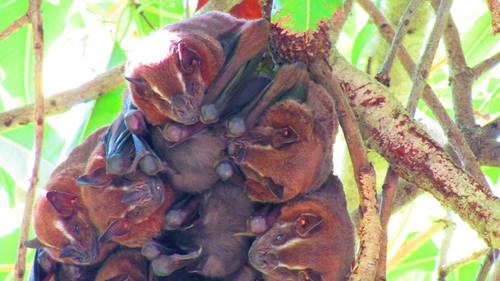
The fur of its back is gray while the fur around its eyes and near its uropatagium is reddish. Its ventral fur is yellowish. Despite being in the sac-winged bat family, it lacks wing sacs. It is a small species, with individuals weighing only 4–6 g (0.14–0.21 oz). Its forearm length is approximately 45 mm (1.8 in). Its dental formula is 1.1.2.33.1.2.3 for a total of 32 teeth.

It is nocturnal, roosting in sheltered places during the day such as hollow trees. It forages for its insect prey with a "slow and maneuverable" flight. It is usually found at low elevations of 0–300 m (0–984 ft) above sea level, but has been documented at up 1,450 m (4,760 ft).

It is found in Belize, Bolivia, Colombia, Costa Rica, Ecuador... Wikipedia →

Global Distribution

Parks Where Found

# Park Country Daily sighting probability
1 Corcovado National Park 🇨🇷 Costa Rica
~10%
2 Arenal Volcano National Park 🇨🇷 Costa Rica
~10%

Before you go

What are the chances of seeing a Thomas's Shaggy Bat in Corcovado National Park?

With luck

About 10% of wildlife watchers report a Thomas's Shaggy Bat sighting in Corcovado National Park on a given day, based on 11 verified sightings from GBIF citizen-science data from 2019 to 2026. It is the 19th most-seen of the 31 mammals we can rate there. Over three days the chance rises to about 30%, and over a week to about 60%, if each day is a fresh chance.

When is the best time to see a Thomas's Shaggy Bat in Corcovado National Park?

February to April

In those months about 20% of wildlife watchers report a Thomas's Shaggy Bat in Corcovado National Park on a given day, against under 5% in June to January, the lowest months. Those are among Corcovado National Park's driest months, with about 140 mm of rain a month against 770 mm in October.

What time of day is best to see a Thomas's Shaggy Bat?

Between 9 am and noon

Across all the parks we cover, that three-hour window holds the most Thomas's Shaggy Bat sightings with a recorded time, and about 9 in 10 of them come between 6 am and 6 pm: it is a daytime animal.

Is Corcovado National Park the best place to see a Thomas's Shaggy Bat?

Yes

Of the 2 parks where we can rate Thomas's Shaggy Bat sightings, Corcovado National Park has the highest daily chance: about 10%. Next come Arenal Volcano National Park (Costa Rica, about 10%).

Which relatives of the Thomas's Shaggy Bat live in Corcovado National Park?

Same family: Emballonuridae

The closest relatives of the Thomas's Shaggy Bat that you can see in Corcovado National Park (family Emballonuridae, Sheath-tailed Bats) are Chestnut Sac-winged Bat (about 10%), Proboscis Bat (about 10%) and Greater Sac-winged Bat (about 10%), with each one's daily chance of a sighting.

Where does the Thomas's Shaggy Bat sighting chance come from?

GBIF citizen-science records

It is estimated from how often the Thomas's Shaggy Bat is recorded against all the mammals logged in Corcovado National Park (11 verified sightings from 2019 to 2026), calibrated against known sighting rates. Figures are rounded to the nearest 10% because citizen-science data supports honest approximations, not decimals, and months with records from fewer than five people show "—". How it works.

← Back to Corcovado National Park