Alpine Coolskink

Alpine Coolskink

Carinascincus greeni

Silhouette: David Orr · PhyloPic

LCNTVUVulnerableENCR Endemic
Daily sighting probability ~30% · Possible
at Cradle Mountain-Lake St Clair National Park

In 3 days ~70% in a week ~90%

26 Verified sightings at Cradle Mountain-Lake St Clair National Park From 2019 to 2026
26 In 1 park
January Best month
🌙 Nocturnal When it's spotted

About the Alpine Coolskink

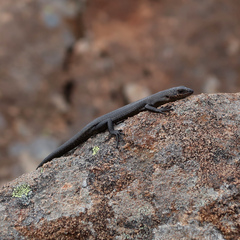
The alpine cool-skink (Carinascincus greeni), also known commonly as the northern snow skink, is a species of lizard in the subfamily Eugongylinae of the family Scincidae. It is endemic to Tasmania, Australia where it mainly occurs within the north of the state.

The specific name, greeni, is in honor of Tasmanian ornithologist Robert "Bob" Green. This species was previously known as Niveoscincus greeni, however it has been reclassified as Carinascincus, along with several other species from the genus Niveoscincus.

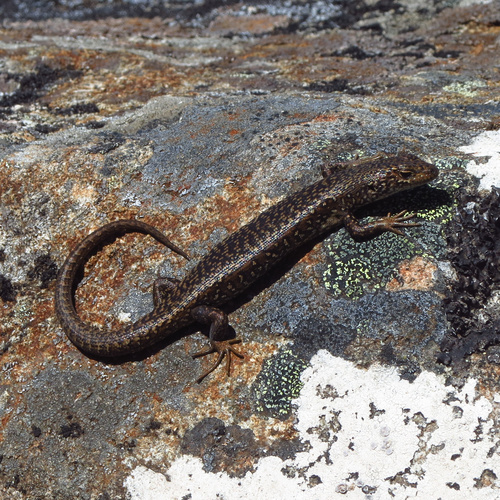
Carinascincus greeni is an alpine skink which has small dark scales with pale green to bronze spots. The head is sometimes paler than the body, with larger spots. C. greeni has been found to grow to a snout-to-vent length (SVL) of up to 7.5 cm (3.0 in), with midbody scales in 40–44 rows around the body.

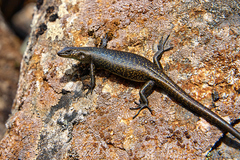
Carinascincus greeni is skink species endemic to alpine areas of Tasmania above 1,000 m (3,300 ft) of elevation. The species is mostly observed around Cradle Mountain and the central plateau, however it is found as far east as Ben Lomond National Park and as far south as Mt... Wikipedia →

Global Distribution

Parks Where Found

# Park Country Daily sighting probability
1 Cradle Mountain-Lake St Clair National Park 🇦🇺 Australia
~30%

More parks will be added in future updates.

Before you go

What are the chances of seeing an Alpine Coolskink in Cradle Mountain-Lake St Clair National Park?

Possible

About 30% of wildlife watchers report an Alpine Coolskink sighting in Cradle Mountain-Lake St Clair National Park on a given day, based on 26 verified sightings from GBIF citizen-science data from 2019 to 2026. It is the 5th most-seen of the 6 reptiles we can rate there. Over three days the chance rises to about 70%, and over a week to about 90%, if each day is a fresh chance.

When is the best time to see an Alpine Coolskink in Cradle Mountain-Lake St Clair National Park?

January

In that month about 50% of wildlife watchers report an Alpine Coolskink in Cradle Mountain-Lake St Clair National Park on a given day, against under 5% in May to November, the lowest months.

What time of day is best to see an Alpine Coolskink?

Between 2 and 5 am

Across all the parks we cover, that three-hour window holds the most Alpine Coolskink sightings with a recorded time, and about 9 in 10 of them come between 6 pm and 6 am: it is mostly seen at night.

Where else can you see an Alpine Coolskink?

Only Cradle Mountain-Lake St Clair National Park, in our data

Cradle Mountain-Lake St Clair National Park is the only park on Wallace's Line with enough records to rate Alpine Coolskink sightings: about 30% of wildlife watchers there report one on a given day.

Which relatives of the Alpine Coolskink live in Cradle Mountain-Lake St Clair National Park?

Same genus: Carinascincus

The closest relatives of the Alpine Coolskink that you can see in Cradle Mountain-Lake St Clair National Park (genus Carinascincus, Coolskinks) are Metallic Coolskink (about 80%), Ocellated Coolskink (about 40%) and Tasmanian Tree Skink (about 30%), with each one's daily chance of a sighting.

Where does the Alpine Coolskink sighting chance come from?

GBIF citizen-science records

It is estimated from how often the Alpine Coolskink is recorded against all the reptiles logged in Cradle Mountain-Lake St Clair National Park (26 verified sightings from 2019 to 2026), calibrated against known sighting rates. Figures are rounded to the nearest 10% because citizen-science data supports honest approximations, not decimals, and months with records from fewer than five people show "—". How it works.

← Back to Cradle Mountain-Lake St Clair National Park