Eastern Tiger Snake

Eastern Tiger Snake

Notechis scutatus

Silhouette: Michael Scroggie, from original photograph by Gary M. Stolz, USFWS (original photograph in public domain). · PhyloPic

LCLeast ConcernNTVUENCR Endemic
Daily sighting probability ~60% · Likely
at Cradle Mountain-Lake St Clair National Park

In 3 days ~90% in a week >90%

79 Verified sightings at Cradle Mountain-Lake St Clair National Park From 2019 to 2026
509 In all 11 parks
February Best month
☀️ Diurnal When it's spotted

About the Eastern Tiger Snake

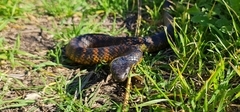
The tiger snake (Notechis scutatus) is a large and highly venomous snake of southern Australia, including its coastal islands and Tasmania. These snakes are often observed and locally well known by their banding, black and yellow like a tiger, although the species can be highly variable in colouration and patterning. All populations are classified within the genus Notechis (Elapidae). Their diverse characteristics have been classified either as distinct species or by subspecies and regional variation.

While tiger snakes are usually ground-dwelling, they are able to swim as well as climb into trees and buildings. The genus Notechis is in the elapid family, venomous snakes with fixed front fangs. The classification of this genus is given as a single and highly variable species, Notechis scutatus, or a second species Notechis ater, and by an arrangement of subspecies or regional morphs.

A 2016 genetic analysis showed that the closest relative of the tiger snakes is the rough-scaled snake (Tropidechis carinatus). Wikipedia →

Sounds

Recording0:03

Australia · 2023

© J E Nash · iNaturalist · CC BY-NC 4.0

Global Distribution

Parks Where Found

# Park Country Daily sighting probability
1 Cradle Mountain-Lake St Clair National Park 🇦🇺 Australia
~60%
2 Wilsons Promontory National Park 🇦🇺 Australia
~50%
3 Maria Island National Park 🇦🇺 Australia
~50%
4 Flinders Chase 🇦🇺 Australia
~40%
5 Great Otway National Park 🇦🇺 Australia
~30%
6 Freycinet National Park 🇦🇺 Australia
~30%
7 Lamington National Park 🇦🇺 Australia
~20%
8 Blue Mountains National Park 🇦🇺 Australia
~20%
9 Kosciuszko National Park 🇦🇺 Australia
~20%
10 Grampians National Park 🇦🇺 Australia
~20%
11 Royal National Park 🇦🇺 Australia
~10%

Cities Where Found

# City Country Daily sighting probability
1 Perth 🇦🇺 Australia
~10%
2 Melbourne 🇦🇺 Australia
~10%

Zoos & Centres Where Found

# Zoo / Centre Country
1 Australia Zoo 🇦🇺 Australia In captivity
2 Taronga Zoo 🇦🇺 Australia In captivity
3 Melbourne Zoo 🇦🇺 Australia In captivity
4 Perth Zoo 🇦🇺 Australia In captivity
5 East Coast Natureworld 🇦🇺 Australia In captivity
6 Moonlit Sanctuary Wildlife Conservation Park 🇦🇺 Australia In captivity
7 Sydney Zoo 🇦🇺 Australia In captivity
8 Touroparc Zoo 🇫🇷 France In captivity
9 Reptile Gardens 🇺🇸 United States In captivity
10 Australian Reptile Park 🇦🇺 Australia In captivity
11 Symbio Wildlife Park 🇦🇺 Australia In captivity
12 Featherdale Sydney Wildlife Park 🇦🇺 Australia In captivity
13 Bonorong Wildlife Sanctuary 🇦🇺 Australia In captivity
14 Sea Life Sydney Aquarium 🇦🇺 Australia In captivity
15 Wild Life Sydney 🇦🇺 Australia In captivity
16 Ranger Red’s Zoo & Conservation Park 🇦🇺 Australia In captivity

Before you go

What are the chances of seeing an Eastern Tiger Snake in Cradle Mountain-Lake St Clair National Park?

Likely

About 60% of wildlife watchers report an Eastern Tiger Snake sighting in Cradle Mountain-Lake St Clair National Park on a given day, based on 79 verified sightings from GBIF citizen-science data from 2019 to 2026. It is the 2nd most-seen of the 6 reptiles we can rate there. Over three days the chance rises to about 90%, and over a week to over 90%, if each day is a fresh chance.

When is the best time to see an Eastern Tiger Snake in Cradle Mountain-Lake St Clair National Park?

February

In that month about 80% of wildlife watchers report an Eastern Tiger Snake in Cradle Mountain-Lake St Clair National Park on a given day, against under 5% in May, July and September, the lowest months. That is one of Cradle Mountain-Lake St Clair National Park's driest months, with about 95 mm of rain against 240 mm in August.

What time of day is best to see an Eastern Tiger Snake?

Between noon and 3 pm

Across all the parks we cover, that three-hour window holds the most Eastern Tiger Snake sightings with a recorded time, and about 9 in 10 of them come between 6 am and 6 pm: it is a daytime animal.

Is Cradle Mountain-Lake St Clair National Park the best place to see an Eastern Tiger Snake?

Yes

Of the 11 parks where we can rate Eastern Tiger Snake sightings, Cradle Mountain-Lake St Clair National Park has the highest daily chance: about 60%. Next come Wilsons Promontory National Park (Australia, about 50%) and Maria Island National Park (Australia, about 50%). All parks ranked.

Where does the Eastern Tiger Snake sighting chance come from?

GBIF citizen-science records

It is estimated from how often the Eastern Tiger Snake is recorded against all the reptiles logged in Cradle Mountain-Lake St Clair National Park (79 verified sightings from 2019 to 2026), calibrated against known sighting rates. Figures are rounded to the nearest 10% because citizen-science data supports honest approximations, not decimals, and months with records from fewer than five people show "—". How it works.

← Back to Cradle Mountain-Lake St Clair National Park