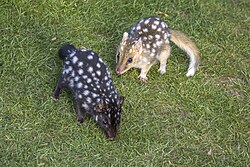
Eastern Quoll

Eastern Quoll

Dasyurus viverrinus

Silhouette: Sarah Werning · PhyloPic

LCNTVUENEndangeredCR Endemic
Daily sighting probability ~40% · Likely
at Cradle Mountain-Lake St Clair National Park

In 3 days ~70% in a week >90%

30 Verified sightings at Cradle Mountain-Lake St Clair National Park From 2019 to 2026
30 In 1 park
June Best month
☀️🌙 Day & Night When it's spotted

About the Eastern Quoll

The eastern quoll (Dasyurus viverrinus, formerly known as the eastern native cat) is a medium-sized, carnivorous marsupial (dasyurid), and one of six extant species of quolls. Endemic to Australia, they occur on the island state of Tasmania, but were considered extinct on the mainland after 1963. The species has been reintroduced to fox-proof fenced sanctuaries in Victoria in 2003 and to the Australian Capital Territory in 2016.

The eastern quoll is a member of the family Dasyuridae, which includes most carnivorous marsupials. Its species name, viverrinus, indicates it is "ferret-like". No subspecies are recognised. Eastern quolls are about the size of a small domestic cat, with adult males measuring 53 to 66 cm (21 to 26 in) in total length, including the 20 to 28 cm (7.9 to 11.0 in) tail, and having an average weight of 1.1 kg (2.4 lb). Females are significantly smaller, measuring 48 to 58 cm (19 to 23 in), including a 17 to 24 cm (6.7 to 9.4 in) tail, and weighing around 0.7 kg (1.5 lb). They have a tapering snout, short legs, and erect ears. They can be distinguished from all other species of quolls by the presence of only four toes, rather than... Wikipedia →

Global Distribution

Parks Where Found

# Park Country Daily sighting probability
1 Cradle Mountain-Lake St Clair National Park 🇦🇺 Australia
~40%

More parks will be added in future updates.

Zoos & Centres Where Found

# Zoo / Centre Country
1 La Torbiera 🇮🇹 Italy In captivity
2 Healesville Sanctuary 🇦🇺 Australia In captivity
3 Berlin Zoological Garden 🇩🇪 Germany In captivity
4 Faunia 🇪🇸 Spain In captivity
5 East Coast Natureworld 🇦🇺 Australia In captivity
6 Frankfurt Zoological Garden 🇩🇪 Germany In captivity
7 Sydney Zoo 🇦🇺 Australia In captivity
8 Bonorong Wildlife Sanctuary 🇦🇺 Australia In captivity
9 devils@cradle 🇦🇺 Australia In captivity
10 Sea Life Sydney Aquarium 🇦🇺 Australia In captivity
11 Wild Life Sydney 🇦🇺 Australia In captivity
12 Aquarium Berlin 🇩🇪 Germany In captivity
13 Trowunna Wildlife Park 🇦🇺 Australia In captivity
14 Wildlife HQ Zoo 🇦🇺 Australia In captivity

Before you go

What are the chances of seeing an Eastern Quoll in Cradle Mountain-Lake St Clair National Park?

Likely

About 40% of wildlife watchers report an Eastern Quoll sighting in Cradle Mountain-Lake St Clair National Park on a given day, based on 30 verified sightings from GBIF citizen-science data from 2019 to 2026. It is the 7th most-seen of the 9 mammals we can rate there. Over three days the chance rises to about 70%, and over a week to over 90%, if each day is a fresh chance.

When is the best time to see an Eastern Quoll in Cradle Mountain-Lake St Clair National Park?

January–February and June

In those months about 50% of wildlife watchers report an Eastern Quoll in Cradle Mountain-Lake St Clair National Park on a given day, against under 5% in May and July–September, the lowest months.

What time of day is best to see an Eastern Quoll?

Between 8 and 11 pm

Across all the parks we cover, that three-hour window holds the most Eastern Quoll sightings with a recorded time, and about 6 in 10 of them come between 6 pm and 6 am: it is seen both by day and at night.

Where else can you see an Eastern Quoll?

Only Cradle Mountain-Lake St Clair National Park, in our data

Cradle Mountain-Lake St Clair National Park is the only park on Wallace's Line with enough records to rate Eastern Quoll sightings: about 40% of wildlife watchers there report one on a given day.

Where does the Eastern Quoll sighting chance come from?

GBIF citizen-science records

It is estimated from how often the Eastern Quoll is recorded against all the mammals logged in Cradle Mountain-Lake St Clair National Park (30 verified sightings from 2019 to 2026), calibrated against known sighting rates. Figures are rounded to the nearest 10% because citizen-science data supports honest approximations, not decimals, and months with records from fewer than five people show "—". How it works.

← Back to Cradle Mountain-Lake St Clair National Park