




Completed


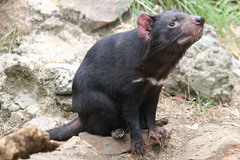


Tasmanian Devil
Sarcophilus harrisii
Silhouette: Sarah Werning · PhyloPic
- KingdomAnimalia (Animals)
- PhylumChordata (Chordates)
- ClassMammalia (Mammals)
- OrderDasyuromorphia (Carnivorous Marsupials)
- FamilyDasyuridae (Dasyurids)
- GenusSarcophilus (Devils)
- SpeciesSarcophilus harrisii (Tasmanian Devil)
In 3 days ~80% in a week >90%
29 Verified sightings at Cradle Mountain-Lake St Clair National Park From 2019 to 2026
92 In all 3 parks
July Best month
🌅 Crepuscular When it's spotted
About the Tasmanian Devil
The Tasmanian devil (Sarcophilus harrisii; palawa kani: purinina) is a carnivorous marsupial of the family Dasyuridae. It was formerly present across mainland Australia, but became extinct there around 3,500 years ago; it is now confined to the island of Tasmania. The size of a small dog, the Tasmanian devil became the largest carnivorous marsupial in the world following the extinction of the thylacine in 1936. It is related to quolls, and distantly related to the thylacine. It is characterised by its stocky and muscular build, black fur, pungent odour, extremely loud screech, keen sense of smell, and ferocity when feeding. The Tasmanian devil's large head and neck allow it to generate among the strongest bites per unit body mass of any extant predatory land mammal. It hunts prey and scavenges on carrion.
Although devils are usually solitary, they sometimes eat and defecate together in a communal location. Unlike most other dasyurids, the devil thermoregulates effectively, and is active during the middle of the day without overheating. Despite its rotund appearance, it is capable of surprising speed and endurance, and can climb trees and swim across rivers. Devils are not monogamous. Males fight one another for females, and guard their partners to prevent female infidelity. Females can ovulate three times in as many weeks during the mating season, and 80% of two-year-old females are seen to be pregnant during the annual mating season.
Females average four breeding seasons in their life, and give birth to 20 to 30 live young after three weeks' gestation. The newborn are pink, lack fur, have indistinct facial features, and weigh around 0.20 g (0.0071 oz) at birth. As there are only four nipples in the pouch, competition is fierce, and few newborns survive. The young grow rapidly, and are ejected from the pouch after around 100 days, weighing roughly 200 g (7.1 oz). The young become independent after around nine months.
In 1941, devils became officially protected. Since the late 1990s, devil facial tumour disease (DFTD) has drastically reduced the population and now threatens the survival of the species, which in 2008 was declared to be endangered. Starting in 2013, Tasmanian devils are again being sent to zoos around the world as part of the Australian government's Save the Tasmanian Devil Program. The devil is an iconic symbol of Tasmania and many organisations, groups and products associated with the state use the animal in their logos. Wikipedia →
Sounds
Call0:19
Australia · 2020
© Marc Anderson · XC959802 · CC BY-NC-ND 4.0
Recording0:10
Australia · 2025
© wellingtonpark · iNaturalist · CC BY-NC 4.0
Recent sightings of Tasmanian Devil in Cradle Mountain-Lake St Clair National Park
LIVEiNaturalistGlobal Distribution
Parks Where Found
| # | Park | Country | Daily sighting probability |
|---|---|---|---|
| 1 | Maria Island National Park | 🇦🇺 Australia | |
| 2 | Cradle Mountain-Lake St Clair National Park | 🇦🇺 Australia | |
| 3 | Freycinet National Park | 🇦🇺 Australia |
Zoos & Centres Where Found
Closest Relatives at Cradle Mountain-Lake St Clair National Park


Before you go
What are the chances of seeing a Tasmanian Devil in Cradle Mountain-Lake St Clair National Park?
Likely
About 40% of wildlife watchers report a Tasmanian Devil sighting in Cradle Mountain-Lake St Clair National Park on a given day, based on 29 verified sightings from GBIF citizen-science data from 2019 to 2026. It is the 6th most-seen of the 9 mammals we can rate there. Over three days the chance rises to about 80%, and over a week to over 90%, if each day is a fresh chance.
When is the best time to see a Tasmanian Devil in Cradle Mountain-Lake St Clair National Park?
January and July
In those months about 50% of wildlife watchers report a Tasmanian Devil in Cradle Mountain-Lake St Clair National Park on a given day, against under 5% in March and September, the lowest months.
What time of day is best to see a Tasmanian Devil?
Between 3 and 6 am
Across all the parks we cover, that three-hour window holds the most Tasmanian Devil sightings with a recorded time, and about half of them come between 6 pm and 6 am: it is most active around dawn and dusk.
Is Cradle Mountain-Lake St Clair National Park the best place to see a Tasmanian Devil?
2nd of 3
Of the 3 parks where we can rate Tasmanian Devil sightings, Cradle Mountain-Lake St Clair National Park ranks 2nd at about 40%. The best odds are in Maria Island National Park (Australia, about 60%).
Where does the Tasmanian Devil sighting chance come from?
GBIF citizen-science records
It is estimated from how often the Tasmanian Devil is recorded against all the mammals logged in Cradle Mountain-Lake St Clair National Park (29 verified sightings from 2019 to 2026), calibrated against known sighting rates. Figures are rounded to the nearest 10% because citizen-science data supports honest approximations, not decimals, and months with records from fewer than five people show "—". How it works.
