
Taiwanese Habu

Taiwanese Habu

Protobothrops mucrosquamatus

Silhouette: Steven Traver · PhyloPic

LCLeast ConcernNTVUENCR
Daily sighting probability ~40% · Likely
at Cuc Phuong National Park

In 3 days ~80% in a week >90%

13 Verified sightings at Cuc Phuong National Park From 2019 to 2026
20 In all 2 parks
July Best month
☀️ Diurnal When it's spotted

About the Taiwanese Habu

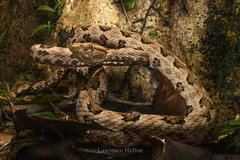
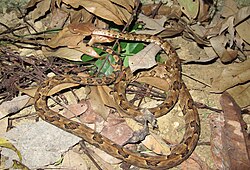
Protobothrops mucrosquamatus is a pit viper species endemic to Asia. Common names include: brown-spotted pit viper, Taiwanese habu and pointed-scaled pit viper. No subspecies are currently recognized. The species was first described by Theodore Cantor in 1839.

Males grow to a maximum total length of 112 cm (44 in) with a tail length of 19.5 cm (7.7 in). Females grow to a maximum total length of 116 cm (46 in) with a tail length of 20.5 cm (8.1 in). The hemipenes are spinose. Scalation: dorsal scales in 25 longitudinal rows at midbody; scales on upper surface of head, small, each scale keeled posteriorly; internasals 5–10 times size of adjacent scales, separated by 3–4 scales; supraoculars, long, narrow, undivided, 14–16 small interoculars in line between them; 2 scales on line between upper preocular and nasal scale; 9–11 upper labials, first upper labial separated from nasal by suture; 2–3 small scales between upper labials and subocular; 2–3 rows of temporal scales above upper labials smooth, above those scales keeled; ventrals 200–218; subcaudals 76–91, all paired.

Color pattern: grayish or olive brown above, with dorsal series of large brown, black-edged spots... Wikipedia →

Global Distribution

Parks Where Found

# Park Country Daily sighting probability
1 Cuc Phuong National Park 🇻🇳 Vietnam
~40%
2 Taroko National Park 🇹🇼 Taiwan
~10%

Cities Where Found

# City Country Daily sighting probability
1 Taipei 🇹🇼 Taiwan
~20%
2 Taichung 🇹🇼 Taiwan
~20%
3 Kaohsiung 🇹🇼 Taiwan
~10%

Before you go

What are the chances of seeing a Taiwanese Habu in Cuc Phuong National Park?

Likely

About 40% of wildlife watchers report a Taiwanese Habu sighting in Cuc Phuong National Park on a given day, based on 13 verified sightings from GBIF citizen-science data from 2019 to 2026. It is the 5th most-seen of the 16 reptiles we can rate there. Over three days the chance rises to about 80%, and over a week to over 90%, if each day is a fresh chance.

When is the best time to see a Taiwanese Habu in Cuc Phuong National Park?

July

In that month about 70% of wildlife watchers report a Taiwanese Habu in Cuc Phuong National Park on a given day, against under 5% in April, the lowest month. That is one of Cuc Phuong National Park's wettest months, with about 350 mm of rain against 40 mm in December.

What time of day is best to see a Taiwanese Habu?

Between 1 and 4 pm

Across all the parks we cover, that three-hour window holds the most Taiwanese Habu sightings with a recorded time, and about 8 in 10 of them come between 6 am and 6 pm: it is a daytime animal.

Is Cuc Phuong National Park the best place to see a Taiwanese Habu?

Yes

Of the 2 parks where we can rate Taiwanese Habu sightings, Cuc Phuong National Park has the highest daily chance: about 40%. Next come Taroko National Park (Taiwan, about 10%).

Where does the Taiwanese Habu sighting chance come from?

GBIF citizen-science records

It is estimated from how often the Taiwanese Habu is recorded against all the reptiles logged in Cuc Phuong National Park (13 verified sightings from 2019 to 2026), calibrated against known sighting rates. Figures are rounded to the nearest 10% because citizen-science data supports honest approximations, not decimals, and months with records from fewer than five people show "—". How it works.

← Back to Cuc Phuong National Park