Common Mock Viper

Common Mock Viper

Psammodynastes pulverulentus

Silhouette: SeismicShrimp · PhyloPic

LCLeast ConcernNTVUENCR
Daily sighting probability ~30% · Possible
at Cuc Phuong National Park

In 3 days ~70% in a week ~90%

7 Verified sightings at Cuc Phuong National Park From 2019 to 2026
142 In all 7 parks
August Best month
☀️ Diurnal When it's spotted

About the Common Mock Viper

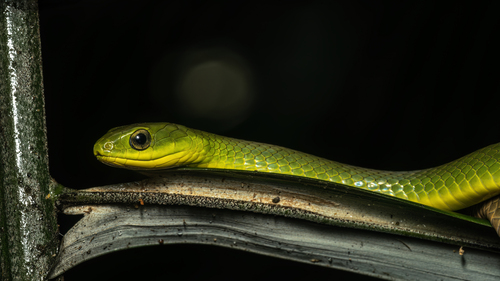
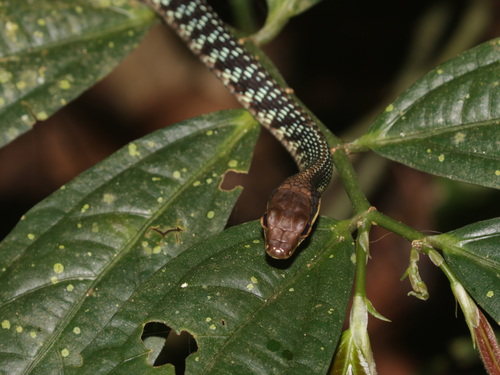
Psammodynastes pulverulentus, the common mock viper, is a species of snake native to Asia. It is a small snake (total length up to 65 cm (26 in), less in males), and it will form defensive coils and strike in a viper-like fashion when threatened, although it is harmless to humans.

The common mock viper is known from Bangladesh, Myanmar (Burma), Cambodia, China (Fujian, Yunnan, Guangxi, Guangdong, Hainan, Hong Kong), north-eastern India (Assam, Sikkim, Darjeeling; Jalpaiguri; Meghalaya, Arunachal Pradesh), Bhutan, Indonesia (Bali, Bangka, Borneo, Butung, Enggano, Flores, Java, Kalimantan, Komodo, Lombok, Mentawai Archipelago, Natuna Archipelago, Padar, Riau Archipelago, Rinca, Sangihe Archipelago, Sulawesi, Sula Archipelago, Sumatra, Sumba, Sumbawa, Togian Archipelago), Laos, Malaysia (Malaya and East Malaysia, Pulau Tioman), Nepal, the Philippines (Balabac, Basilan, Bohol, Bongao, Busuanga, Dinagat, Jolo, Leyte, Luzon, Mindanao, Negros, Palawan, Panay, Polillo, Samar), Taiwan, Thailand (incl. Phuket), and Vietnam. It has been reported from Singapore.

Subspecies Psammodynastes pulverulentus papenfussi is endemic to Taiwan. Wikipedia →

Global Distribution

Parks Where Found

# Park Country Daily sighting probability
1 Cat Tien National Park 🇻🇳 Vietnam
~40%
2 Cuc Phuong National Park 🇻🇳 Vietnam
~30%
3 Kinabatangan Wildlife Sanctuary 🇲🇾 Malaysia
~30%
4 Danum Valley Conservation Area 🇲🇾 Malaysia
~20%
5 Kinabalu Park 🇲🇾 Malaysia
~20%
6 Kaeng Krachan National Park 🇹🇭 Thailand
~10%
7 Khao Yai National Park 🇹🇭 Thailand
~10%

Cities Where Found

# City Country Daily sighting probability
1 Guangzhou 🇨🇳 China
~10%
2 Hong Kong 🇨🇳 China
~10%
3 Taipei 🇹🇼 Taiwan
~10%
4 Kaohsiung 🇹🇼 Taiwan
~10%

Zoos & Centres Where Found

# Zoo / Centre Country
1 Zoológico Miguél Álvarez del Toro 🇲🇽 Mexico In captivity

Closest Relatives at Cuc Phuong National Park

No species of the same family or order lives in Cuc Phuong National Park, so these are its closest relatives here: other reptiles.

Before you go

What are the chances of seeing a Common Mock Viper in Cuc Phuong National Park?

Possible

About 30% of wildlife watchers report a Common Mock Viper sighting in Cuc Phuong National Park on a given day, based on 7 verified sightings from GBIF citizen-science data from 2019 to 2026. It is the 11th most-seen of the 16 reptiles we can rate there. Over three days the chance rises to about 70%, and over a week to about 90%, if each day is a fresh chance.

When is the best time to see a Common Mock Viper in Cuc Phuong National Park?

August

In that month about 60% of wildlife watchers report a Common Mock Viper in Cuc Phuong National Park on a given day, against under 5% in January and March–April, the lowest months. That is one of Cuc Phuong National Park's wettest months, with about 390 mm of rain against 40 mm in December.

What time of day is best to see a Common Mock Viper?

Between 2 and 5 pm

Across all the parks we cover, that three-hour window holds the most Common Mock Viper sightings with a recorded time, and about 8 in 10 of them come between 6 am and 6 pm: it is a daytime animal.

Is Cuc Phuong National Park the best place to see a Common Mock Viper?

2nd of 7

Of the 7 parks where we can rate Common Mock Viper sightings, Cuc Phuong National Park ranks 2nd at about 30%. The best odds are in Cat Tien National Park (Vietnam, about 40%).

Where does the Common Mock Viper sighting chance come from?

GBIF citizen-science records

It is estimated from how often the Common Mock Viper is recorded against all the reptiles logged in Cuc Phuong National Park (7 verified sightings from 2019 to 2026), calibrated against known sighting rates. Figures are rounded to the nearest 10% because citizen-science data supports honest approximations, not decimals, and months with records from fewer than five people show "—". How it works.

← Back to Cuc Phuong National Park