Lucifer Hummingbird

Lucifer Hummingbird

Calothorax lucifer

Silhouette: Ferran Sayol · PhyloPic

LCLeast ConcernNTVUENCR
Daily sighting probability <5% · Rare
at Cumbres de Monterrey National Park

In 3 days ~10% in a week ~20%

48 Verified sightings at Cumbres de Monterrey National Park From 2019 to 2026
186 In all 2 parks
August Best month
☀️ Diurnal When it's spotted

About the Lucifer Hummingbird

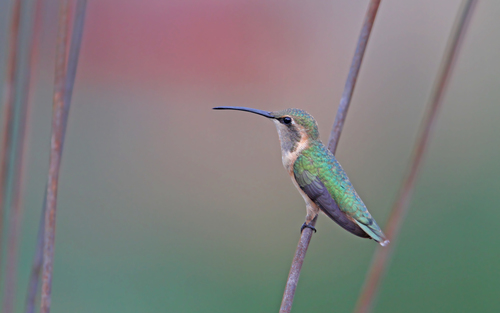
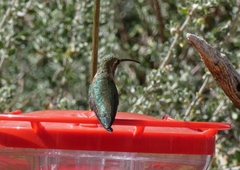
The lucifer sheartail or lucifer hummingbird (Calothorax lucifer) is a medium-sized, 10 cm long, green hummingbird with a slightly curved bill and distinctive outward flare of its gorget feathers. Its habitat is in high-altitude areas of northern Mexico and southwestern United States. It winters in central Mexico.

The lucifer sheartail was formally described in 1827 by the English zoologist William Swainson based on a specimen collected at Temascaltepec in central Mexico. Swainson placed the species in the genus Cynanthus and coined the binomial name Cynanthus lucifer. The specific epithet lucifer is Latin meaning "light-bearing" from lux, lucis meaning "light" and -fera meaning "-bearing". The lucifer sheartail is now placed with the beautiful sheartail in the genus Calothorax that was introduced in 1840 by the English zoologist George Robert Gray.

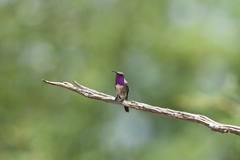
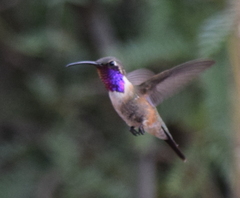
The lucifer sheartail is a medium-sized, 10-centimetre (3.9 in) long, green hummingbird with a long curved bill, small wings, and white streak behind its eye. The male has an iridescent plumage, forked dark tail, green crown, long magenta gorget, and white underparts. The female is larger with duller plumage... Wikipedia →
Sounds

Call0:08

Mexico · 2022

© Manuel Grosselet · XC698483 · CC BY-NC-SA 4.0

Wing buzz0:05

United States · 2013

© Richard E. Webster · XC132968 · CC BY-NC-SA 3.0

Call0:15

United States · 2015

© Ross Gallardy · XC297549 · CC BY-NC-SA 4.0

Global Distribution

Parks Where Found

# Park Country Daily sighting probability
1 Cumbres de Monterrey National Park 🇲🇽 Mexico
<5%
2 Big Bend National Park 🇺🇸 United States
<5%

Cities Where Found

# City Country Daily sighting probability
1 Mexico City 🇲🇽 México
<5%

Before you go

What are the chances of seeing a Lucifer Hummingbird in Cumbres de Monterrey National Park?

Rare

Under 5% of wildlife watchers report a Lucifer Hummingbird sighting in Cumbres de Monterrey National Park on a given day, based on 48 verified sightings from GBIF citizen-science data from 2019 to 2026. It is the 150th most-seen of the 275 birds we can rate there. Over three days the chance rises to about 10%, and over a week to about 20%, if each day is a fresh chance.

When is the best time to see a Lucifer Hummingbird in Cumbres de Monterrey National Park?

August to October

In those months about 10% of wildlife watchers report a Lucifer Hummingbird in Cumbres de Monterrey National Park on a given day, against under 5% in November to July, the lowest months.

What time of day is best to see a Lucifer Hummingbird?

Between 8 and 11 am

Across all the parks we cover, that three-hour window holds the most Lucifer Hummingbird sightings with a recorded time, and about 9 in 10 of them come between 6 am and 6 pm: it is a daytime animal.

Is Cumbres de Monterrey National Park the best place to see a Lucifer Hummingbird?

Yes

Of the 2 parks where we can rate Lucifer Hummingbird sightings, Cumbres de Monterrey National Park has the highest daily chance: under 5%. Next come Big Bend National Park (United States, under 5%).

Where does the Lucifer Hummingbird sighting chance come from?

GBIF citizen-science records

It is estimated from how often the Lucifer Hummingbird is recorded against all the birds logged in Cumbres de Monterrey National Park (48 verified sightings from 2019 to 2026), calibrated against known sighting rates. Figures are rounded to the nearest 10% because citizen-science data supports honest approximations, not decimals, and months with records from fewer than five people show "—". How it works.

← Back to Cumbres de Monterrey National Park