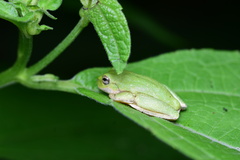
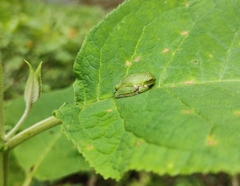
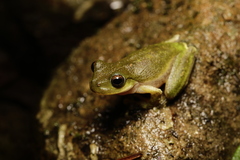
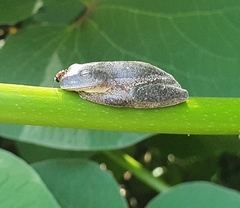

Small-eard Hyla

Small-eard Hyla

Rheohyla miotympanum

Silhouette: Robbi Bishop-Taylor · PhyloPic

LCLeast ConcernNTVUENCR Endemic
Daily sighting probability ~30% · Possible
at Cumbres de Monterrey National Park

In 3 days ~70% in a week ~90%

200 Verified sightings at Cumbres de Monterrey National Park From 2019 to 2026
200 In 1 park
September Best month
☀️🌙 Day & Night When it's spotted

About the Small-eard Hyla

Rheohyla is a genus of frogs in the family Hylidae. As currently recognized, it is monotypic, containing only Rheohyla miotympanum, also known as the small-eared hyla or small-eared treefrog. However, the nominal species likely is a complex of more than one species. It is endemic to eastern and central Mexico. The generic name refers to streams, the breeding habitat of this frog (from Greek rheos meaning 'stream' combined with Hylas). The specific name is derived from Greek meion, a diminutive prefix, together with Greek tympanon (='drum') and refers to the small tympanum.

This genus was erected in 2016 to accommodate former Ecnomiohyla miotympanum; AmphibiaWeb still uses this earlier classification. Faivovich and colleagues argued in 2018 that splitting Rheohyla miotympanum from Ecnomiohyla was not necessary on the grounds of obtaining monophyletic Ecnomiohyla, but is nevertheless convenient because it allows associating Ecnomiohyla with several putative phenotypic synapomorphies, which Rheohyla miotympanum lacks. There is no phenotypic autapomorphy defining Rheohyla.

Males can grow up to 38 mm (1.5 in) and females to 51 mm (2.0 in) in snout–vent length... Wikipedia →

Sounds

Recording0:30

Mexico · 2024

© mayaglziza · iNaturalist · CC BY-NC 4.0

Recording1:49

Mexico · 2024

© pau_mg · iNaturalist · CC BY-NC 4.0

Global Distribution

Parks Where Found

# Park Country Daily sighting probability
1 Cumbres de Monterrey National Park 🇲🇽 Mexico
~30%

More parks will be added in future updates.

Cities Where Found

# City Country Daily sighting probability
1 Monterrey 🇲🇽 México
<5%

Before you go

What are the chances of seeing a Small-eard Hyla in Cumbres de Monterrey National Park?

Possible

About 30% of wildlife watchers report a Small-eard Hyla sighting in Cumbres de Monterrey National Park on a given day, based on 200 verified sightings from GBIF citizen-science data from 2019 to 2026. It is the most-seen of the 10 amphibians we can rate there. Over three days the chance rises to about 70%, and over a week to about 90%, if each day is a fresh chance.

When is the best time to see a Small-eard Hyla in Cumbres de Monterrey National Park?

June and August–September

In those months about 40% of wildlife watchers report a Small-eard Hyla in Cumbres de Monterrey National Park on a given day, against about 10% in December, the lowest month. Those are among Cumbres de Monterrey National Park's wettest months, with about 140 mm of rain a month against 20 mm in December.

What time of day is best to see a Small-eard Hyla?

Between noon and 3 pm

Across all the parks we cover, that three-hour window holds the most Small-eard Hyla sightings with a recorded time, and about 6 in 10 of them come between 6 am and 6 pm: it is seen both by day and at night.

Where else can you see a Small-eard Hyla?

Only Cumbres de Monterrey National Park, in our data

Cumbres de Monterrey National Park is the only park on Wallace's Line with enough records to rate Small-eard Hyla sightings: about 30% of wildlife watchers there report one on a given day.

Where does the Small-eard Hyla sighting chance come from?

GBIF citizen-science records

It is estimated from how often the Small-eard Hyla is recorded against all the amphibians logged in Cumbres de Monterrey National Park (200 verified sightings from 2019 to 2026), calibrated against known sighting rates. Figures are rounded to the nearest 10% because citizen-science data supports honest approximations, not decimals, and months with records from fewer than five people show "—". How it works.

← Back to Cumbres de Monterrey National Park