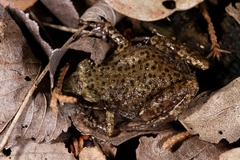
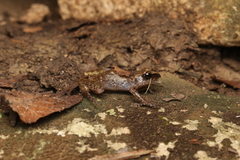
Camp's Chirping Frog

Camp's Chirping Frog

Eleutherodactylus campi

Silhouette: Graham Montgomery · PhyloPic

LCLeast ConcernNTVUENCR
Daily sighting probability <5% · Rare
at Cumbres de Monterrey National Park

In 3 days ~10% in a week ~30%

5 Verified sightings at Cumbres de Monterrey National Park From 2019 to 2026
5 In 1 park
November Best month
☀️🌙 Day & Night When it's spotted

About the Camp's Chirping Frog

Eleutherodactylus cystignathoides, also known as the Rio Grande chirping frog, Mexican chirping frog, or lowland chirping frog, is a small eleutherodactylid frog. It is found from the southern United States in Texas, and in the northeastern Mexico in the states of Nuevo León, Tamaulipas, San Luis Potosí, Hidalgo, and Veracruz. Its range in Texas has expanded because of transport in potted plants and has been reported in Louisiana and Georgia.

Two subspecies are sometimes recognized, although they are poorly delineated: Eleutherodactylus cystignathoides cystignathoides (Cope, 1877) — Rio Grande chirping frog, Mexican chirping frog Eleutherodactylus cystignathoides campi (Stejneger, 1915) — Rio Grande chirping frog, Camp's frog

Only Eleutherodactylus cystignathoides campi occurs in Texas. Adult males measure 16–24 mm (0.6–0.9 in) and adult females 16–26 mm (0.6–1.0 in) in snout–vent length. The snout is pointed and the body is flat and elongated. Tympanum is visible. The finger tips are slightly expanded. Dorsal skin is weakly pustular, that of venter is smooth to areolate. Dorsal coloration is variable (brown, gray, or yellow-green) and includes... Wikipedia →

Sounds

Advertisement call0:21

United States · 2015

© Chris Harrison · XC890495 · CC BY-NC-SA 4.0

Recording0:01

United States · 2023

© Marley Diehl · iNaturalist · CC BY-NC 4.0

Recording0:13

United States · 2021

© Caleb Helsel · iNaturalist · CC BY-NC 4.0

Global Distribution

Parks Where Found

# Park Country Daily sighting probability
1 Cumbres de Monterrey National Park 🇲🇽 Mexico
<5%

More parks will be added in future updates.

Cities Where Found

# City Country Daily sighting probability
1 Austin 🇺🇸 United States
~10%
2 Houston 🇺🇸 United States
~10%
3 Dallas 🇺🇸 United States
~10%
4 San Antonio 🇺🇸 United States
~10%
5 Monterrey 🇲🇽 México
~10%

Before you go

What are the chances of seeing a Camp's Chirping Frog in Cumbres de Monterrey National Park?

Rare

Under 5% of wildlife watchers report a Camp's Chirping Frog sighting in Cumbres de Monterrey National Park on a given day, based on 5 verified sightings from GBIF citizen-science data from 2019 to 2026. It is the 9th most-seen of the 10 amphibians we can rate there. Over three days the chance rises to about 10%, and over a week to about 30%, if each day is a fresh chance.

When is the best time to see a Camp's Chirping Frog in Cumbres de Monterrey National Park?

July–September and November

In those months about 10% of wildlife watchers report a Camp's Chirping Frog in Cumbres de Monterrey National Park on a given day, against under 5% in October and December–June, the lowest months.

What time of day is best to see a Camp's Chirping Frog?

Between 9 pm and midnight

Across all the parks we cover, that three-hour window holds the most Camp's Chirping Frog sightings with a recorded time, and about 7 in 10 of them come between 6 pm and 6 am: it is seen both by day and at night.

Where else can you see a Camp's Chirping Frog?

Only Cumbres de Monterrey National Park, in our data

Cumbres de Monterrey National Park is the only park on Wallace's Line with enough records to rate Camp's Chirping Frog sightings: under 5% of wildlife watchers there report one on a given day.

Where does the Camp's Chirping Frog sighting chance come from?

GBIF citizen-science records

It is estimated from how often the Camp's Chirping Frog is recorded against all the amphibians logged in Cumbres de Monterrey National Park (5 verified sightings from 2019 to 2026), calibrated against known sighting rates. Figures are rounded to the nearest 10% because citizen-science data supports honest approximations, not decimals, and months with records from fewer than five people show "—". How it works.

← Back to Cumbres de Monterrey National Park