Tawny-collared Nightjar

Tawny-collared Nightjar

Antrostomus salvini

Silhouette: Sheatherius · PhyloPic

LCLeast ConcernNTVUENCR Endemic
Daily sighting probability <5% · Rare
at Cumbres de Monterrey National Park

In 3 days ~10% in a week ~20%

50 Verified sightings at Cumbres de Monterrey National Park From 2019 to 2026
50 In 1 park
May Best month
🌙 Nocturnal When it's spotted

About the Tawny-collared Nightjar

The tawny-collared nightjar (Antrostomus salvini) is a species of nightjar in the family Caprimulgidae. It is endemic to Mexico. The tawny-collared nightjar was originally described as Caprimulgus salvini; Antrostomus was later split as a separate genus. It and the Yucatan nightjar (A. badius) were for a time considered subspecies of the silky-tailed nightjar (A. sericocaudatus). The tawny-collared nightjar is monotypic.

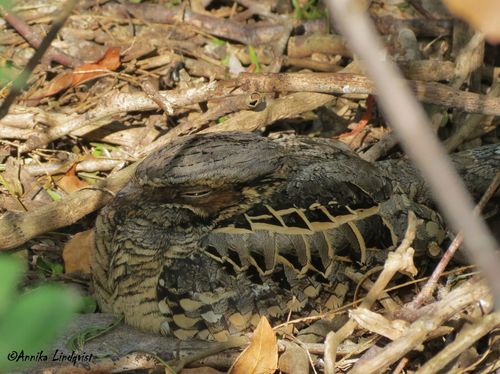
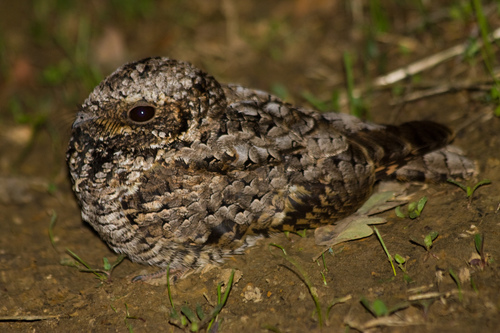
The tawny-collared nightjar is 23 to 25.5 cm (9.1 to 10 in) long. One female weighed 56 g (2.0 oz). The male's upperparts are blackish brown; the crown has blackish spots and the back and rump have fine light brown speckles and broad blackish streaks. It has a broad tawny or buff collar on the nape and the sides of the neck that give the species its name. The tail is also dark brown and the three outermost pairs of feathers have wide white tips. The wings are brown to blackish brown with tawny spots and bars. The face is dark reddish with brown barring. The chin and throat are blackish brown with a narrow white band below the latter, the breast blackish brown with cinnamon speckles, and the belly and flanks blackish brown... Wikipedia →

Sounds

Song0:09

Mexico · 2022

© Leonardo Guzman Hernandez · XC920408 · CC BY-NC-SA 4.0

Song0:06

Mexico · 2016

© Amy McAndrews · XC309799 · CC BY-NC-SA 4.0

Song0:24

Mexico · 2000

© Peter Boesman · XC220377 · CC BY-NC-ND 4.0

Global Distribution

Parks Where Found

# Park Country Daily sighting probability
1 Cumbres de Monterrey National Park 🇲🇽 Mexico
<5%

More parks will be added in future updates.

Before you go

What are the chances of seeing a Tawny-collared Nightjar in Cumbres de Monterrey National Park?

Rare

Under 5% of wildlife watchers report a Tawny-collared Nightjar sighting in Cumbres de Monterrey National Park on a given day, based on 50 verified sightings from GBIF citizen-science data from 2019 to 2026. It is the 152nd most-seen of the 275 birds we can rate there. Over three days the chance rises to about 10%, and over a week to about 20%, if each day is a fresh chance.

When is the best time to see a Tawny-collared Nightjar in Cumbres de Monterrey National Park?

May and August

In those months about 10% of wildlife watchers report a Tawny-collared Nightjar in Cumbres de Monterrey National Park on a given day, against under 5% in June–July and September–April, the lowest months.

What time of day is best to see a Tawny-collared Nightjar?

Between 7 and 10 pm

Across all the parks we cover, that three-hour window holds the most Tawny-collared Nightjar sightings with a recorded time, and about 7 in 10 of them come between 6 pm and 6 am: it is mostly seen at night.

Where else can you see a Tawny-collared Nightjar?

Only Cumbres de Monterrey National Park, in our data

Cumbres de Monterrey National Park is the only park on Wallace's Line with enough records to rate Tawny-collared Nightjar sightings: under 5% of wildlife watchers there report one on a given day.

Where does the Tawny-collared Nightjar sighting chance come from?

GBIF citizen-science records

It is estimated from how often the Tawny-collared Nightjar is recorded against all the birds logged in Cumbres de Monterrey National Park (50 verified sightings from 2019 to 2026), calibrated against known sighting rates. Figures are rounded to the nearest 10% because citizen-science data supports honest approximations, not decimals, and months with records from fewer than five people show "—". How it works.

← Back to Cumbres de Monterrey National Park