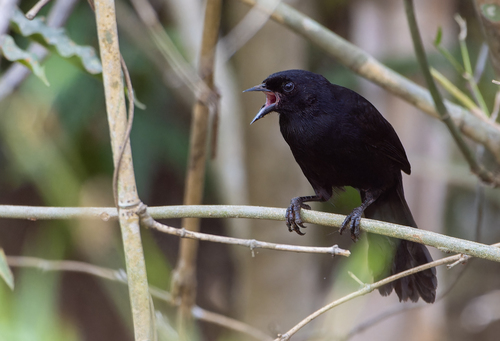
Ecuadorian Cacique

Ecuadorian Cacique

Cacicus sclateri

Silhouette: Sheatherius · PhyloPic

LCLeast ConcernNTVUENCR
Daily sighting probability <5% · Rare
at Cuyabeno Wildlife Reserve

In 3 days <5% in a week ~10%

5 Verified sightings at Cuyabeno Wildlife Reserve From 2019 to 2026
12 In all 2 parks
December Best month

About the Ecuadorian Cacique

The Ecuadorian cacique (Cacicus sclateri) is a species of bird in the family Icteridae. It is found in Colombia, Ecuador, and Peru, where its natural habitat is subtropical or tropical moist lowland forest. A fairly common bird with a wide range, the IUCN has rated it a "species of least concern".

The male Ecuadorian cacique grows to a length of about 23 cm (9 in), with the female being a little smaller. The plumage of both sexes is entirely black, the beak is whitish, long and pointed, and the iris is blue in adults and brown in juveniles. This bird can be distinguished from the otherwise similar solitary cacique (Cacicus solitarius) because that species is larger, has a darker-coloured iris and spends more time in undergrowth and near the ground and less time in trees. Also similar is the red-rumped cacique (C. haemorrhous), but it reveals its bright red rump patch when in flight.

This bird has a number of noisy calls, including a repeated "péach-yo" and "péach-yo-yo", uttered while perched with raised tail, a "k-cheeyow?", and a "kweeyh-kweeyh-kweeyh-kweeyh-wonhh?" among others. The species is native to southern Colombia, eastern Ecuador... Wikipedia →

Sounds

Call0:23

Ecuador · 1999

© Mitch Lysinger · XC261313 · CC BY-NC-SA 4.0

Song0:21

Ecuador · 1999

© John V. Moore · XC259973 · CC BY-NC-SA 4.0

Song0:20

Ecuador · 2001

© Charlie Vogt · XC21086 · CC BY-NC-ND 2.5

Global Distribution

Parks Where Found

# Park Country Daily sighting probability
1 Cuyabeno Wildlife Reserve 🇪🇨 Ecuador
<5%
2 Yasuní National Park 🇪🇨 Ecuador
<5%

Before you go

What are the chances of seeing an Ecuadorian Cacique in Cuyabeno Wildlife Reserve?

Rare

Under 5% of wildlife watchers report an Ecuadorian Cacique sighting in Cuyabeno Wildlife Reserve on a given day, based on 5 verified sightings from GBIF citizen-science data from 2019 to 2026. It is the 307th most-seen of the 328 birds we can rate there. Over three days the chance rises to under 5%, and over a week to about 10%, if each day is a fresh chance.

When is the best time to see an Ecuadorian Cacique in Cuyabeno Wildlife Reserve?

December

In that month about 10% of wildlife watchers report an Ecuadorian Cacique in Cuyabeno Wildlife Reserve on a given day, against under 5% in January to November, the lowest months.

Is Cuyabeno Wildlife Reserve the best place to see an Ecuadorian Cacique?

Yes

Of the 2 parks where we can rate Ecuadorian Cacique sightings, Cuyabeno Wildlife Reserve has the highest daily chance: under 5%. Next come Yasuní National Park (Ecuador, under 5%).

Where does the Ecuadorian Cacique sighting chance come from?

GBIF citizen-science records

It is estimated from how often the Ecuadorian Cacique is recorded against all the birds logged in Cuyabeno Wildlife Reserve (5 verified sightings from 2019 to 2026), calibrated against known sighting rates. Figures are rounded to the nearest 10% because citizen-science data supports honest approximations, not decimals, and months with records from fewer than five people show "—". How it works.

← Back to Cuyabeno Wildlife Reserve