Lucifer Titi

Lucifer Titi

Cheracebus lucifer

Silhouette: T. Michael Keesey · PhyloPic

Daily sighting probability ~40% · Likely
at Cuyabeno Wildlife Reserve

In 3 days ~70% in a week >90%

23 Verified sightings at Cuyabeno Wildlife Reserve From 2019 to 2026
32 In all 2 parks
June Best month
☀️ Diurnal When it's spotted

About the Lucifer Titi

The Lucifer titi monkey (Cheracebus lucifer) is a species of titi, a type of New World monkey, from South America. It is found in Brazil, Colombia, Ecuador, and Peru. It was described as Callicebus lucifer in 1914. The Lucifer titi has previously been treated as part of C. torquatus, the collared titi.

This species occurs near the interfluve north of the Solimões and Napo Rivers, and south of the Japurá River. The Lucifer titi is found in lowland Colombian Amazonia up to about 500 m (1,600 ft) of altitude in Putumayo and probably about the same in Caquetá. Outside of Colombia this species extends from the Napo River northward to the Ecuadorian Amazon.

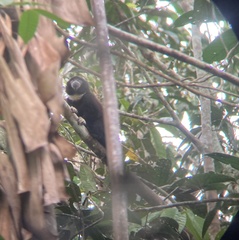
The pelage of this species is basically blackish but intermixed with many hairs on the back (extending to the top of the crown) and flanks with many reddish brown hairs, giving the animal a definite reddish appearance in the sunlight.

Robinson et al. also report a birth season of December to January for the species in Peru at 4ºS. Why this specific birth season should be chosen by the species in such widely divergent places both north and south of the equator with different... Wikipedia →
Sounds

Recording0:21

Colombia · 2023

© annahd · iNaturalist · CC BY-NC 4.0

Global Distribution

Parks Where Found

# Park Country Daily sighting probability
1 Cuyabeno Wildlife Reserve 🇪🇨 Ecuador
~40%
2 Amacayacu National Natural Park 🇨🇴 Colombia
~20%

Before you go

What are the chances of seeing a Lucifer Titi in Cuyabeno Wildlife Reserve?

Likely

About 40% of wildlife watchers report a Lucifer Titi sighting in Cuyabeno Wildlife Reserve on a given day, based on 23 verified sightings from GBIF citizen-science data from 2019 to 2026. It is the 11th most-seen of the 19 mammals we can rate there. Over three days the chance rises to about 70%, and over a week to over 90%, if each day is a fresh chance.

When is the best time to see a Lucifer Titi in Cuyabeno Wildlife Reserve?

May and June

In those months about 50% of wildlife watchers report a Lucifer Titi in Cuyabeno Wildlife Reserve on a given day, against under 5% in September to December, the lowest months.

What time of day is best to see a Lucifer Titi?

Between 11 am and 2 pm

Across all the parks we cover, that three-hour window holds the most Lucifer Titi sightings with a recorded time, and about 8 in 10 of them come between 6 am and 6 pm: it is a daytime animal.

Is Cuyabeno Wildlife Reserve the best place to see a Lucifer Titi?

Yes

Of the 2 parks where we can rate Lucifer Titi sightings, Cuyabeno Wildlife Reserve has the highest daily chance: about 40%. Next come Amacayacu National Natural Park (Colombia, about 20%).

Which relatives of the Lucifer Titi live in Cuyabeno Wildlife Reserve?

Same family: Pitheciidae

The closest relatives of the Lucifer Titi that you can see in Cuyabeno Wildlife Reserve (family Pitheciidae, Sakis, Titis, and Uakaris) are Miller's Saki (about 70%) and White-tailed Titi (about 30%), with each one's daily chance of a sighting.

Where does the Lucifer Titi sighting chance come from?

GBIF citizen-science records

It is estimated from how often the Lucifer Titi is recorded against all the mammals logged in Cuyabeno Wildlife Reserve (23 verified sightings from 2019 to 2026), calibrated against known sighting rates. Figures are rounded to the nearest 10% because citizen-science data supports honest approximations, not decimals, and months with records from fewer than five people show "—". How it works.

← Back to Cuyabeno Wildlife Reserve