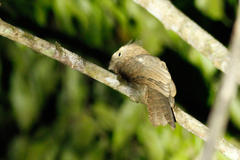
Blyth's Frogmouth

Blyth's Frogmouth

Batrachostomus affinis

Silhouette: Matt Wilkins · PhyloPic

Daily sighting probability <5% · Rare
at Danum Valley Conservation Area

In 3 days ~10% in a week ~20%

63 Verified sightings at Danum Valley Conservation Area From 2019 to 2026
243 In all 6 parks
May Best month
☀️🌙 Day & Night When it's spotted

About the Blyth's Frogmouth

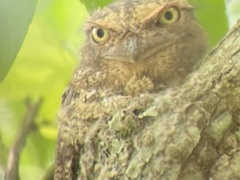
Blyth’s frogmouth (Batrachostomus affinis) is a species of bird in the family Podargidae. They are brownish or rufescent brown with a slightly round bill and tail, and have tufts of bristles in front of the eyes and at the base of the bill. Batrachostomus occur from India and Sri Lanka, across mainland southeast Asia and as far as Borneo, Java, and Sumatra. More specifically, the Blyth’s frogmouths are scattered between southeastern Myanmar and Indonesia. Like other frogmouth species, they are insectivorous.

The English zoologist, curator of the Museum of the Asiatic Society of Bengal (Calcutta), and collector Edward Blyth (1810–1873) gave his name to B. affinis. “Frogmouth” simply refers to the frog-like large and extremely wide bills of the birds. In French, the word “podarge” in Podarge de Blyth was given by the naturalist Baron Cuvier, referencing the bird’s short legs and awkward appearance. The term is derived from the Greek word “podargos”, which means “gouty man”.

Blyth’s frogmouth is one of 17 species of frogmouths in the family Podargidae, which includes the three genera Podargus, Rigidipenna, and Batrachostomus. Blyth’s frogmouth is in the genus... Wikipedia →

Sounds

Call0:14

Malaysia · 2026

© Lim Ying Hien 林勇贤 · XC1156802 · CC BY-NC-ND 4.0

Song0:15

Malaysia · 2024

© Lim Ying Hien · XC937687 · CC BY-NC-ND 4.0

Call1:13

Malaysia · 2023

© Kim Chuah Lim · XC828583 · CC BY-NC-SA 4.0

Global Distribution

Parks Where Found

# Park Country Daily sighting probability
1 Khao Luang National Park 🇹🇭 Thailand
~10%
2 Danum Valley Conservation Area 🇲🇾 Malaysia
<5%
3 Cat Tien National Park 🇻🇳 Vietnam
<5%
4 Taman Negara National Park 🇲🇾 Malaysia
<5%
5 Khao Sok National Park 🇹🇭 Thailand
<5%
6 Kaeng Krachan National Park 🇹🇭 Thailand
<5%

Before you go

What are the chances of seeing a Blyth's Frogmouth in Danum Valley Conservation Area?

Rare

Under 5% of wildlife watchers report a Blyth's Frogmouth sighting in Danum Valley Conservation Area on a given day, based on 63 verified sightings from GBIF citizen-science data from 2019 to 2026. It is the 181st most-seen of the 258 birds we can rate there. Over three days the chance rises to about 10%, and over a week to about 20%, if each day is a fresh chance.

When is the best time to see a Blyth's Frogmouth in Danum Valley Conservation Area?

March and May

In those months about 10% of wildlife watchers report a Blyth's Frogmouth in Danum Valley Conservation Area on a given day, against under 5% in April and June–February, the lowest months.

What time of day is best to see a Blyth's Frogmouth?

Between 6 and 9 pm

Across all the parks we cover, that three-hour window holds the most Blyth's Frogmouth sightings with a recorded time, and about half of them come between 6 pm and 6 am: it is seen both by day and at night.

Is Danum Valley Conservation Area the best place to see a Blyth's Frogmouth?

2nd of 6

Of the 6 parks where we can rate Blyth's Frogmouth sightings, Danum Valley Conservation Area ranks 2nd at under 5%. The best odds are in Khao Luang National Park (Thailand, about 10%).

Where does the Blyth's Frogmouth sighting chance come from?

GBIF citizen-science records

It is estimated from how often the Blyth's Frogmouth is recorded against all the birds logged in Danum Valley Conservation Area (63 verified sightings from 2019 to 2026), calibrated against known sighting rates. Figures are rounded to the nearest 10% because citizen-science data supports honest approximations, not decimals, and months with records from fewer than five people show "—". How it works.

← Back to Danum Valley Conservation Area