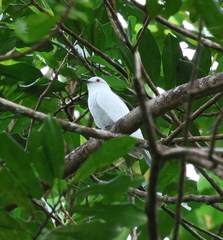
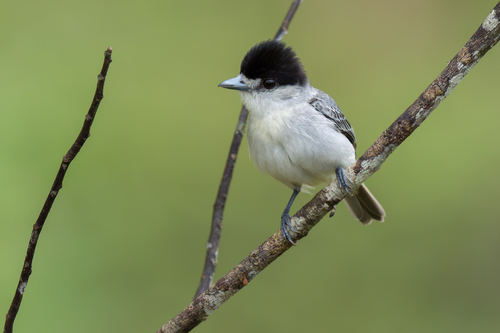
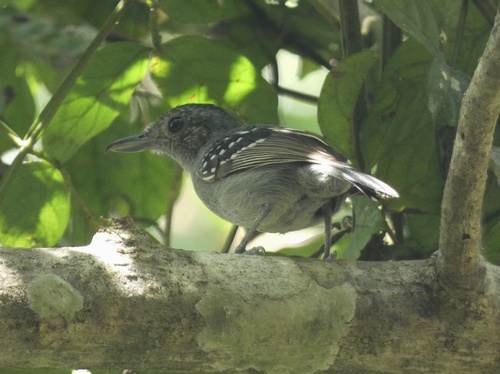
Black-tipped Cotinga

Black-tipped Cotinga

Carpodectes hopkei

Silhouette: Edwin Price · PhyloPic

LCLeast ConcernNTVUENCR
Daily sighting probability <5% · Rare
at Darién National Park

In 3 days ~10% in a week ~20%

18 Verified sightings at Darién National Park From 2019 to 2026
48 In all 2 parks
January Best month
☀️ Diurnal When it's spotted

About the Black-tipped Cotinga

The black-tipped cotinga (Carpodectes hopkei) is a species of bird in the family Cotingidae. It is found in Colombia, Ecuador, and Panama. The black-tipped cotinga shares genus Carpodectes with the yellow-billed cotinga (C. antoniae) and the snowy cotinga (C. nitidus). One early twentieth century author treated them as conspecific but they have been otherwise treated as separate species. The three form a superspecies. The black-tipped cotinga is monotypic.

At least one twentieth century author called Carpodectes hopkei the white cotinga. The black-tipped cotinga is 22 to 25 cm (8.7 to 9.8 in) long. The species is sexually dimorphic. Adult males are almost entirely white. They have a very faint gray tinge on their crown, back, and tail and small blackish spots on the tips of the outer primaries and innermost pair of tail feathers. Their flight feathers are wide and have rounded tips. Adult females have a dark grayish head and upperparts and a blackish tail. Their wings are mostly blackish with white edges on the coverts and inner flight feathers. Their breast is pale gray that fades to white towards the vent. Their secondaries are much... Wikipedia →

Sounds

Recording

© Paula Caycedo - Fernando Ayerbe · XCXC289689 · CC BY-NC-SA 4.0

Recording

© Niels Krabbe · XCXC290028 · CC BY-NC-SA 4.0

Global Distribution

Parks Where Found

# Park Country Daily sighting probability
1 Utría National Natural Park 🇨🇴 Colombia
~30%
2 Darién National Park 🇵🇦 Panama
<5%

Before you go

What are the chances of seeing a Black-tipped Cotinga in Darién National Park?

Rare

Under 5% of wildlife watchers report a Black-tipped Cotinga sighting in Darién National Park on a given day, based on 18 verified sightings from GBIF citizen-science data from 2019 to 2026. It is the 282nd most-seen of the 397 birds we can rate there. Over three days the chance rises to about 10%, and over a week to about 20%, if each day is a fresh chance.

When is the best time to see a Black-tipped Cotinga in Darién National Park?

March and December–January

In those months about 10% of wildlife watchers report a Black-tipped Cotinga in Darién National Park on a given day, against under 5% in February and April–November, the lowest months. Those are among Darién National Park's driest months, with about 160 mm of rain a month against 450 mm in November.

What time of day is best to see a Black-tipped Cotinga?

Between 7 and 10 am

Across all the parks we cover, that three-hour window holds the most Black-tipped Cotinga sightings with a recorded time, and about 9 in 10 of them come between 6 am and 6 pm: it is a daytime animal.

Is Darién National Park the best place to see a Black-tipped Cotinga?

2nd of 2

Of the 2 parks where we can rate Black-tipped Cotinga sightings, Darién National Park ranks 2nd at under 5%. The best odds are in Utría National Natural Park (Colombia, about 30%).

Which relatives of the Black-tipped Cotinga live in Darién National Park?

Same family: Cotingidae

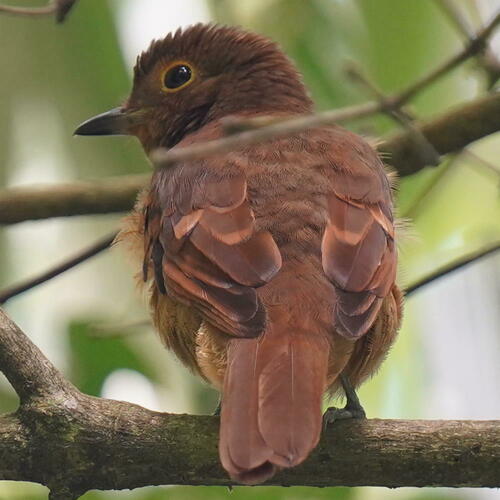
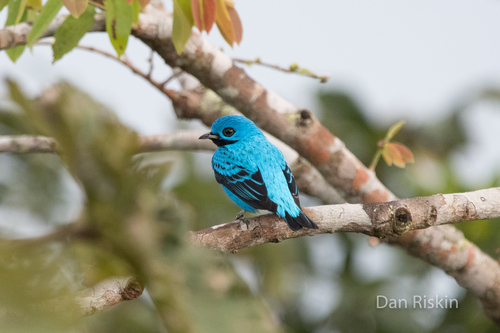
The closest relatives of the Black-tipped Cotinga that you can see in Darién National Park (family Cotingidae, Cotingas) are Rufous Piha (about 30%), Purple-throated Fruitcrow (about 20%) and Sharpbill (about 10%), with each one's daily chance of a sighting.

Where does the Black-tipped Cotinga sighting chance come from?

GBIF citizen-science records

It is estimated from how often the Black-tipped Cotinga is recorded against all the birds logged in Darién National Park (18 verified sightings from 2019 to 2026), calibrated against known sighting rates. Figures are rounded to the nearest 10% because citizen-science data supports honest approximations, not decimals, and months with records from fewer than five people show "—". How it works.

← Back to Darién National Park