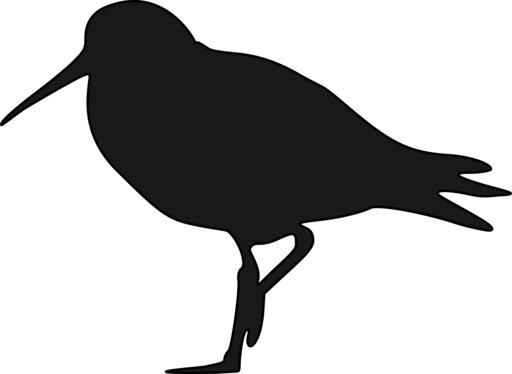
African Black Oystercatcher

African Black Oystercatcher

Haematopus moquini

Silhouette: terngirl · PhyloPic

LCLeast ConcernNTVUENCR
Daily sighting probability ~20% · Possible
at De Hoop Nature Reserve

In 3 days ~50% in a week ~80%

178 Verified sightings at De Hoop Nature Reserve From 2019 to 2026
4,510 In all 6 parks
August Best month
☀️ Diurnal When it's spotted

About the African Black Oystercatcher

The African oystercatcher or African black oystercatcher (Haematopus moquini) is a large charismatic wader resident to the mainland coasts and offshore islands of southern Africa. This oystercatcher has a population of over 6,000 adults, which breed between November and April. The scientific name moquini commemorates the French naturalist Alfred Moquin-Tandon who discovered and named this species before Bonaparte.

The African oystercatcher is a large, noisy wader, with completely black plumage, red legs and a strong broad red bill. The sexes are similar in appearance, however, females are larger and have a slightly longer beak than males. Juveniles have soft grey plumage and do not express the characteristic red legs and beak until after they fledge. The call is a distinctive loud piping, very similar to Eurasian oystercatchers. As the Eurasian oystercatcher is a migratory species they only occur as a vagrant in southern Africa, and its black-and-white plumage makes confusion impossible.

Body Length: 42–45 cm (17–18 in) Wingspan: 80 and 88 cm (31 and 35 in) Mass: ♂ 665 g (1.466 lb) ♀ 730 g (1.61 lb) Tarsus: 50.6 to 60.8 mm (1.99 to 2.39... Wikipedia →

Sounds

Flight call0:45

Namibia · 1965

© Nature sounds by Simply Birding · XC615683 · CC BY-NC-ND 4.0

Call0:12

South Africa · 2026

© JJSUN · XC1079081 · CC BY-NC-SA 4.0

Call0:14

South Africa · 2019

© Frank Lambert · XC512630 · CC BY-NC-ND 4.0

Global Distribution

Parks Where Found

# Park Country Daily sighting probability
1 West Coast National Park 🇿🇦 South Africa
~70%
2 Table Mountain National Park 🇿🇦 South Africa
~20%
3 De Hoop Nature Reserve 🇿🇦 South Africa
~20%
4 Garden Route National Park 🇿🇦 South Africa
~20%
5 iSimangaliso Wetland Park 🇿🇦 South Africa
~10%
6 Addo Elephant National Park 🇿🇦 South Africa
~10%

Cities Where Found

# City Country Daily sighting probability
1 Durban 🇿🇦 South Africa
~10%
2 Cape Town 🇿🇦 South Africa
~10%

Zoos & Centres Where Found

# Zoo / Centre Country
1 World of Birds Wildlife Sanctuary and Monkey Park 🇿🇦 South Africa In captivity
2 Two Oceans Aquarium 🇿🇦 South Africa In captivity

Before you go

What are the chances of seeing an African Black Oystercatcher in De Hoop Nature Reserve?

Possible

About 20% of wildlife watchers report an African Black Oystercatcher sighting in De Hoop Nature Reserve on a given day, based on 178 verified sightings from GBIF citizen-science data from 2019 to 2026. It is the 77th most-seen of the 189 birds we can rate there. Over three days the chance rises to about 50%, and over a week to about 80%, if each day is a fresh chance.

When is the best time to see an African Black Oystercatcher in De Hoop Nature Reserve?

August

In that month about 40% of wildlife watchers report an African Black Oystercatcher in De Hoop Nature Reserve on a given day, against about 10% in January, March, July and November, the lowest months. June has too few records to rate.

What time of day is best to see an African Black Oystercatcher?

Between 10 am and 1 pm

Across all the parks we cover, that three-hour window holds the most African Black Oystercatcher sightings with a recorded time, and nearly all of them come between 6 am and 6 pm: it is a daytime animal.

Is De Hoop Nature Reserve the best place to see an African Black Oystercatcher?

3rd of 6

Of the 6 parks where we can rate African Black Oystercatcher sightings, De Hoop Nature Reserve ranks 3rd at about 20%. The best odds are in West Coast National Park (South Africa, about 70%) and Table Mountain National Park (South Africa, about 20%). All parks ranked.

Which relatives of the African Black Oystercatcher live in De Hoop Nature Reserve?

Same order: Charadriiformes

The closest relatives of the African Black Oystercatcher that you can see in De Hoop Nature Reserve (order Charadriiformes, Shorebirds and Allies) are Crowned Lapwing (about 60%), Dominican Gull (about 60%) and Caspian Tern (about 40%), with each one's daily chance of a sighting.

Where does the African Black Oystercatcher sighting chance come from?

GBIF citizen-science records

It is estimated from how often the African Black Oystercatcher is recorded against all the birds logged in De Hoop Nature Reserve (178 verified sightings from 2019 to 2026), calibrated against known sighting rates. Figures are rounded to the nearest 10% because citizen-science data supports honest approximations, not decimals, and months with records from fewer than five people show "—". How it works.

← Back to De Hoop Nature Reserve